
|
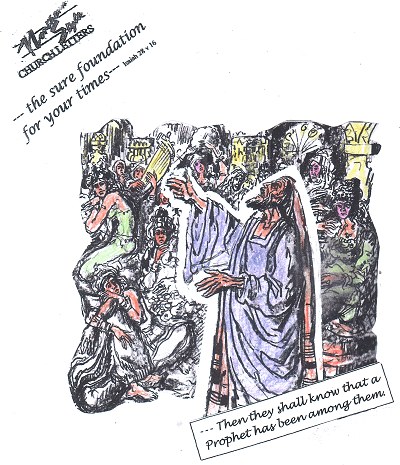 OUR SURE FOUNDATION 4
` Then they shall know . . . . '
The eagle-eyed reader will recognise from our title that this `Sure Foundation' concerns Prophets and their Prophecies, for the wording comes from the Book of the Prophet Ezekiel. In chapter 33 we read: `The Word of the LORD came to me, saying: `Speak to the children of your people (Judah) and say to them . . .' . and the following verses speak of appointing `a Watchman' over the LORD's people. The writings of Ezekiel come in the
form of logical sequences and not necessarily in chronological order. Logical order simply means `this action causes another action', and here particularly the Watchman is appointed to look out for those actions in the LORD's people, which if not changed would lead to terrible consequences. Such men as Ezekiel, a priest who was raised up and anointed for service, were the historians of their day, for they understood from previous times how the LORD would work once again with His rebellious people. They were also the politicians of their times, able to move in and out of `the corridors of power', speaking and warning the priests and kings where their actions would lead them. As we know from Scriptural sources, in the Hebrew Canon of Scripture the Prophets were separated into the `Former and the Latter Prophets', the Former comprising Joshua through to Kings.
Joshua records Israel being brought into the Promised Land.
Judges records Israel in the Land, their breaking of the Covenant and the failure of the priesthood.
Samuel again records Israel in the Land, together with the LORD's mercy in appointing Prophets as Watchmen to warn and chasten His wayward people, but always within the Covenanted Promise of a King Who would rule over them for ever.
Kings reveals a rebellious people finally ejected from the Land. And so we see the Law being outworked in the LORD's people, whose rebellious actions led to tragedy.
It was from the Writings of the Former Prophets that such Prophets as Ezekiel, one of the Latter Prophets, would grow in knowledge of the ways of the LORD in His dealings with His rebellious people through the surrounding nations. We usually speak of the Prophets of Israel, but rarely do we speak of them as the historians and politicians of their day, but it was this `dual role' that enabled such men as the Latter Prophets to speak as `Thus says the LORD'. However such words as they were told to speak - of disasters or war or pestilence, were tempered with a call to faith in the LORD Who allowed such things only to bring them back to Himself.
The background of the times of Ezekiel are well recorded and scattered not only among the `Historical Books of Scripture' but also in the Book of Jeremiah. However the opening verses of the Book of Ezekiel are not so well recorded (Ezekiel 1:1-3)
" Now it came to pass in the thirtieth year . . . . as I was among the captives by the River Chebar, that the heavens were opened and I saw visions of God . . . . On the fifth day of the month in the fifth year of King Jehoiachin's captivity the Word of the LORD came expressly to Ezekiel the priest . . . "
The `thirtieth year' is either ignored today, or it is erroneously taught that this was Ezekiel's age and the beginning of his ministry in `the Tabernacle of the congregation'. This is based on a misunderstanding of the Book of Numbers 4:2-3 which records: `. . . the children of Levi . . . from thirty years old . . . who enter the service to do the work in the Tabernacle'. This was later altered - as recorded in 1 Chronicles 23:27: `For by the last words of David the Levites were numbered from twenty years old'. These opening words of Ezekiel indicate that those who would later read his words would remember an event which had occurred in their lifetime, thus causing them to stop and think about the words that Ezekiel would be given `expressly' to speak, and give a more full understanding as to why, as captives, the LORD's people were standing by the River Chebar, in exile, in a foreign land. So we must look again at these opening words and seek the reason as to why such seemingly unnecessary words open such an important Book as Ezekiel's - which one day they will read again, seeking an answer to the same question, `Why are we captives in exile . . . .'.
The opening words clearly have little to do with King Jehoiachin, and so we are left with the words: `And it came to pass in the thirtieth year (and later in verse 2) . . . the fifth year of King Jehoiachin's captivity'. Rather than trying to find this thirtieth year as relating to a person, we shall take the words as simply an historical date - which takes us back thirty years to 513 BC and to the time of King Josiah's Great Passover following the finding of The Book of the Law in the Temple. As we know, this event released Judah into a fourty-year Probation Period, testing their character and commitment to the LORD - and we also know that this continual flaw in Judah's charcter soon ate away at their commitment! Those who would read Ezekiel's words would have fully understood the mention of the `thirtieth year' and understood the reason for the captivity of King Jehoiachin (now in his fifth year) and his people! Such are the consequences of continuing apostacy among the LORD's people! Among those people was Ezekiel, not because of a flawed character but because the LORD required a faithful witness among the captives to speak of the consequences for an adulterous nation, but also to speak of the Righteous acts of mercy to a wayward people who did nothing to deserve God's ultimate Mercy and Grace!
And so we find Ezekiel the priest in the land of the Chaldeans, by the River Chebar, where the Word of the LORD came expressly to Ezekiel, and the hand of God was upon him. `And I looked, and behold . . .'. What he saw was to set the seal on his ministry of prophecy, which lasted for over twenty-two years in captivity. Ezekiel saw the Glory of the LORD, in the storm, in a great cloud and fire (verse 4): `And brightness was all around it and radiating out of its midst like the colour of amber, out of the midst of the fire'. This was accompanied by the Glory of the LORD, which no human mind could ever fully describe:
" This was the appearance of the likeness of the Glory of the LORD. So when I saw it, I fell on my face, and I heard a Voice of One speaking. And He said to me: `Son of man, stand on your feet and I will speak to you' . . . . And He said to me: `Son of man, I am sending you to the children of Israel, to a rebellious nation that has rebelled against Me . . . . As for them, whether they hear or refuse . . . . yet they will know that a prophet has been among them . . . . And you, son of man, do not be afraid of them . . . . You shall speak My words to them, whether they hear or whether they refuse . . . . But you, son of man . . . . open your mouth and eat what I give to you'. " (Ezekiel 1:28b - 2:8)
This was the setting for Ezekiel's faithful ministry. It is said by many in Church circles that prophecy in these days should only be spoken within the parameters of encouragement or correction, but we can find no justification for such a generalisation of a spiritual gift. Prophecy is foretelling, speaking as `Thus says the LORD' concerning His intended acts towards His people. Such foretelling is set within the closed Canon of Scripture and therefore foretelling is closed and complete. However prophecy is also forthtelling, that is, speaking for God of what He has already foretold through His earlier Prophets, which is `to hear the Word of the LORD'. There are therefore no new prophetic foretellings, but only a continuous forthtelling coming from those who watch and pray for understanding. One of the many tragedies in today's `Prophetic Circles' is the misuse of a foretold Word of Prophecy for Israel, which is directed towards a modern-day secular nation on the basis that it was once a God-fearing nation with its Precepts and Laws built upon Scriptural Laws. The recorded `woes and burdens' were directed against Israel's surrounding nations, only in the sense of dealing with Israel's backsliding! And even if such a misuse of the foretold words of Prophecy was used towards Redeemed Israel, they should be used within the context of the New Covenant.
With this background in mind we can now turn to Ezekiel the Prophet to `hear the Word of the LORD for today's Redeemed Israel. Although the words Ezekiel was required to speak were of total destruction upon his beloved Jerusalem and its Temple - which was completed within the six years of his first vision - little consideration is given to the enormity of his emotional distress at such a calamity. For sure, great visions were given to him in later years, but they were for a time to come although he knew that as an anointed Watchman he was compelled to speak, for the LORD had said: `Open your mouth and eat what I give you'. Only years later was Ezekiel enabled to speak of `the return of the Glory of the LORD' - years of emotional distress over what had happened, and what need not have happened to his beloved Jerusalem and its Temple. There are three great themes running through the Book of Ezekiel: Judgement upon an adulterous nation who had willingly entered into a Covenanted Relationship with the LORD Who had set them above all nations to be His `special people! Following that, Judgement was spoken against the nations who had continually harassed Israel! And finally there came the promise of a full and total Restoration following a great and necessary purging! There would have been a constant stream of people coming to that `Community of Exiles' on the banks of the River Chebar, bringing news of the on-going disintegration of the civic and social life of the great city of Jerusalem, and of the rebuttal of Ezekiel's words from the LORD - which would have led to more warnings from the Prophet. Chapter 8 records a terrifying vision given to him of the LORD's retributive Justice upon Jerusalem and its Temple, now given over to abomination after abomination. But even in his deep emotional distress Ezekiel could understand that this coming complete and total Judgement was a `spiritual' purifying sacrifice upon the altar of the Temple, for only through such a purifying fire could the LORD's Righteousness be revealed to His people.
In general terms, this is the logical sequence of events in the Book of Ezekiel: Continual adulterous sin . . . the LORD's warnings through His appointed Prophet . . . the LORD's righteous purifying Judgement in order to restore His people to their Covenanted place to be a witness to a Holy Righteous God. As we are not intending to write an exergesis on this Book, leaving that to more learned scholars, we return to the opening verses of Ezekiel in order to bring forth a forthtelling that lays within them, which is relevant for today's Redeemed Israel living within Land of Israel, and more particularly for those who live within the Isles of Great Britain. `In the thirtieth year . . . in the fifth year of King Jehoiachin's captivity' - as we have set out above, something dramatic had occurred some thirty years earlier which would lend credence to what the LORD was to say through Ezekiel. Furthermore, thirty years following that event Ezekiel found himself with his companions in exile living by the River Chebar in `the fifth year of King Jehoiachin's captivity'. Today, for our forthtelling, we also need to recall a dramatic event that occurred earlier, and now, years later, find the LORD's people brought into `exile', prepared and waiting to speak `the Word of the LORD' to the religious leaders of the Church and to the secular and civic leaders of the realm concerning the dire situation they find thmeselves in. A reading of chapters 19 and 20 show that this task was given to Ezekiel:
" Moreover, take up the lamentation for the Princes of Israel . . . . . .
Son of man, speak to the Elders of Israel. "
But this was all to no avail, and so we find that the purifying fire of Judgement fell upon the civic heart of Israel as Jerusalem was totally destroyed, along with the total destruction of the Temple, the heart of Israel's religious life.
For our `thirty years' dramatic event we need to recall the great outpouring of the Holy Spirit in 1967 (we have set this out in a previous Church Letter `Is there anything of which it may be said . . . See this new? It has already been before us'). This great Movement was within a Jubilee Year when we saw Jerusalem completely restored to its original Qwner and entrusted again to the nation of Israel. Many times we have written that this great spiritual move was world-wide, touching the lives of all human kind and breaking down oppresive Secular Power and equally oppressive Religious Power, releasing the people to hear the Good News of the Gospel of God in Jesus. As we set out in our `Parabola' Church Letter (mentioned above) by the following Jubilee Year of 2017: "the Congregation of Redeemed Israel . . . . has returned to its earlier captivity, but in a different guise". The `Movement' of 1967 devastated the Institutional Churches of these Britannic Isles as countless numbers of people, now `born of the Spirit', sought a spiritual reality to their lives. The great impregnable Roman Catholic Church was also broken apart - the Second Vatican Council was called earlier when they saw the `crumbling edifice' of the Church. But all to no avail, for more-powerful groups within its `closed doors' were actively at work in that great Council, waiting for `a mighty rushing wind' that was to come. Within these Western Isles the Churches sought to harness this `mighty wind', seeing it as the Holy Spirit's refreshing of a dead institutional religious system, but as with the Roman Church other forces within were at work ensuring its final break-up.
Today, as our `Parabola' Church Letter has set out, this leaves the Institutional Churches, both Catholic and Protestant, empty shells of spiritual life, with one seeking to project itself as a `moral light' on a hill . . . but still above the people! The others are fast becoming the `moral arm' of a secular State! As we also set out in our `Parabola' Letter, such Movements which culminate in a dramatic moment (in this Letter it's centred on a Jubilee Year of the LORD's timing) are fuelled by earlier events. Again in an earlier Church Letter we had written that, following the end of the Second World War in 1945 America found itself with a fully geared-up manufacturing economy but with few outlets, therefore facing great social unrest through massive unemployment. Finding itself deeply embedded in Europe, America turned its full marketing strategy onto `rebuilding' Europe! Today it dominates not only the European markets but the whole of the Capitalist global trade system!
America brought with it its `Consumer Economics' system, and by 1967 it had opened up a whole new world of wealth and general prosperity. It also brought with it a social culture previously not known to Europe, which prepared the way for the `sexual revolution' fuelled by music, drugs and intoxigating new freedoms Coupled to this came `cultural Americanism' which exploded onto a willing British, indeed, Western European, people. Hard on its heels came American-style Evangelism, which preached prosperity, wealth and individual freedom within the Churches. The great Move of the Holy Spirit of 1967 had become culturally and spiritually `consumerised', and fifty years later the results of this can be seen throughout the secular land and the spiritual land of these Isles. Now, with little else to consume, this has left behind only the empty `container' of a Consumer economy, and within the `spiritual land' it has left a spiritual vacuum filled with entertainment and the promise of wealth and prosperity for those who are called for `the blessing of giving' - a hedonistic individualism has entered both secular and Church life!
`Thirty years' later this leaves today's `Ezekiels' with their small communities `on the banks of the River Chebar', speaking the Word of the LORD of a coming `purifying fire of judgement' upon both the civic, secular powers and the religious `Elders' who have fully embraced the social and sexual changes that have already been accepted by the people. In a short fifty years a full inculturation has taken place, that is, the gradual acceptance of the characteristics and norms of another group or culture, Not only is this so in the secular culture but it is also within the religious culture of these Isles, which while maintaining the outward form of Christianity has absorbed within it a non-Christian culture. We would narrow down these general remarks further to the recent times of the British Brexit campaign, for it is our certain belief that the LORD in His infinite Grace and Mercy - and for His purposes concerning His unredeemed people Israel, has set before the rulers of these Isles, together with the people, the opportunity to be free from the shackles of Europe to become an instrument for His purpose. In saying that we are aware that within Christian circles there are those who have merged their thinking with the nation in which they live, a form of what we have previously called a `Throne and Altar' concept - that is, a sentimental belief that the LORD will use this nation if only it will return to its Judaeo-Christian heritage. Be that as it may, we accept that the LORD will, and does, work in all worldly systems to fulfil His purposes. It is also our understanding that He requires this separation from Europe - and the `battle' for this has been seen in the Brexit controversy! We have no doubt that His gracious Hand was upon the recent Prime Minister of the British people, who was thwarted by the intransigence of the Members of Parliament. Finally He allowed this Prime Minister to `step down' with dignity, and she was allowed to attend the 75th Anniversary of the European D Day landings surrounded by all the pomp and ceremony of the world's leaders. Now Great Britain will be ready for the `purifying fires' which will bring her into the LORD's will, purging both `Throne and Altar' and making them fit for His purpose!
Now we must return to Ezekiel, for a further seven years had elapsed since the `fifth year of King Jehoiachin's captivity', and now in the twelfth year of Ezekiel's captivity `sacrificial fires' had occurred within Jerusalem, the seat of civic power, and the Temple, the spiritual heart of Israel. Both were destroyed and the people taken into Babylonian captivity. During those past twelve years of Ezekiel's captivity he had heard of the growing power of Nebuchadnezzar's armies sweeeping away the nations surrounding Israel, which had constantly caused Jerusalem great distress and anxiety as to its future. The Book of Ezekiel gives no less than nine chapters (chapters 24 through to chapter 32) over to those Babylonian wars as Nebuchadnezzar was raised up as `the arm of the LORD to cause these `purifying fires of Judgement' against His people Israel. The end came when Egypt under Pharaoh Hophra besieged and captured Gaza, moving on to attack Sidon and the Prince of Tyre, upon whom Israel's puppet King Zedekiah relied - thereby incurring the final onslaught of Babylon against Israel. And so by the twelfth year Israel lay open and ready for its final humiliation and captivity in a foreign land. Israel now had no king, for Jehoiachin was in captivity and its puppet King Zedekiah was about to face the full fury of his master, the King of Babylon. All was in place for that final purging fire of Judgememt to fall upon Israel!
Now came the Word of the LORD to Ezekiel, appointing him as a Watchman for the House of Israel: `Therefore you shall have a Word from My mouth, and warn them for Me'. The warnings were ignored, even mocked, as the people trusted in other voices. But still, for entertainment or even for interest, they would come to hear from Ezekiel: `Please come and hear what the word is that comes from the LORD': (Ezekiel 33:31-33)
" So they come to you, as people do, they sit before you as My people, and they hear your words, but they do not do them; for with their mouth they show much love, but their hearts pursue their own gain. Indeed you are to them as a very lovely song of one who has a pleasant voice and can play well on an instrument. For they hear your words, but they do not do them. And when this comes to pass - surely it will come - they will know that a prophet has been among them. "
There we will leave Ezekiel and turn to the latter-day `Ezekiels' of our contemporary times in these British Isles. Here we find the country with a new Prime minister with promises which seemingly cannot be fulfilled as the Parliamentary governing system has not changed. Truly the `surrounding nations' only wait for the `Brexit promises' to fade into oblivion and then captivity will be complete. The Nation's Religious Leaders are busy reinventing their Institutions so as to identify with the people, and the many Prophetic Ministries have moved on to `new pastures' as prayers and proclamation come to nought. Not so with the Word of the LORD! These Isles and the people, both secular and redeemed, are required for the LORD's purpose concerning His unredeemed people. Yes, the purifying, purging fires will come, but out of them will come `a people and a land' which will be ready, out of captivity and set apart for service - not by works but by His Grace and Mercy! As for the many `Ezekiels' who in these times hold firm to their trust in the LORD as `Watchmen' over the affairs of this country, they will hear in their spirits the Word of the Lord spoken to Ezekiel:
" And when this comes to pass - surely it will come - then they will
know that prophets have been among them. "
Selah
~ ~ ~ ~ ~ ~ ~ ~
|
You may E-mail us at: derek@northernstyletrust.com or Telephone (01493) 444494 (UK)
Our Web Address: www.northernstyletrust.com
|


