
|
 OUR SURE FOUNDATION 3
The Great Alphabet
As we mentioned in an earlier `Sure Foundation', the Hebrew Canon of Scripture is divided into three groups: The Law (Torah); The Prophets (Nev'im); The Writings (Ketuvim). However there is not in any sense a diminishing of importance in this grouping but simply one of `subject matter'. Torah was given to the Hebrews following their exodus from Egypt. The Prophets were raised up by the LORD to correct, admonish and encourage the Hebrews, who were now the twelve tribes of Israel on their walk into the fulness of the LORD's Covenanted Promises. The Writings are a collection of writings which were not directly concerned with that `walk' - yet still recognised as Divinely inspired of God. One such book in `The Writings' which has caused confusion among the Lord's people is that the Book of Daniel is highly prophetic. This is easily explained, for the Prophets spoke directly to the Israelites in their walk with the LORD, but Daniel spoke into the wider historical scene involving the rise and fall of the great Gentile nations who would be involved with Israel's walk, and the great personages within those nations. Another seeming anomaly is the Book of Chronicles which closes the Hebrew Canon of Scripture. This is most likely explained for the Book of Chronicles covers the southern kindom of Judah from the standpoint of the observance of the priestly laws of Moses as the way to blessing, and the idolatry of the northern kingdom of Israel is passed over. Again this points to the fact that `the Writings' are no lesser in value than the other great Books, but the Jewish scribes, as well as being devoutly religious, were also pragmatic. As Paul later wrote to Timothy; `All Scripture is God-breathed'.
And so with that we turn to `the Law of Moses' - not as seen in Torah but in `the Writings' - and to the Book of Psalms. We have mentioned before that the Misnah says:
" Just as Moses gave the Israelites the Five Books of the Law,
corresponding with them David gave them the Five Books of Psalms. "
The Misnah and the Gemara form the core of the Talmud, which of course is not part of Scripture. However it is worth remembering that many of the great Talmudic scholars were also great Torah scholars who would never corrupt the sacred writings entrusted to them by the LORD. Later came the Massorites, to whom were given the sacred task of copying to the most exact detail the Scriptures brought together by the Sopherim at the time of Ezra and Nehemiah. As the Massorites worked, they would make notes in the margin of the script of anything they found of special importance which would enrich the actual Scriptures.
With this we will turn first to the Law, as given to Moses, and then to the Psalms for a corresponding `Massorite notation' - and particularly to the Psalms written within the `Deuteronomic grouping', for Torah and the Psalms show a prophetic movement within their respective groupings. First, in Genesis we see God's purpose (the Beginnings), Secondly, in Exodus we find God calling out His special people. Thirdly, in Leviticus we therefore find Him calling them to be the righteous people they were intended to be - a witness to the surrounding nations. Fourthly, in Numbers we see them walking towards the fulfillment the LORD had planned for them though a testing of their committment to their God. Fifthly, in Deuteronomy we see the Israelites about to cross over the River Jordan into their Covenanted Promise. The five corresponding Books reveal this in a more personal way through `the Psalms of David'.
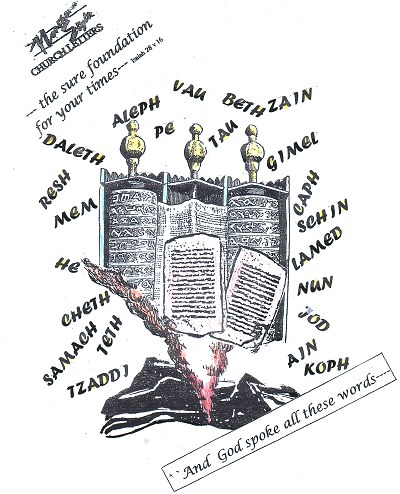
And so at last we come to the Great Psalm of the Law, Psalm 119. We are not intending here to enter the great doctrinal battle over Law and Grace concerning our position in Christ Jesus, although we do write from a position that it is wholly of Grace. The Law reveals to us the impossibility of a relationship with God through keeping the Law, which the Apostle Paul said `is holy, righteous and good' as it leads us to Christ Jesus, through Whom alone we can enter into a relationship with God. As we have already said, Scripture is one complete revelation, seen here in the joining of Torah (the Law) with the Writings (the Psalms) and then continuing to take us beyond the Psalms. Psalm 119 is known as an `Acrostic Psalm' - that is, each one of the twenty-two sections of the whole Psalm begin with the twenty-two successive letters of the Hebrew alphabet. Furthermore, each of the twenty-two sections of eight verses take the form of classical iambic style, giving it rhythm and drama. In copying the sacred scripts the Massorites noted in the margin that, with the exception of verse 122, in every verse of Psalm 119 there were one of ten words expressing the essence of the Ten Commandments, which are a summary of the whole Law given through Moses to the Israelites. (The ten words noted when written in English are: Way, Testimony, Precepts, Commandment, Saying, Law, Judgement, Righteousness, Statutes and Word.) The omission in verse 122 can be seen in the wording:
" Be surety (be responsible) for Your Servant
for good. Do not let the proud oppress Me. "
The Massorites had seen `beyond the script', which refers to a coming Messiah Who would suffer at the hands of the proud, but Who would prevail through One Who would stand surety for Him. From what we have set out we have to accept the integrity of those faithful Massorites who understood something - perhaps in a way which is lost in today's egalitarian world - of the Righteous and Holy God they served. Furthermore, our English Scripture in Psalm 119 is a transliteration of the Hebrew or Greek words, that is, writing words using a different alphabet but without losing the the original meaning. We see this in the opening verses of the `Aleph' section, which in English reads:
" Blessed are the undefiled . . . .
Blessed are those who keep . . . . . "
whereas in the Hebrew script it would appear as (again writing in English but as a transliteration):
" Ah! The joy of the perfect . . . .
Ah! The joy of the keepers . . . . "
In this Psalm we see the Hand of God, revealing in His Word the Wholeness of the Law given through Moses - for this Psalm is known as the Great Alphabet, and each letter, each jot and tittle of the Hebrew alphabet, has Divine origins. This may seem incompatible with our words that God's way towards man is wholly of Grace - until we understand that `the
holy, righteous and good' ways of the Law are by Grace through the enabling of the Holy Spirit!
But we must move on for as disciples of Christ Jesus we are called to live by the Law of Christ. We cannot go to Mark 12 to find the Law of Christ (where we find Jesus talking to a Teacher of the Law), for here Jesus was speaking to a Teacher living under the Mosaic Law. His words to this Teacher are a `two-part' summary of the Ten Commandments:
" Hear, O Israel . . . love the LORD your God with all your heart . . . and love
your neighbour as yourself. There is no commandment greater than these. "
Neither can we `twist' the words of James (chapter 2) when he refers to `the Royal Law', for the words he uses are, `according to Scripture, you shall love your neighbour as yourself', and are a quotation from Leviticus 19. The `Royal Law, therefore, is not referring to the Law of Christ, for James, one of the first disciples to write an Epistle, was still a mixture of the Mosaic Covenant and the New Covenant - it could be said that James' Letter almost shadows `the Sermon on the Mount'! In fact `the Law of Christ' is only mentioned twice in the Pauline Epistles. The first, 1 Corinthians 9, uses the expression to refer to the bringing in of the Gentiles, who are ` without the Law towards God, (to become) under the Law to Christ, that I may win those who are without Law'. Such words, when read within the whole of Paul's words, do not establish `the Law of Christ'. The other mentioning is found in Galatians 6, where it refers to bringing back an erring brother into fellowship: `Bear one another's burdens and so fulfill the Law of Christ'.
At last we have a direct mention of the Law of Christ, and turning to chapter 13 of John's Gospel we can begin to understand this title more fully. The setting is the Feast of Passover, `when Jesus knew that His hour had come'. Here Jesus is speaking His final words to His disciples for, `having loved His own who were in the world, He loved them to the end'. Continuing in chapter 13 we read (verse 34) that during the Last Supper Jesus said: `A New Commandment I give to you, that you love one another; as I have loved you, you also love one another'. But we cannot limit the words of Jesus to just a single chapter, as recorded in our English Bibles, for Jesus is speaking from chapter 13 through to the end of chapter 17. We then read the opening words of chapter 18: `When Jesus had spoken these words, He went out with His disciples over the Kidron Brook. . . . . "
Throughout these five chapters we read of the fulness of what is known as the Law of Christ, the continuous emphasis being, `Trust, Love, Abide and Peace' with the help of the Holy Spirit Whom Jesus would send - and above all Jesus constantly speaks such words as `a new command . . . if you love Me keep My commandments . . . If anyone loves Me he will keep My word'. An important extension of these words appears in verse 10 of chapter 15:
" If you keep My commandments, you will abide in My love, just
as I have kept My Father's commandments and abide in His love. "
The words spoken here, and previously, speak of a `commandment', which in its written English form has a meaning of `ritual Law' which must be kept if we are to enter into the fulness of `the Law of Christ' - which is contrary to Scripture. However the word `commandment' should read as `My charge, which I entrust to you', and therefore the wording in verse 10 would read:
" This is My charge entrusted to you, as you abide in My love, just as I
have kept the charge entrusted to Me by My Father and abide in His love. "
This amazing statement by Jesus to His disciples reveals that all who follow on have been entrusted (given a charge) by the Father through the Son, and enabled by the promised Holy Spirit to share in, participate in the Father's work through our life in the Law of Christ: `This is My charge entrusted to you, that you love one another as I have loved you'. Continuing into chapter 17 we read:
" I do not pray for these alone, but also for those who will believe in Me through their word; that they may be one as You, Father, are in Me, and I in You, that they also may be one in Us, that the world may believe that You sent Me. "
When writing to the Romans the Apostle Paul said: `For what I do is not the good I want to do. No, the evil I do not want to do, this I keep on doing'. Under the `Law of Moses' temporary atonement was found in the continuous sacrfices of animals, for the Law of Moses was set within a Covenant which was conditional upon the people's ritual sacrifices at the Tabernacle, and later the Temple. But with the destruction of the Temple the people's ritual sacrifices cannot now continue, which has resulted in their turning to `good works' in the vain hope of atonement through them.
We do not wish to extend this aspect of Grace and Works here, but desire to show that the Law of Moses was enshrined within a Covenenant, therefore we would expect to find the Law of Christ is also enshrined within a Covenant. For this we need to turn to the Book of Jeremiah, where we find this precept in the well-known chapter 31 and verses 31-33:
" Behold, the days are coming, says the LORD, when I will make a new Covenant . . . . But this is the Covenant that I will make . . . . I will put My Law in their minds, and write it on their hearts, and I will be their God and they will be My people. "
As we have written many times, the Feast of Pentecost is known as `the closing Feast of Passover', thereby linking, indeed compounding, the two as one! And so we find that fourty-nine days following that Passover, of which we read in John 13, on the fiftieth day in the Temple Compound in Jerusalem, the New Covenant promised through Jeremiah was released to those gathered there (as recorded in Acts 2). Thus we find the Law of Christ enshrined within the New Covenant, which is: `My Father's charge entrusted to Me and now entrusted to you . . . that you love one another as I have loved you'.
We have travelled a short distance to find the Law of Christ, clearly seen within Psalm 119 which contains `the whole Word of God as seen in the Great Alphabet, and also in John's Gospel, whose opening words reveal the `whole Word of God in the Person of Christ Jesus, Who through the New Covenant enables His disciples to live the Law of Christ through the Holy Spirit - which is, `love one another as I have loved you'.
~ ~ ~ ~ ~ ~ ~ ~
|
You may E-mail us at: derek@northernstyletrust.com or Telephone (01493) 444494 (UK)
Our Web Address: www.northernstyletrust.com
|


