
|
 OUR SURE FOUNDATION 2
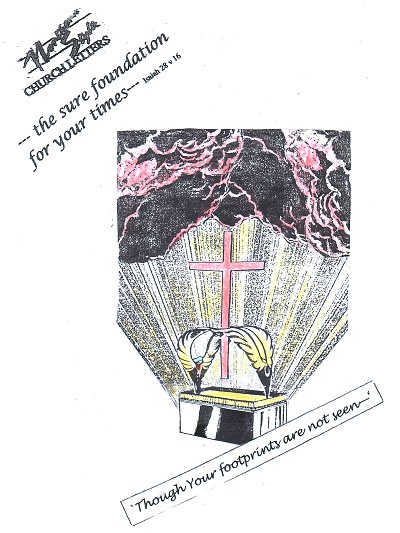
`Though Your footprints are not seen . . .'
These words come from the end of Psalm 77, but first we need to look at the background. We know that the Five Books of Psalms correspond in the same sequence to the Five Books of Torah, and therefore we find Psalm 77 in the Third Book of Psalms, corresponding to the Third Book of Torah, Leviticus. This totally concerns the People of God who were brought out of Egypt through a mighty Exodus from slavery and into the Promised Land and the Rest and Protection of the LORD. In their midst was the Tabernacle, and within it was the Sanctuary of the LORD, the Most Holy Place wherein He dwelt - a constant reminder of His Presence in the very heart of the `Commonwealth of Israel' (of which the Apostle Paul would write later). You will also recall that in the Hebrew Canon of Scripture there are no Psalm numberings, but that they are separated by `inscriptions', which are part of Scripture. Although these days they are largely ignored in most translations, these inscriptions, if incorrectly placed, separate the Psalms - which is probably why they are ignored! However if they are part of Scripture, it is important that they are understood correctly within the setting or content of the writing, for Scripture is all `inspired by God'. In simple terms they are in the content of the preceeding Psalm and of the one which follows, and Psalm 77 is no exception, for in all the translations we have seen Psalm 77 opens with the inscription, `To the Chief Musician, to Jeduthun, a Psalm of Asaph'. As Jeduthun came from a different family line to Asaph (who in the Psalms is never mentioned as a Chief Musician) this only confuses what follows.
With that we can now turn to Psalm 77, which opens with the words, `A Psalm of Asaph'. As this Psalm is the sixth of his twelve Psalms, those with an understanding of Scriptural numbering will see this `sets the scene' for what follows, for Asaph, being a Temple Musician (although not mentioned as such in the Psalms) would be aware of the full Perfection required for matters concerning Temple rituals, for the number `six' tells us that these are man's problems in his dealings with God's `Perfection' (seen in the number `12'). Furthermore, the word `Psalm' in Hebrew is written as `Mizmor', that is, what follows should be thought about, meditated on. Also, remembering that the Psalms are both Prophetic and Messianic, we find the Psalmist writes in the unique Hebraic form where his cries become the cries of his people, who through anxiety and fear of outside forces have moved out of trust in the LORD. Now we are ready to look at this sixth Psalm of Asaph, the Temple Musician.
The opening verses 1-2 shows that the Psalmist has stepped outside the Sanctuary of the LORD, and in his distress he finds himself outside the LORD's Rest, which can only be found in the Sanctuary:
" I cried unto God with my voice, even to God with my voice,
and He gave ear to me. "
This was no casual prayer! The Psalmist was in great distress! He cried and cried again,
loudly and with real emotion in his voice, showing his deep heart-cry, totally concerned with
the problem, knowing, yet hardly believing, that God had heard or even understood the reason for his cry of distress:
" In the day of my trouble I sought the LORD . . . . . My soul
refused to be comforted. I remembered God, and was troubled;
I complained and my spirit was overwhelmed. "
And so Asaph brings in a Selah, giving time to stop and think and recalling his past trust. But if he would indeed stop and think he would see that this inward looking at the situation was the cause of his misery. But no heed was given to the Selah for the Psalmist was deeply into anxiety, and so even more misery was expressed:
" I am so troubled . . . . I have considered the past . . . . my song in the
night . . . . I meditate within my heart and my spirit makes diligent search
(for the reason why he was affected and complaining) Will the LORD cast
off forever? Will He be favourable no more? Has God forgotten to be
gracious? Has He in His anger shut up His tender mercies? "
Asaph brings in another Selah, and at last the Psalmist understands the reason for a Selah:
" And I said this is my anguish (I will put aside my anxiety); I will
remember the years of the right hand of the Most High. "
Here the word for `Most High' is `Elyon', revealing the Person of the great God as Possessor of heaven and earth, Who alone releases His blessings on the earth. This is catching sight of blessings that come through a High Priest, a King upon His Throne ruling and reigning over his Creation, but also seeing them joined as One. Asaph continues: `I will remember (call to remembrance) the works of the LORD' - Who had become the Psalmist's salvation through and because of a relationship. `I will also meditate on all Your work'. At last, with anxiety put away, the Psalmist worships the great Elyon Who is far above the comprehension of mere men, yet He is also known as the LORD Who has become our salvation. In his remembrance of the works of the LORD the Psalmist remembers the mighty exodus from slavery in Egypt: (v14-15)
" You are the GOD Who does wonders: You have declared Your strength
among the peoples. You have with Your arm redeemed Your people,
the sons of Jacob and Joseph. "
Once again the use of the name `God' as `GOD' reveals the mighty EL in all His strength and power! In these verses we see nothing of self, but all in the worship of One Whom the Apostle Paul writes of: (1 Timothy 6:16)
" God, the blessed, the only Potentate, the King of kings and Lord of lords,
Who alone has immortality, dwelling in unapproachable light, Whom no man
has seen or can see, to Whom be honour and everlasting power. Amen! "
`Your way is in the Sanctuary. Who is so great a GOD as our God?'. And so the Psalmist is drawn back into the Sanctuary and into the LORD's Peace and Rest as he remembers what the Most High did in that great Salvation. So why had he ever become fearful and anxious, for his opening words had been: `I cried to God with my voice . . . and He gave ear to me'. The LORD heard Asaph and required only his trust and obedience in the midst of his problems! Today we may read with just half an interest the story of `the Exodus', and maybe we also need a Selah, for there now appears in this Psalm a third and final Selah as the Psalmist's mind and emotions return to the security of the Sanctuary - which for us is now found in the Lord Jesus Christ.
This crossing over into a new Land was not simply walking thorugh a `tidal check' between two walls of water, with the gentle wind holding back the water to enable a quiet walk through on a dry sea bed! There would have been a terrifying cosmic upheaval beyond our imagination, and beyond Hollywood's digital imagination:
" The waters saw You, O God . . . they were afraid . . . The depths also trembled . . . The clouds poured out water . . . The skies sent out a sound . . . Your arrows also flashed about . . . The voice of Your thunder was in the whirlwind; the lightnings lit up the world . . . The earth trembled and shook. "
In catching sight of the Most High. . . of the LORD . . . there is no place for anxiety, only thanksgiving that He has brought us into His Sanctuary where He dwells. The Israelites saw and experienced the clouds of anxiety; the lightnings of total fear; the thunder of danger when the whole world trembled and shook but they knew at last that `Your way was in the sea, Your path in the great waters where Your footsteps were not seen as You led Your people like a flock by the hand of Moses and Aaron'.
For sure the path of the LORD has not changed for His people. Troubles, ill health and great difficulties will continue until He calls us home, but His path is still in the great waters - and even though we cannot see His footsteps He is there, for He has `given ear' to our cries of fear and anxiety! We are called to walk through those waters of fear and anxiety in trust that He will bring us back into His Sanctuary of Rest, if we heed the Selahs He gives us! His Sanctuary is for all His people who are in His Rest through acceptance of Christ Jesus. This is the `Meeting Place', the Sanctuary of the LORD where heaven and earth meet as one! History is removed and only our Rest in Him remains. The First Book of Kings shows us this, where the LORD appears to Solomon: (1 Kings 9:3)
" Then the LORD said to him: `I have heard your prayer and your supplication that you have made before Me. I have hallowed this House which you have built to put My Name there forever, and My eyes and My heart shall be there forever. "
Where is this House now? John 15 tells us as we read through the first eight verses where we find Jesus speaking to His disciples:
" I am the true Vine, and My Father is the Vinedresser. Every branch that does not bear fruit He purges it that it may bring forth more fruit . . . . "
The writer to the Hebrews knew of this purging, and he concludes the matter in chapter 12:
" Since we also are surrounded by such a great cloud of witnesses, let
us lay aside every weight and sin that so easily ensnares us . . . . .
Looking unto Jesus, the Author and Finisher of our faith . . .. . "
This is walking through `the great waters even though Your footsteps were not seen'!
Amen
~ ~ ~ ~ ~ ~ ~ ~
|
You may E-mail us at: derek@northernstyletrust.com or Telephone (01493) 444494 (UK)
Our Web Address: www.northernstyletrust.com
|


