
|

 |
IN HIS FOOTSTEPS 3
... the beginning of the gospel of Jesus Christ
|
A HARMONISING OF THE GOSPELS
IN ONE CONTINUAL NARRATIVE
First published in March 1993 as 12 individual A5 booklets
These are still available in the original form upon request.
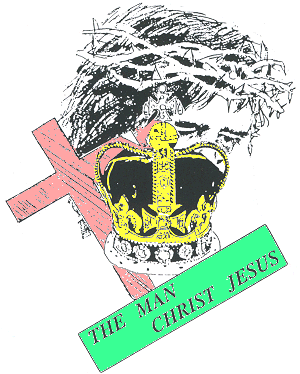
In this third study of walking in the footsteps of `the Man Christ Jesus' there is set before us the stage upon which the public ministry of Jesus would begin. The two earlier studies introduced `The Word (who) became flesh and lived for a while amongst us' - the Word, the Memra . . the living, personal, communicating revelation of a Creator God, now made flesh in `the Man Christ Jesus and tabernacling amongst us. The earlier years, so easily sanitised through endless `Christmas scenes', reveal a baby born in a cave and wrapped in discarded burial `swaddling' cloths - already pointing to the path this Memra of God would take!
The angels had announced to the shepherds, `This will be a sign to you' - a true mystery of God. `Suddenly a great company of the heavenly host appeared with the angels, praising God and saying:
" Glory to God in the highest, and on
earth peace to men whom His favour rests. "
In the first study we saw that before the King came there was a herald, John, whose very name meant `grace' - pointing forward to a break with the old. A new Dispensation of Grace and Truth was being offered to the Jewish nation of Israel by `the Man Christ Jesus'. He was the long-awaited Messiah foretold by the prophets, and in John the Baptist we have the last of the Old Covenant prophets heralding the New Covenant (foretold by Jeremiah, and others) now to be fulfilled in Jesus. In the second study we presented the main protagonists in the coming drama, those who would test, accuse, and finally reject and hand over to the authorities the Son of God for a cruel death. But this was allowed by God for His eternal purpose - to reconcile all things in heaven and on earth to the Father through His Son Jesus.
As we approach the third study, and the ones that follow, we therefore need to keep in mind those different `players on the stage'; the authority they exercised; the areas over which their authority held sway; and the traditions and beliefs which motivated those men - men, we believe, with sincerely held beliefs, albeit now hardened into self-righteousness, leading to a self-indulgent pride in their position in society. Such are the ways of men, and more especially of religious men, for these things are not new in the religious world! What was unique, however was the fact that those men were all in place in a small strip of land amongst a people with whom God had made a Covenant, now at last to be fulfilled in His Son Jesus, who, `in the beginning was the Word, and the Word was with God, and the Word was God. He was with God in the beginning'. It has been recorded that of the incredible drama revealed in the four Gospels, only between seventy and eighty days in the life of `the Man Christ Jesus' are covered, but in those few days God revealed His provision of all that would be required for the salvation of all mankind for those who would believe, although the public ministry of `the Man Christ Jesus' was spread over some three and a half years. John records at the end of his Gospel that, `Jesus did many other things as well. If every one of them was written down, I suppose that even the whole world would not have room for the books that would be written' (John 21:25). In this third study we now turn to those seventy or eighty days, walking in His footsteps.
Mark records the appearance of the Messiah at the onset of His public ministry in the short, sharp, precise words that we have come to expect in his Gospel narrative: `At that time Jesus came from Nazareth in Galilee and was baptised by John in the Jordan' (1:9). We can locate this place as Bethany-beyond-the-Jordan (or by its more usual name of Bethbara, meaning `house of the ford'). It was situated on the east bank of the River Jordan and must not be confused with Bethany, the home of Lazarus, just two miles outside of Jerusalem, on the east side of the Mount of Olives. It is important to keep these geographical settings in mind as Bethbara was in the Tetrarchy of Herod Antipas in Perea and, as we have already seen, outside of the immediate authority of the Sanhedrin. In these first ministry journeys of Jesus we shall see Him covering all the main areas of the land of Israel, the journeys being spread over many months. In His first journey from Nazareth in Galilee He went down to the Jordan through the area of Perea (which was under the authority of Herod Antipas). Following His baptism He was led into the Judean Wilderness before returning to Bethany-beyond-the-Jordan, from where He would journey back to Galilee, to the town of Capernaum (close to the borders of the Tetrarchy of Herod Philip) on the edge of Lake Galilee, which would become the base for His later Galilean ministry. In accordance with the Law, which commanded all Jewish men to attend three of the great Feasts every year, we then find Him moving down to Jerusalem for the Feast of Passover, but quickly moving back into the comparative safety of Galilee in the Tetrarchy of Herod Antipas, passing through Samaria on His way there. From this brief overview of His first public ministry journeyings we see Him ministering in Perea, in Galilee, in Judea and Samaria, covering most of the areas of the land of Israel and proclaiming the Good News that the Kingdom of God had come. The long-awaited Messiah . . the Anointed One of God . . had come, and we shall now walk in His footsteps in His first ministry journeys.
The practice of baptism was common amongst the Jewish people long before the arrival of John the Baptist announcing the coming of the Kingdom of God. The word implies `dipping into', usually associated with cloth being dipped into dye, signifying a change of character, the dye being worked into the cloth. Therefore, within the context of the Gospel of Mark the baptism of Jesus by John was seen as identifying with a movement, that is, the coming Kingdom of God, and the identification of a person, the coming Messiah! John's message was clear. As we have previously seen in the Gospel of Mark, `John came baptising in the desert region and preaching a baptism of repentance for the forgiveness of sins' (1:4), and Jesus came to be baptised by John in order to identify with the message John preached. Matthew records that `John tried to deter Him, saying: `I need to be baptised by You, and do You come to me?' Jesus replied, `Let it be so for now; it is proper for us to fulfill all righteousness.' Then John consented' (3:14-15). John recognised his unworthiness to baptise Jesus, but then consented to do so, and by that act Jesus identified Himself with the message of the preaching of the Kingdom of God. Not only this, but John's remark that he should be baptised by Jesus made known to Israel that this Jesus was the One who would come after him, `one more powerful than I, the thongs of whose sandals I am not worthy to stoop down and untie' (Mark 1:7). It was also an identification with the faithful remnant who recognised the message and accepted their need of repentance for the forgiveness of sins. Finally, it was to receive and reveal the confirmation of His Messiahship from God, for Mark records: `As Jesus was coming up out of the water, He saw Heaven being torn open and the Spirit descending on Him like a dove. And a voice came from Heaven saying: `You are My Son, whom I love; with You I am well pleased' (1:10-11).
It was, as Jesus Himself said, `proper for us to fulfill all righteousness', but the baptism of John is not to be confused with the Christian believer's act of baptism. John's baptism was an identification with the message of the coming Kingdom of God and the need for repentance for the forgiveness of sins. And through the subsequent death, resurrection and ascension of Jesus into heaven, the believer in Him is indeed called to be baptised . . dipped into the water . . not to identify with the message of the coming Kingdom of God but to identify with the death and resurrection to new life in the risen Christ Jesus! Paul's Letter to the Romans records this fact: (Romans 6:3-4)
" Or don't you know that all of us who were baptised into Christ Jesus were baptisedinto His death? We were therefore buried with Him through baptism into death, inorder that just as Christ was raised from the dead through the Glory of the Father,we too may live a new life. "
And so at baptism believers, by this dipping into the water, this immersion in water, have the `character of the cloth changed by the dye' as we identify ourselves with Christ's death and resurrection!
Mark then records that, after Jesus' first public act of baptism `at once the Spirit sent Him out into the desert, and He was in the desert for fourty days, being tempted by Satan' (1:12-13) and we immediately see the unspoken message. Just as Israel (who were called as a people by God) was sent into the desert for fourty years for testing, so also was `the Man Christ Jesus'. He was called by God, and after the confirmation of His call He too was immediately sent into the desert. But just as surely as Israel failed in their testing `the Man Christ Jesus' succeeded in His! The message was clear! Israel, the chosen people of God failed, but Jesus, as a representative of Israel, succeeded - and those watching and waiting would have known what was implied. We all know the familiar story of the temptations of Jesus by Satan; we have seen that at the time of His baptism He was confirmed by God to be `My Son, whom I love; with You I am well pleased'. Now He was tempted to prove that He was the Son of God. All too often we have heard emphasised the fact that Satan had the right to offer what he did, but in doing so we have missed the point of the Gospel message. All that Jesus was offered was already His by right as the Son of God - but the means by which He achieved His rights were the temptations set before Him. We need to understand that once we are called by God, and accepted by Him, there is no need to prove that calling. That is God's responsibility. But we shall be tested, and we shall certainly be tempted to outwork that call outside of God's total provision. The Church needs to understand the message spoken by Jesus in His temptation, clearly recorded in Matthew, that it is written, `Man does not live by bread alone, but by every word that comes from the mouth of God' (4:4) - which is a total trust in the faithfulness of God to all who are called by Him to outwork His purposes. Luke records the ending of the temptations of Jesus in the Wilderness: `When the devil had finished all this tempting, he left Him until an opportune time' (4:13). And with that we shall now move to John's account of the unfolding events.
We see here the next stage of the investigations of the Sanhedrin, following on from what has happened at the River Jordan. They now turned to investigate John and `sent priests and Levites to ask him who he was. He did not fail to confess, but confessed freely: `I am not the Messiah' (1:19-20). But still the interogation continued: `Then who are you, they asked. Are you Elijah? . . Are you the Prophet?' . . Finally they said, `Who are you? Give us an answer to take back to those who sent us. What do you say about yourself?' (1:21-22). John's answer did not waiver: `I am the voice of one calling in the desert. Make straight the way for the Lord' (1:23). Those priests and Levites knew the Scriptures! They were not asking needless questions! The Scriptures clearly foretold a coming Messiah, and their questions formed part of an elaborate systen devised by the Sanhedrin to investigate any Messianic movement - and there had been many over the years! And John clearly identified this Jesus as the Messiah, the Anointed One of God, when `the next day (he) John saw Jesus coming towards him and said: `Look, the Lamb of God, who takes away the sin of the world. This is the One I meant when I said, a Man who comes after me has surpassed me because He was before me. I myself did not know Him, but the reason I came baptising with water was that He might be revealed to Israel'. Then John gave this testimony: `I saw the Spirit come down from heaven as a dove and remain on Him. I would not have known Him, except that the One who sent me to baptise with water told me: The man on whom you see the Spirit come down and remain is He who will baptise with the Holy Spirit. I have seen and testify that this is the Son of God' (29-34). The Jews in Jerusalem (the Sanhedrin) who sent priests and Levites to investigate John therefore received a very clear answer to their questions: `I testify that this is the Son of God!'
Still remaining with John's Gospel we now see Jesus calling to Himself His disciples. John's work was coming to an end, and true to his nature he was prepared to pass on his own disciples to the One who would follow, for `the next day John was there again with two of his disciples. When he saw Jesus passing by, he said, `Look, the Lamb of God'. When the two disciples heard him say this, they followed Jesus' (35-37). We then read of Andrew bringing his brother Simon Peter, saying, `We have found the Messiah' (1:41) and the Lord calling Philip, and Philip excitedly telling Nathanael, `We have found the one Moses wrote about in the Law, and about whom the prophets also wrote - Jesus of Nazareth, the son of Joseph' (1:45). However it seemed that it would take more than excitement to turn the heart of Nathanael, but Jesus was able . . and is still able . . to turn even the most stubborn heart to Himself, and this calls for a response. As Nathanael approached Him, Jesus said, `Here is a true Israelite, in whom is no guile'. `How do You know me?' Nathanael asked. Jesus answered, `I saw you while you were still under the fig-tree before Philip called you'. Then Nathanael declared, `Rabbi (Master), You are the Son of God; You are the King of Israel!' Jesus said, `You shall see greater things than that'. He then added, `I tell you the truth, you shall see heaven open, and the angels of God ascending and descending on the Son of Man' (1:47-51).
A word of knowledge spoken by Jesus to Nathanael, that He saw him `under the fig-tree before Philip called him', was enough to cause Nathanael to cry out, `Rabbi, I believe'. Was there, perhaps, a twinkle in the eyes of Jesus as He told Nathanael more than even that? For it was the Rabbinic teaching at that time that the best place to meditate on the Scriptures was under a fig-tree! Jesus was saying to Nathanael, `Even before Philip called you I saw you there, like the good Jew that you are'. But He also said, `I see you are an Israelite in whom there is no guile' - thereby telling him that He (Jesus) also knew that Nathanael had been meditating on a Jew in whom there had been much guile! Jesus went on to say to Nathanael, `Not only that, but the man whom you are reading about and meditating upon saw only `a stairway resting on the earth, with the top reaching into heaven, and the angels of God ascending and descending on it' (Genesis 28:12). But you, Nathanael, will see the angels of God ascending and descending on the Son of Man!' Not only did Jesus see Nathanael sitting under a fig-tree like the good Jew he was, but Jesus also told him that He knew that he was meditating on the story of Jacob - later to be called Israel. Surely this was enough to still the unbelief in anyone, even one who had said, `Nazareth? Can any good come from there?' `Yes', said the gentle humour of Jesus, `I tell you the truth. You shall see heaven open and the angels of God ascending and descending on the Son of Man' (1:51). By such signs did Jesus call His disciples to leave all and follow Him.
John records that just prior to their call, `Jesus decided to leave for Galilee' (1:43) and on the third day a wedding took place at Cana in Galilee. Jesus' mother was there, and Jesus and His disciples had also been invited to the wedding' (2:1-2). The story of the first miracle that Jesus performed is very familiar. Countless Sunday School classes have been enthralled by this story - and countless sermons have been preached on the old and the new wine. However we would keep the story within the context of the message that Jesus had come to proclaim - that of the long-awaited Kingdom of God and of His Messiahship! We read of His rebuke to His mother for her attempts to persuade Him to demonstrate His Messiahship, and His message was clear: `My time has not yet come' (2:4). His public ministry . . His demonstrated authority . . must begin in Jerusalem and not Cana of Galilee. But we see Him at this private function graciously giving an understanding and a foretaste of what was yet to come. With this first miracle He was revealing that at a future Wedding Feast of the Bridegroom and His Bride . . at the end of a future Feast of Tabernacles . . the best wine would indeed be provided! But John simply records, `This, the first of His miraculous signs, Jesus performed in Cana of Galilee. He thus revealed His Glory, and His disciples put their faith in Him' (2:11). We then find Jesus going `down to Capernaum with His mother and brothers and His disciples. There they stayed for a few days' (2:12). Capernaum, on the shore of Lake Galilee, was to become a haven for Jesus, and we shall find Him constantly returning there for rest. But now we see Him at the beginning of His public ministry, and John's narrative records that `when it was almost time for the Jewish Passover, Jesus went up to Jerusalem' (2:13).
So often a simple sentence of Scripture contains more drama than any secular novelist could dream of: `Jesus went up to Jerusalem' for the Feast of Passover, and there in the Temple He exposed the total corruption of those who had been given the responsibility and authority of leading the `flock' of the nation of Israel. We read of it merely as this: `In the Temple courts He found men selling cattle, sheep and doves, and others sitting at tables exchanging money. So He made a whip out of cords, and drove all from the Temple area, both sheep and cattle; He scattered the coins of the money changers and overturned their tables. To those who sold doves He said, `Get these out of here! How dare you turn My Father's House into a market' (2:14-16). His actions were a direct challenge to the priests and Levites who had control of the Temple ceremonies involving the sacrificial animals. The party of the Sadducees, who had control of the priests and Levites, would be here in the Temple compound taking money to inspect the sacrificial animals brought in by the people. Often the animals would be rejected as unfit and then officially approved animals would be sold to the people in their place. The Temple tax was also brought to this place, and this could only be approved coinage without the idolatrous image of the Roman Caesar stamped on it. Again, the Sadducees had control of the exchange of the Roman coins for the approved Temple coins, and so the whole area had been turned into a vast money-making enterprise, thereby debasing the Temple built to the glory of God.
And yet this act was not merely the act of an angry Jesus who overturned the tables and drove the money changers out. This was also a Messianic act! `How dare you turn My Father's House into a market! His disciples remembered that it is written, `Zeal for Your House will consume Me' (2:16-17). It produced the required response from the Jews (the Sadducees), who demanded of Him, `What miraculous signs can You show us to prove Your authority to do all this?' (2:18). They knew precisely what they were saying: They had sent people out to Bethany-beyond-the-Jordan to investigate and interogate the people connected with an apparent Messianic movement - and here they were at the beginning of their rejection of His claims! `What miraculous signs can You show us to prove Your authority to do all this?'. Jesus gave them an answer they could not begin to understand. Speaking of His forthcoming death, Jesus answered them, `Destroy this Temple, and I will raise it up again in three days. Now whilst He was in Jerusalem at the Passover Feast, many people saw the miraculous signs He was doing and believed in His Name' (2:23). Here we have the clear and definite progression of His public ministry. His Messiahship had been proclaimed, and now He set out to demonstrate and authenticate that Messiahship and the message He had come to proclaim . . that He was the long-awaited Messiah . . that He had come to offer the Kingdom of God to the nation. Miraculous signs would be given to the nation so that they would make a choice, `and many people saw the miraculous signs He was doing, and believed in His Name' (2.23).
One such person was a man of the party of the Pharisees, a member of the Jewish ruling Council (the Sanhedrin). As a Pharisee, he too would have been disapproving of the work of the Sadducees in the Temple compound - perhaps it was this which first caused him to seek Jesus out at night. As a member of the Sanhedrin Nicodemus would have been involved in sending people to investigate the claims of this new Messianic movement, but all we know of him is that `he came to Jesus at night and said, `Rabbi, we know You are a teacher who has come from God. For no-one could perform the miraculous signs You are doing if God were not with him'. In reply Jesus declared: `I tell you the truth, unless a man is born again, he cannot see the Kingdom of God'. `How can a man be born again when he is old?' Nicodemus asked. `Surely he cannot enter a second time into his mother's womb to be born?' Jesus answered, `I tell you the truth, unless a man is born of water and the Spirit he cannot enter the Kingdom of God. Flesh gives birth to flesh, but the Spirit gives birth to spirit. You should not be surprised at My saying, you must be born again. The wind blows wherever it pleases. You hear its sound, but you cannot tell where it comes from or where it is going. So it is with everyone born of the Spirit'. `How can this be?' asked Nicodemus. `You are Israel's teacher', said Jesus, `and you do not understand these things? I tell you the truth, we speak of what we know, and we testify to what we have seen, but still you people do not accept our testimony. I have spoken to you of earthly things and you do not believe; how then will you believe is I speak of heavenly things?' (3:1-12).
Nicodemus came at night, but as a member of the Sanhedrin he knew of the testimony of those who had been sent by the Sanhedrin. He knew of the miraculous signs confirming Jesus as the Messiah! And yet he could not break free from the teachings of the Pharisees with their mix of tradition and Scripture . . with their written and oral Torah . . with the traditions of the Mishnah, which had become the authority over the written Torah! The Mishnah taught that being born a natural Jew ensured entrance into the Kingdom of God (do we hear echos of this in some of our Christian denominations?). To be `born of water' was an expression of physical birth for a Jew and cannot in any way be used as an argument for water baptism for believers. Nicodemus was puzzled in his mind and confused by the teachings of the Mishnah, for he understood the expression `You must be born again'. The words of Jesus must have stung him, `You are Israel's teacher and you do not understand these things?' The teaching of the Rabbis of the sect of the Pharisees, to which Nicodemus belonged, taught that there were six different ways in which a man could be `born again' - that is, six different levels of advancement through childhood to manhood - and Nicodemus had been `born again' through all the stages open to him. He had been brought to manhood, born again from childhood at his bar Mitzvah; as a member of the Sanhedrin he was required to be married and had, therefore, been born again into the state of marriage; and he was appointed (born again) as a Rabbi, and then born again into becoming a member of the Rabbinical School of teaching, `a teacher of Israel'. (The other stages of being born again were not open to him - that of a Gentile proselyte accepting the Law of Moses, and finally, because he was not of the tribe of Judah, he could not be born again into a kingly position.) But Jesus was saying that this was still not enough: He must be born again, this time by a spiritual acceptance of Jesus as Messiah and King of Israel! Jesus was saying `Nicodemus, you are talking of earthly things; I am talking of spiritual matters' - and later events will show the response Nicodemus made to the words of Jesus.
However, it was now time to move out of Jerusalem. The initial work of Jesus had been acomplished; His Messiahship had been proclaimed by the herald John; His interogation by the Jewish leaders had begun; miraculous signs had been demonstrated and witnessed, and we read in John's account that `after this Jesus and His disciples went out into the Judean countryside, where He spent some time with them and baptised' (3:22). We read of John the Baptist's understanding, that the time of his ministry was coming to an end. The herald, who had been so faithful to his calling, did not seek to hold on to his ministry or seek new work, and we see the simple humility of this man when his disciples came to him with a question over ceremonial washing, and also a complaint: `Rabbi (Master), that man who was with you on the other side of the Jordan - the one you testified about - well, He is baptising and everyone is going to Him' (3:26). We would do well to hold John's reply in our hearts as we see the modern-day jostling for positions in the Church, with zealous disciples seeking to `serve the Lord'! John replied, `A man can receive only what is given him from Heaven' (3:27). John refused to accept anything that had not been given to him by God. He continued, `You yourselves can testify that I said: I am not the Messiah, but am sent ahead of Him. The Bride belongs to the Bridegroom' (and speaking of himself he continues) `the friend who attends the Bridegroom waits and listens for Him, and is full of joy when he hears the Bridegroom's voice. That joy is mine, and it is now complete. He must become greater; I must become less' (3:28-30). John, the last of the Old Testament prophets, the faithful friend of the Bridegroom, was now ready to pass on the work to `the One who comes from above (and) is above all' (3:31). John's joy was complete - and we shall see his joy at the glorious Marriage Supper at the beginning of the Millennium reign of King Jesus, when he stands beside the triumphant King and His radiant Bride. Truly his joy will be even more complete - if that were possible!
However, for a time we must return to the Gospel narratives. John's Gospel continues: `The Pharisees heard that Jesus was gaining and baptising more disciples than John . . . When the Lord heard of this, He left Judea and went back once more to Galilee' (4:1-3). By moving out of Judea, Jesus once again left the area under the authority of the Sanhedrin, and the danger this implied. And as He moved back into the comparative safety of the Tetrarchy of Herod Antipas we shall see the Pharisees continuing in their antagonism and hostility towards Him, pursuing Him wherever He journeyed but unable to arrest Him or bring any charges against Him whilst He was in a Tetrarchy outside the direct authority of the Sanhedrin. The danger was now becoming intense, for the un-compromising message of John the Baptist had reached the ears of the Sanhedrin, whose authority did not extend into the area of Perea where he was preaching and baptising. Luke recalls that `when John rebuked Herod the Tetrarch (whose authority covered Perea) because of Herodias, his brother Philip's wife, and all the other evil things he had done, Herod added this to them all; he locked John up in prison' (3:19-20). However Luke goes on to say that `Jesus returned to Galilee in the power of the Spirit, and news about Him spread through the whole countryside. He taught in the synagogues, and everyone praised Him' (4:14-15). John also tells us that, `when the Lord learned of the talk of the Pharisees (that He was gaining more disciples than John) He left Judea and went back once more to Galilee. Now He had to go through Samaria' (4:2-4).
The region of Samaria was a part of the old kingdom of Herod the Great, which had been separated into two Tetrarchies, with the provinces of Judea, Samaria and Idumea coming under the civil authority of a Roman Procurator. So here, in the region of Samaria, there was comparative safety for Jesus as he travelled back to Galilee, for although the religious authority of the Sanhedrin extended all over the area of the Roman Procurator, Samaria was, to use a modern expression, `beyond the pale' and was cut off from mainstream Judaism due to the Samaritans being of mixed race. This was the result of the policy of the Assyrians, who during their conquest of Israel colonised the area of Samaria with people other than Jews (a policy pursued by many other despots down the ages, even into the time of contemporary history!). As such, the Samaritans' religious activities had become polluted with pagan idolatry, and in their rebellion they had set up a rival system of religious ceremonies on Mount Gerizim (in opposition to the Temple in Jerusalem), and with their form of Scriptures, which were different to the Torah of the Jewish people, they were an anathama to the Jews. Therefore at the time of the Gospel narratives there was, at the very least, an uneasy hostility between the Jews and Samaritans, and so with this understanding we can see the wisdom of Jesus in journeying through Samaria on His way back to Galilee. We read in John's account of the story of Jesus coming to Sychar `near the plot of ground Jacob had given to his son Joseph. Jacob's well was there, and Jesus, tired as He was from the journey, sat down by the well. It was about the sixth hour' (4:5-6). Here in this closed-off region Jesus would bring the Good News of the Kingdom of God - even to those outcasts from the Jewish people!
The story is familiar: `When a Samaritan woman came to draw water, Jesus said to her, `Will you give Me a drink?' (4:7). The surprise of the Samaritan woman was evident: `You are a Jew and I am a Samaritan woman. How can You ask me for a drink?' (For Jews do not associate with the Samaritans). Jesus answered her, `If you knew the gift of God and who it is that asks you for a drink, you would have asked Him and He would have given you living water' (4:9-10). The Good News of the Kingdom had now come, even to the Samaritans, and the conversation between Jesus and the outcast Samaritan woman would lead to the revelation of the extent of the Good News - that once the work of Jesus was complete, the way would be open for all men . . . Jews and Samaritans . . . Jews and Gentiles . . . to worship God through His Son. Jesus declared, `Believe Me, woman, a time is coming when you will worship the Father neither on this mountain nor in Jerusalem. You Samaritans worship what you do not know; we worship what we do know, for salvation is of the Jews. Yet a time is coming and has now come when the true worshippers will worship the Father in spirit and truth for they are the kind of worshippers the Father seeks. God is Spirit, and His worshippers must worship in spirit and truth'. The woman said, `I know that Messiah is coming. When He comes, He will explain everything to us'. Then Jesus declared, `I who speak to you am He' (4:21-26). Although she was cut off from Judaism Jesus responded to the simple faith of the Samaritan woman's words `I know that Messiah is coming', and as we read on we find `many of the Samaritans from that town believed in Him because of the woman's testimony' (4:39). `After two days He left for Galilee'.
Jesus would now spend about a year and a half working and teaching in Galilee. Away from the direct hostility of the Sanhedrin in Jerusalem He could now set out on His great Galilean ministry, teaching the people and training His disciples for what was to follow. We should note that during this early period He never spoke publicly of His Messiaship: It was only amongst His disciples that He allowed Himself to be regarded as the Messiah - but here, in Samaria, amongst a people cut off from the Jews, He responded directly to the words of personal faith, `I who speak to you am He'. Clearly He knew the dangers, and He would do nothing to precipitate the violent actions of the Pharisees and Sadducees, which, He knew, would result in a premature death. They had already followed Him to the Judean Wilderness; reports of a Messianic Movement had been taken to the Sanhedrin in Jerusalem; the Scribes and the Pharisees had come down to investigate and interogate; but at this point Jesus had other work to do rather than declare His Messiahship. First must come the teaching of the multitudes and the training of His disciples for what He knew would follow. The time would come, but until then `He arrived in Galilee (and) the Galileans welcomed Him. They had seen all that He had done in Jerusalem at the Passover Feast, for they had been there' (4:45).
There we shall leave this third study of walking in the footsteps of `the Man Christ Jesus'. The time ahead in Galilee would be momentous; the teaching would be revolutionary, incurring the hatred of the Pharisees and the Teachers of the Law as it exposed the hypocrisy of the system that had been built up over the centuries, so placing a heavy yoke upon the people of God. But now the Son of Man had indeed come to offer a lighter yoke - and it would lead to the cross and to His triumphant cry, `It is finished' - but that was yet to come!
* * * * * * * *
In this second study, walking in the footsteps of `the Man Christ Jesus', we continue the task of harmonising the four Gospels into a single narrative whilst at the same time seeking to bring out the historical contextual setting in which the Man Christ Jesus outworked His ministry.
It is our belief that the Church has for too long appropriated to itself - almost to the point of excluding all others - the message contained in the Gospels. In effect, the Gospels have become a kind of Christian `Promise Box', and so the central message contained in them has been distorted. And whilst it is correct and proper to meditate on any of the verses in the Gospels for personal devotional purposes, allowing the Holy Spirit to speak and guide as He wills, it is nevertheless imperative that we fully understand them in the contextual setting of their time in order to understand the purposes of God within the timescale of our journey as aliens and strangers in the world, as we live in the sure and certain hope of the coming of our Lord and Saviour, Jesus Christ. In the first study of this series we set the scene, preparing the background leading up to the time when Jesus would begin His ministry in the nation of Israel. It would therefore seem right, in order to understand what unfolds, to introduce the main characters who will appear from time to time, filling in their background so as not to disturb the narrative as it unfolds within this series. We have briefly mentioned the Herodian house, or dynasty, in the first study, and as several of these Herods appear in the Gospels it would seem appropriate to begin with them, for knowing who they were and what areas they ruled over will greatly assist our understanding of the events to follow.
We begin with Herod 1st - he was also called Herod the Great or Herod the King. He covered the period from 37 BC to 4 BC, and in fact he was not a Jew at all but an Idumean of Edomite stock, a descendant of Esau. The Idumeans came into Israel during the conquest of Palestine in about 130 BC and quickly adopted the lifestyle of the Jews through observing the Mosaic Law - which would have included circumcision. But they were never fully accepted by the Jews and, as we shall see, when the family house of Herod came to power they ruled as despotic tyrants in their attempt to establish and maintain their dynasty. According to Josephus, the Jewish historian, Herod 1st was appointed Procurator of Galilee when he was only fifteen years old, but much of Josephus' work is suspect as he was the equivalent of the modern-day public relations man, serving whichever master paid him best. It is certainly recorded that Mark Anthony later gave Herod 1st a Tetrarchy and set about the task of persuading the Roman Senate to make him king over the whole of Palestine. However, it was not until he captured Jerusalem in 37 BC that this was accomplished. Much has been written of Herod's cruelty, which was extreme even by the standards of his time, but it must also be recorded that he was a builder of magnificent buildings and monuments. Whether this was an attempt to establish his dynasty or was a way of pacifying the Jews has given historians much fuel for argument. Certainly the restoration of the Temple at Jerusalem was a magnificent achievement! (We say `the restoration of the Temple', for it was never his intention to build a Temple. Even he would not have dared to upset the Jews in this way!) He took the Temple that Zerubbabel had built down to its foundations and rebuilt it into the magnificent temple that stood at the time of Jesus. In fact it was only completed in 64 AD, just six years before the Roman armies of Titus destroyed it!
In the first study of this series we wrote a little of his murderous inclinations; of how even the court favourites were not safe from his cruel, vengeful ways. In fact his favourite wife Mariamne and her two brothers , Aristobulous and Alexander, suffered death at his hands, and just five days before his own death he ordered his son Antipater to be killed. Paranoid as he was at the possibility of assassination, his favourites - whether they were wives or sons - did not last long at the court of Herod the Great, and it was to this king Herod that the Wise Men came enquiring after the place where the King of the Jews had been born! It was this background that led him to slaughter all the male children of two years and under in Bethlehem. But that awful day nearly two thousand years ago fulfilled the prophecy of Jeremiah, where he prophesied: (Jeremiah 31:15)
" Rachel weeping for her children, refusing to be comforted
because they are no more. "
Joseph, Mary and the child Jesus escaped into Egypt before that dreadful time, but later, when Joseph was commanded by God to return to Israel, it was discovered that although Herod the Great was dead, his son Herod Archaelus had succeeded his father, and so it is recorded that Joseph made his way to Nazareth in Galilee. Although Herod the Great provided in his will for Archaelus to succeed him as king over the whole of Palestine, Archaelus never actually inherited the throne, mainly due to the efforts of fifty Jews of great distinction who journied to Rome to protest at this successor, asking instead for the country to be ruled by a Roman Procurator. The Roman Emperor Augustus therefore refused to grant the right of succession to Archaelus but appointed to him an Ethnarch (meaning `one half') over a half of his father's kingdom - which would include Judea, Samaria and Idumea.
However, Augustus did promise Archaelus that if he governed his Ethnarchy wisely, in time he (Augustus) would acknowledge his right to succeed his father as king over these three territories. But once established as Ethnarch, the evil stain of his father's blood soon emerged and he began to assume the rights of a king with the same measure of vengeful cruelty as had his father, Herod the Great. (It is recorded that at one Feast of Passover in Jerusalem he was responsible for the deaths of three thousand Jews!) Obviously the Romans could not allow this to go on for long, and so his Ethnarchy lasted only from 4 BC to 6 AD, at which time he was deposed and banished to a town in Gaul where he died, whereupon the Ethnarchy of Judea, Samaria and Idumea became a Roman Province under a Roman Proconsul. During this time Joseph, Mary and the boy Jesus were living in Galilee, an area not under the authority of Herod Archaelus, and there `Jesus grew in wisdom and stature and in favour with God and men'. This act of turning the Ethnarchy of Herod Archaelus into a Roman Province in 6 AD, under the authority of the Procurator Coponius, led to the appointment of Pontius Pilate to this position during the time of the public ministry of Jesus, and we therefore need to remember that Pilate's authority as Procurator was limited to the boundaries of Herod Archaelus' old Ethnarchy of Judea, Samaria and Idumea.
Pilate was no worse than most of his contemporaries - although historical sources reveal that he certainly upset the Jews during his time in this position. The first occasion was when he was appointed to this position in 26 AD by the Emperor Tiberius and moved his headquarters from Caesarea on the coast of Samaria to Jerusalem. When his armies entered the City of Jerusalem with all their standards bearing the images of the Emperor, the sight of those idolatrous images so close to the Temple incited the Jews to riot. Also, apparently indifferent to the religious niceties of the Jews, on another occasion he hung up golden shields inscribed with the names of other gods in his palace on Mount Zion. Tension over this was so high that finally the Emperor himself became involved and he gave the order for their removal. On another occasion Pilate took certain revenues from the Temple funds in order to build an aqueduct, and of course Luke 13:1 records his killing of certain Galileans. So we see that while Pilate was no worse than many others of his kind, he certainly gave offense to the Jewish religious leaders - and at the appropriate time they demanded and extracted their revenge!
We now move on to another more familiar figure in the Gospel narratives in the person of Herod Antipas, covering the period of 4 BC to 39 AD. He was a younger brother of Herod Archaelus, and in his father's will he had been appointed the Tetrarchy (meaning `a quarter') of Galilee and Perea - the latter being an area to the south of Galilee, reaching down to the top half of an area east of the Dead Sea, touching the northern border of ancient Moab and part of the western border of ancient Ammon. Tiberias, on the west side of Lake Galilee, was its capital and the seat of its government. Herod Antipas has been described as sly, ambitious, cunning, and a man `utterly destitute of principle'. It is therefore little wonder that Jesus Himself, when warned that Herod Antipas wanted to kill Him, said, `Go tell that fox . . .' (Luke 13:32). Jesus knew the character of this Herod. He knew of his cunning and cruelty, but He continued, `In any case, I must keep going today and tomorrow and the next day - for surely no prophet can die outside Jerusalem' (v33). We know of this Herod's sexual problem that led to the death of John the Baptist. He (Antipas) had been having an affair with Herodias - the wife of his half-brother Herod Philip 1st - in their house where Antipas was a guest, Finally Antipas and Herodias eloped together whilst they were both still married to others and, to make the sin even worse, Herodias was the grandaughter of Herod the Great and sister of Herod Agrippa 1st, as well as the wife and niece of Herod Philip 1st. It was into this foul mess that John the Baptist spoke, finally ending up in prison. The rest of the story is well known. Here it is enough to say that Herod Antipas flagrantly flouted and ignored the Jewish Law, and his outrageous promiscurity gave grave offense to all in his Tetrarchy. News of his continuous wickedness reached the Roman Caesar, and eventually the Emperor Caligula removed Herod Antipas from his Tetrarchy and banished him to Gaul, and finally to Spain, where he died.
We now turn to Herod Philip 2nd, covering the period 4 BC to 34 AD. He also was a son of Herod the Great and later married the daughter of Herodias, the infamous Salome. Nevertheless, Herod Philip 2nd was probably the best of the Herodian dynasty, having been recorded as `a person of moderation and quietness in the conduct of his life and government'. He was appointed Tetrarch (meaning `a quarter') on the death of his father Herod the Great in 4 BC, and remained so until his death in 34 AD. The Tetrarchy of Philip 2nd covered an area in the north of Palestine - areas with the names of Gaulonitus, Trachonitis and Batanea, reaching up to Paneas and touching the base of Mount Hermon and the northern borders of the Tetrarchy of Galilee. He followed in his father's footsteps in the building of monuments, and his greatest achievement was the building of Caesarea Philppi in the far north of his Tetrarchy. When he died in 34 AD his Tetrarchy was annexed to the Roman Province of Syria for his marriage to Salome had produced no heirs. And there we shall leave the Herodian dynasty: There were others, but they appeared on the stage of history at a time later than this Gospel narrative, and to introduce them would be of no real value. This potted history of the dynasty of the Herods during the time of Jesus is necessary in order that we might understand the narrative of the Gospels. It has not been written for the sake of mere interest but forms an integral part of the tapestry of intrigue which was the background to the life of `the Man Christ Jesus.
We shall now turn briefly to the other principal people of this Gospel narrative - the Pharisees, the Sadduces, the priests, the scribes, the Herodians and, finally, the Sanhedrin, of whom much has been recorded but perhaps little known. This is important if we are to fully understand the contextual setting of the Gospels. The name `Pharisee' comes from the Greek translation of an Aramaic word meaning `separated'. This perhaps tells us that in its initial form Pharisaism was not all bad, but the repeated use of this word in Sunday School and Bible study alike may well have left us with prejudiced views on this! It has been suggested that Pharisaism had its origins back in the times of Zerubbabel and Ezra, when the Israelites separated themselves from the Gentiles who had settled in the land of Israel during their captivity in Babylon. We read of this in Ezra 10:10-11 where Ezra says to the Israelites:
"You have been unfaithful; you have married foreign women, adding to Israel's guilt.Now make confession to the LORD, the God of your fathers, and do His will. Separateyourselves from the peoples around you and from your foreign wives. "
However it is more probable that this name came from the attitude of some men in distancing and separating themselves from fellow Jews on the question of a more strict observance of the Mosaic Law - which was in danger of falling into apostacy due to the spread of Greek thought and lifestyle. They, however, called themselves by the name of Haberim, an Amaraic name which means `an associate', with a wider meaning of `one who associates himself with a more strict compliance of the Mosaic Law'. They were mainly to be found within the ranks of the Teachers of the Law or the Scribes rather than the priests, and as such, with their knowledge, which came from their study of the Scriptures, they became known for their legalistic approach to the application of the Law.
As is common with any religious society, when apostacy sets in there will inevitably arise a movement of separation, which without the work of the Holy Spirit will quickly move into self-righteousness, a separation of well-meaning zealots! This is not limited to Judaism, or indeed to Christianity, but it can also be seen in the different sects amongst Moslems, Hindus, and many other religious groupings. However, in this study we are limiting our thoughts to the Pharisees in the days of the Gospel narrative. Their interpretation of the Mosaic Law extended beyond the written Torah, or indeed beyond the entire Tanarkh (the Old Testament Scriptures). To these Haberim, or Pharisees, Torah meant not only the written part of the Law but the oral part of the Law also, and in Rabbinical Judaism it was referred to as Torah, which `Moses received on Sinai and handed it on the Joshua, Joshua to the elders, the elders to the prophets, and the prophets handed it to the men in the great assembly'. To the Pharisees, therefore, Torah meant not only the written Scriptures, as we know them, but also the oral Scriptures, as passed on `by Moses to Joshua . . .'. The interpretation of Torah became known as the Talmud, which was fully and finally developed long after the period covered by the Gospel narratives, and which would become as authoratitive as Torah - indeed, they are not separated in the thinking of the Jews. But for the sake of brevity we would merely say that the Talmud is a compilation of interpretations of Torah, consisting of the Mishna, the Gemara (itself a further commentary of the Mishna) and the Tosefta (which could well be called a supplement of the Mishna) - all of which have come down to modern times through what are known as the Palestinian and the Babylonian Talmud, completed around 400-500 AD. However, during the time of the Gospels the Pharisees would have concerned themselves with the interpretation of Torah (both written and oral), known as the Mishnah, which, as far as can be established, began to be compiled around 400 BC - or as the Jews prefer to call it, BCE - Before the Common Era. (The expression `AD' which we use is known to them as CE - Common Era.) This has given us a brief overview of what Pharisaism had become during the time of the Gospel narratives. The Teachers of the Law (Torah), which included all of what we have briefly described, with their detailed interpretations and knowledge had developed such a self-righteous zeal that they not only separated themselves from the Gentiles (lest they be defiled by association), but they also separated themselves from Amhaarez (that is, the Israelites who were not Pharisees). This was the root of the question to the disciples: `Why does your Teacher eat with tax collectors and `sinners'? ' (Matthew 9:11). This wasn't just a polite question. They were reasoning that if this Man Jesus was from God then why was He not like them, separated from the Amhaarez - which would include `defiled' Jews!.
Moving on we will briefly look at the other group of religious leaders who feature in the Gospel narratives. Again they have been depicted as an apostate or, at least, a comprising group of religious leaders - which is far from the truth. In fact, using today's terminology, we would call them fundamentalists. Their basic religious beliefs came from a strict interpretation of the written Torah, refusing to accept the oral part of Torah as having any authority, and it is suggested that their name `Sadducee' springs from a Hebrew word with a meaning of `righteous'. The apostacy label has been given through a misunderstanding of the fact that they would not accept the existence of angels or believe in the resurrection of the dead or the Judgement to come. However, it must be stressed that this only came about through their strict interpretation and observance of the written part of Torah, which they said contained no such teaching. In fact it was recorded by Josephus the Jewish historian that the Sadducees were far more strict in applying the written Law than the Pharisees, who would rely more heavily upon the Mishnah with all its twistings and turnings over words and phrases. By and large the Sadducees were gathered from the ranks of the priests who had a daily, indeed yearly, round of ceremionial duties in the Temple. As such, they too became a separated group of self-righteous people, but seen from a social-tendency position (that of priests) rather than from a legal-tendency position (the predominant feature of the Pharisees).
By the time of Jesus, the Sadducees had separated themselves not just into the priestly party, but also into a party of more aristocratic priests who looked with disdain upon their fellow Jews. And this included the Pharisees, with their agonising and nit-picking over minor details of what were men's opinions rather than the authoratitive written Torah. We see this in such passages as Matthew 22:23 where `that same day the Sadducees, who say there is no resurrection, came to Him with a question. `Teacher', they said, `Moses told us . . .'. The essential difference between the two parties could perhaps be summed up this way: The Pharisees, with their minute delving into every aspect of the Law, and their opinionated interpretation of it, saw God involved in every aspect of life. But taking this understanding to the extreme led to legalism, bondage and self-righteousness for those who thought they had succeeded in keeping the Law. The Sadducees, however, who understood life to be an observance of the written Law, exactly as laid down in Torah, believed that man's will (or choice) was the overriding factor. Taking this to the extreme had led to a blind obedience to ceremonies and rituals which attracted the priestly element, particularly those who ministered in the Most Holy Place.
We shall now turn to the Scribes. These men would have been more than just mere letter-writers but would have been the keepers and registrars of public documents. Today we might possibly call them senior administrative civil servants, or perhaps Government or private secrataries, and as such they had developed into those `learned in the Law' or `Teachers of the Law'. We see them in Matthew 22:34-34:
"On hearing that Jesus had silenced the Sadducees, the Pharisees got together.
One of them, an expert in the Law, tested Him with this question . . . "
They had become Teachers of the Law, with the respectable title of `Master' (from the Hebrew word `Rabbi') given them, and so these men became the Rabbis of popular understanding. As such they were drawn from the ranks of the Pharisees, and in the course of time they would become the dominant, zealous guardians of the Law of Moses, having a dominant authority and control over the lives of the Jews. In doing so they would gather around themselves groups of disciples who would seek to learn as much as possible from these great and learned men so that in time they too would receive the title of Rabbi. Obviously in time this had led to some of them becoming extremely opinionated, but they commanded great respect as they taught the Law with all their detailed knowledge of the written and oral parts of Torah and the Mishnah. Then they further developed their position and began to pass sentence on criminals, for Israel, as a Theocratic nation, had its judicial system rooted in and controlled by the interpretation of Scripture, and so the Scribes, drawn from the sect of the Pharisees, held positions of great power and authority over the Jewish people.
A brief mention must be made here of the small party called the Herodians, and we see them recorded in Matthew 22:15-16:
"Then the Pharisees went out and laid plans to trap Him (Jesus) in His words.
They sent their disciples to Him along with the Herodians . . . "
Little information is given concerning them, but it has been suggested that they formed into a party at the time of Herod the Great - probably receiving benefits of patronage and privilege by doing some homage to King Herod because they could not obtain power by way of the Law or the priesthood. They obviously did have power, and were probably more than just a political party, but they were not accepted as a religious sect until they finally joined forces with the Pharisees and the Sadducees in their opposition to Jesus.
To close this overview of the principal players or institutions on the `stage' at the time of the Gospel narratives, we would look briefly at the Sanhedrin. This is an Aramaic word meaning `a council or assembly' and came into a recognisable form during the time of the Greek Empire. At one time its authority extended over all Israel, but by 57 BC the Jewish territory had been divided by the Romans into five areas, or Councils, so that the Council in Jerusalem no longer exercised authority over the whole land. (For a brief time in 47 BC it did have authority over Galilee, but by the time of the Ethnarchy of Herod Archaelus its civil authority had shrunk to the areas of Judea, Samaria and Idumea, and more likely its active authority was really limited to the region of Judea.) Certainly after the removal of Herod Archaelus and his Province being placed under the Roman Procurator, the civil administration of the area was left in the hands of the Sanhedrin in Jerusalem and was seen as the the Jewish Supreme Court of Judea. We can see this in Matthew 5:22 in the words of Jesus. `Again anyone who says to his brother `Raca' is answerable to the Sanhedrin'. At the time of Jesus the Sanhedrin was headed by the High Priest and composed of those who had been High Priests in the past; members of leading families from which the High Priests had been appointed, elders (that is, tribal family heads); and the Scribes (all drawn from the Pharisees and the Sadducees). Strangely, it was the Mishnah, which the Sadducees objected to very strongly, which determined that the number of the Sanhedrin would be seventy, with the acting High Priest called the President of the Council of the Assembly. We can see this in Matthew 26:3:
"Then the chief priests and the elders of the people assembled in the
palace of the High Priest, whose name was Caiaphas. "
Although the moral influence of the Sanhedrin reached into most, if not all, of the Jewish communities, it must be borne in mind that its judicial authority was limited to the area of Judea, and therefore it had no authority over Jesus whilst He remained in Galilee - an important point to remember when we move into the Gospel narratives of the ministry of Jesus! But the authority of the Sanhedrin was more than just religious or spiritual, for it was the Supreme Court of the population of Judea, allowed and tolerated by the Roman Proconsul to the limits laid down by him. He dealt with all matters which could not be dealt with competently by the local courts, and also matters which he decided should be dealt with directly by himself. To a degree, therefore, the Sanhedrin was constantly `pushing against' Roman authority in order to extend its own authority, and in the event of an indifferent Procurator its authority could increase to the measure of his indifference. The procedure of the Council was very clearly laid down by the Mishnah, as might be expected, and it is said that the members of the Council sat in a semi-circle so that they could all see each other. In front of them would sit two clerks, one to the left and the other to the right, in order to count and record the votes correctly. In addition there would also be learned men, disciples of the seventy members, no doubt longing for the day when they would be elevated! The prisoner was expected to appear in a humble attitude, dressed as for mourning, and the hearings would follow an exact and correct procedure of arguments for and against the prisoner - a fact that needs to be borne in mind when we come to look at the scene of the trial of Jesus before the Sanhedrin!
We shall end this second study of `walking in the footsteps of the Man Christ Jesus' by turning at last to the Gospel narrative. (We make no apology, however, for this brief review of `the players on the stage', for it is necessary in order to see the stage on which the drama is to unfold.) We pick up the narrative in the Gospel of Luke, where he records, `In the fifteenth year of the reign of Tiberias Caesar - when Pontius Pilate was Governor of Judea, Herod (Antipas) Tetrarch of Galilee, his brother (Herod) Philip (2nd) Tetrarch of Iturea and Traconitis, and Lysanias (not of the house of Herod) Tetrarch of Abilene (to the north of Mount Hermon and outside the boundaries of Israel) - during the high priesthood of Annas and Caiaphas the word of God came to John son of Zechariah in the desert' (3:1-2). As we would expect, we find Luke setting the historical scene by placing the actual historical people in their actual geographical areas over which their authority held sway.
The time had come in the purpose of God for the herald to come with the Good News of the Kingdom of God. Mark records it in this way:
"The beginning of the Gospel about Jesus Christ,
the Son of God. It is written in Isaiah the prophet:
I will send My messenger ahead of You,
who will prepare Your way -
a voice of one calling in the desert,
` Prepare the way for the Lord,
make straight paths for Him'. "
Matthew sets the geographical location: `In those days John the Baptist came preaching in the Desert of Judea and saying, `Repent, for the Kingdom of Heaven is near' (3:1-2). Luke takes this a little further and tells us that he was `preaching a baptism of repentance for the forgiveness of sins' (3:3). The sole ministry of John the Baptist was to announce the coming of the King and His Kingdom of Heaven, calling upon those who listened to be baptised for repentance and forgiveness of sins. Baptism wasn't new to the religious ceremonies of the Jews. What was new was the announcement of the long-awaited Messianic Kingdom and the Messiah who would rule over that Kingdom. His message was clear. It was a Messianic call, a call for those who heard it to identify themselves with this coming Messiah by being baptised for repentance and forgiveness of sins This passage is not to be taken as Scriptural authority for water baptism for believing Christians today, but it certainly was a clear message for the Jewish nation to repent and prepare for the long-awaited and promised Messiah and His everlasting Kingdom! Mark recalls their response: `The whole Judean countryside and all the people of Jerusalem went out to him. Confessing their sins, they were baptised by him in the Jordan River' (1:5).
Over the years many had come claiming to be the long-awaited Messiah, but the Sanhedrin had prepared for such a contingency and in Matthew's Gospel we see this plan moving into place. Whenever such a person appeared the Sanhedrin followed a well-prepared course of action. First, they would send out observers who would report back to the Sanhedrin, and after some consideration they would return to investigate and ask questions. Finally, they would come with all the authority and backing of the Sanhedrin to interogate those involved. We shall see all these stages in the course of the unfolding drama recorded in the various Gospels, and here in Matthew we see the first stage: `But when he saw many of the Pharisees and Sadducees coming to where he was baptising, he said to them, `You brood of vipers! Who warned you to flee from the coming wrath? Produce fruit in keeping with repentance' (3:7-8). The words of John were not as undeserved as it would first seem, for he knew very well the system laid down for investigating a reported Messianic movement. Here he was baptising the multitudes in preparation for the coming Messiah - and the Pharisees and Sadducees came only to observe! `You brood of vipers' was John's reponse, `bring forth fruit in keeping with repentance (as have those whom you are observing)'.
The multitudes who came to John didn't come to observe. Luke records their words, `What shall we do then?' (3:10) and in answer John told them what was expected of them in the coming Kingdom. The Tax Collectors, he said, were called to act justly; the wealthy must show mercy; the soldiers were not to be violent. Luke goes on to tell us that `the people were waiting expectantly and were wondering in their hearts if John might possibly be the Messiah' (3:15). Matthew records John's quick response to their wondering - and with that response we have the clear revelation of the outcome of the ministry of the King who was soon to appear! John said, `I baptise you with water for repentance but after me will come One who is more powerful than I, whose sandals I am not fit to carry. He will baptise you with the Holy Spirit and with fire. His winnowing fork is in His hand, and He will clear His threshing floor, gathering wheat into His barn and burning up the chaff with unquenchable fire' (3:11-12).
Keep clear in your understanding that this was a message of the herald to the people of Israel at that time to prepare themselves for the coming Messiah. All of those in the land of Israel who heard the message would be baptised one way or another. Those who believed that Jesus was the Messiah would be baptised with the Holy Spirit - born from above into the spiritual Kingdom of God. But those who would not believe in Him as Messiah would be baptised with fire and judgement in the Lake of Fire! The message was clear: The coming Messiah would `clear His threshing floor, gathering wheat (the believing Jews) into His barn and burning up the chaff (the unbelieving Jews) with unquenchable fire' (3:12). Following the death and resurrection of Jesus and His ascension into heaven, the way would be opened up for all people, Jews and Gentiles alike, to be born from above into the spiritual Kingdom of God through belief in Jesus as Messiah and Christ. But here in these passages of Scripture the Gospel writers are referring to the Jews in the land of Israel at the time of the preaching of the Good News by the faithful herald. John . . his very name meaning `grace' . . announced a new Kingdom of Grace and Truth for all who would believe in the coming Messiah. The new Covenant of Grace and Truth was indeed close at hand!
We close this second study of following in the footsteps of `the Man Christ Jesus' with the words of Luke: (Luke 3:18)
" And with many other words John exhorted the
people and preached the Good News to them. "
* * * * * * * *
|
You may E-mail us at: derek@northernstyletrust.com or Telephone (01493) 444494 (UK)
Our Web Address: www.northernstyletrust.com
|


