
|

 The SABBATH of Sabbaths
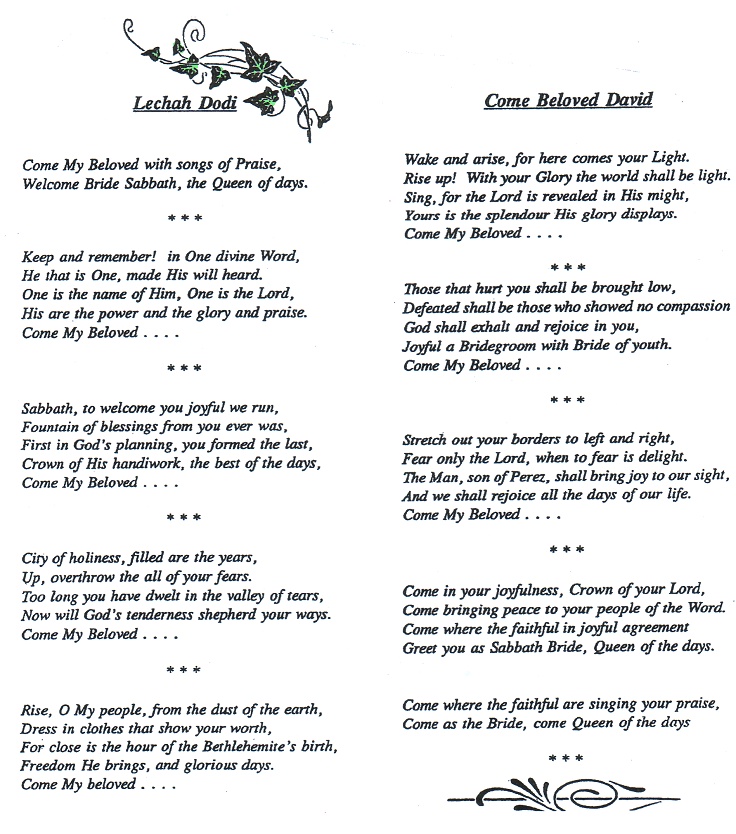
We turn our thoughts to the words of a well-loved Jewish Sabbath Song of Praise, composed by Rabbi Solomon ha Levi over 400 years ago and read or sung at most if not all Jewish Sabbath evening meals. The title of this Song of Praise is Lecha Dodi - the meaning of which in Hebrew is `Come, Beloved David', the words `Beloved' and `David' both springing from the same Hebrew root word of `Dodi'. This Song of Praise has clear Messianic overtones and was written by the Rabbi in the Jewish town of Safed, which later became a centre of great spiritual revival for the Jewish people in the 16th century.
First we need to set out a general background to the spiritual revival amongst the Jewish Kabbalists who had established their centre of the small Galillean town of Safed in the mid 16th century, later spilling out into the land of Israel, and beyond. In certain Christian (and for that matter, Jewish) circles, the mention of Kabbalists raises fear and a denouncing outcry, but we need to understand Kabbalism from a different perspective as the Holy Spirit waters the dry ground of God's Covenanted people, the nation of Israel, on their journey to meet and greet their soon-to-come Messiah. Kabbalism, taken to the extreme (and beyond God's intention), leads to excess and disaster - and in the history of Kabbalism there have been many excesses! In general terms Kabbalism is Jewish mysticism, and as such is usually opposed by the great Talmudic-teaching Rabbis, and yet some of the greatest names among Kabbalists have been raised up from among renowned Talmudic Rabbis. The two combined (mysticism and Scriptural understanding) provide the tension to keep each other in balance - one bringing a new vitality, the other grounding it on sound Scriptural exposition - but rarely can these two halves of spiritual life be kept in harmony. In Christian circles today the two halves can be called `Charismatics' and `Evangelicals'. Both are needed to bring balance into the full life in the Spirit but rarely will either side see the need for each other's experience and learning! The Church has always had its mystical branch, always uncomfortable to be associated with. Today we can read of Madame Guyon or Mother Julian safely at a distance, but if they were alive today they would attract the same reaction as did the Kabbalists when the Holy Spirit moved amongst them and used them to bring vital new life to the nation of Israel. And in the same way the Church today needs the fulness of all the `members of the Body' in order to keep the correct tension and vitality in the Body of Christ.
There is no simple description of Kabbalism for it is mystical. In its pure form it is the Kabbalist's effort to unite their rational minds to the intellect emanating from God, thus receiving true knowledge from God and leading them into a communion with Him and so becoming `gods'. That, in the correct sense, is their earnest and pious desire - to join their minds with `the mind of God', leading them into a complete indifference to the things of the world and a complete abandonment to God. Classical Kabbalism (if there is such a term) acknowledges a God who cannot be described as having any form of attributes or vital personality . . a God of philosophy so indescribable and unknowable that nothing can be said about Him . . a kind of spiritual state of total Divine Nothingness . . but they also acknowledge a God who is a living dynamic Person who reveals Himself in all His vital personality and attributes. The Kabbalists combine these two aspects of God: The first aspect they call `En Sof', the `Infinite God' - and yet they understand that the Hebrew Scriptures reveal this hidden God, who in order to exist must be manifest and capable of being understood by man. This `process' of a hidden En Sof becoming comprehensible to man comes about when the `Infinite God' turns from His introverted En Sof and reveals Himself and emanates (comes forth) from Himself into a vital self-revealing manifestation of Himself to man. This emanation is the key expression of Kabbalism - to repeat, it is the process by which an introverted, infinite, spiritual Divinity (a kind of Divine spiritual Nothingness) becomes a revealing comprehensible Divine Being with identifiable attributes. This emanation is expressed by the Kabbalists in ten Sefiroth (a Kabbalist term) of ten stages of manifestations of the Divine Being.
In Kabbalist thinking these Sefiroth all inter-relate and make up the totality of the Godhead's inner life, and yet He remains One Being. Obviously this kind of expression brings with it the accusation of setting up a ten-fold God - which is even worse than the `three-fold God' of the Christians. But the Kabbalists stand their ground as they seek to understand the main attributes of a God whom they accept as Unknowable Infinity - yet a God, according to their own Scriptures, who manifests (tabernacles) among them. In Kabbalist theology there are two particular Sefiroth which, when inter-related, are of particular importance and practice. They are the sixth Sefirah (Tif'ereth) and the tenth Sefirah (Malkhuth). Tif'ereth is looked upon as a central Sefirah. All the others turn upon this sixth Sefirah, receiving from the `higher' Sefiroth and harmonising them before passing them to the `lower' Sefiroth. This sixth Sefiroth is expressed in dominant male terms - such as the King, the Sun, the Husband and the Bridegroom - whereas the tenth Sefirah (Malkhuth) is at the lower end of the scale and becomes the point where the Divine sphere meets the non-Divine and is expressed in more subservient words - such as the Womb, the Moon, the Queen, the Wife or the Bride. This kind of expression describes the relationship the Kabbalists seek; it becomes a holy union of the Divine with the non-Divine and often leads in Kabbalist writings to seemingly erotic expressions. However, this erotic mysticism is limited to the area of the inner Divine (Sefirah) life and has no physical expression in man's relationship to God. Here we see a perfect blending of Kabbalism - mysticism and rational Scriptural revelation expressed in Genesis as man and woman . . husband and wife . . one flesh . . a passing of the Divine life through the sixth Sefirah to the tenth Sefirah where they meet in a mystical joining of the Divine and the non-Divine!
Kabbalism, however, is a developing theology, and through Isaac Luria (1534-1572 AD) there came a further development of mystical Kabbalism (Lurian Kabbalism) and this is the form of Kabbalism we shall be referring to in what follows. Luria developed a new thinking whilst still using the classical Kabbalist Sefiroth. His thinking saw a closer union between God and man because the whole cosmos that is heaven and earth had been damaged by Adam's sin and needed salvation - not only mankind but every part of the cosmos had been tainted by sin and God needed mankind to work with Him in that salvation! It brought a new depth of understanding of Israel as the Wife of God - a joining of the sixth and tenth Sefiroth of Kabbalist theology. The nation of Israel became the Malkhuth, the tenth Sefirah (not as in orthodox Judaism a receptacle, a `womb', wherein the attributes could be manifest). Israel became an active factor in the universe, related to the inner life of God in a vital living way. Luria developed his Kabbalist thinking to the point of seeing Israel as God's `vehicle' in the battle to restore the perfect eternal order, overcoming the demonic forces opposing God's purposes and thereby actively assisting God in bringing salvation to the cosmos (the whole of creation). In Orthodox Judaism doing the will of God meant carrying out His commandments as laid out in the Mosaic Covenant. Now Lurian Kabbalism combined this intellectual element with the mystical to produce a theology of God and Israel working together for the salvation of the cosmos. It therefore became obvious that Lurian Kabbalism would demand a Messiah, for it is essentially Messianic in its theology and practice - and Messiahs certainly did spring from this form of Kabbalism, which led to many disasters! Nevertheless, if we over-critisise Lurian Kabbalism we fail to see the hand of God upon His Covenanted people, for in order to fulfil the prophetic words `Judaic' Kabbalism had to fail - not only because it is man's attempt to fuse the Divine with the non-Divine, but because of the rejection by the nation of Israel of God's Messiah, revealed in Jesus, by that particular generation.
The way was opening up for the Gentiles, too, to be offered redemption through Jesus Christ as well as the Jewish nation. Until `the Times of the Gentiles' have been fulfilled, the Holy Spirit would (and will) release a gentle `rain' upon His Covenanted people Israel - seen in Kabbalism or the Hasidic Movements - in order to keep them looking to God for their coming Messiah. This `mystical thread' runs throughout Scripture, and the greatest Jewish Kabbalists were noted and honoured Talmudic theologians. Their mysticism was based upon their profound knowledge of the Hebrew Scriptures, whilst their Kabbalist theology sprang from a deep desire to enter into a spiritual relationship with God that was clearly revealed in Scripture. Those Kabbalists were steeped in knowledge of the Scriptures . . they had read and expounded the writings of Isaiah . . they understood the words of Jeremiah when he talked of `the Wife of God' and the divorce He gave her because of her unfaithfulness . . they read and expounded the words of the New Covenant . . they understood the deep significance of Hosea's unfaithful wife being compared to Israel . . and from such Scriptures they developed mystical Kabbalism with its ten Sefiroth, or attributes, of God in an attempt to experience what the prophets so often wrote down as their own mystical experiences of God.
Many centuries after the Hebrew canon of Scripture was closed there came the only One (the Messiah Jesus) who could fuse together the Divine and the non-Divine, as the Kabbalists understood it. But because that generation of the Jewish nation rejected the Messiah Jesus, Lurian Kabbalism - and for that matter any other development of Judaic Kabbalism - will fail and lead to deception. That is not to say that we cannot feel anything of the longing of the Jewish people for that relationship, which can only be expressed through the God-Man-Jesus, for there is much expressed desire for righteousness contained in the Kabbalist writings, but an understanding of their theology will keep our eyes firmly fixed on the only Emanation of the attributes of the Godhead, the Person of the Lord Jesus Christ. Many centuries before Isaac Luria developed his Kabbalist thinking we see the Apostle John, writing in the Gospel attributed to his name, proclaiming what Isaac Luria and others so earnestly and sincerely sought: (John 1:1)
" In the beginning was the Word, and the Word was with God,
and the Word was God. He was with God in the beginning. "
If Isaac Luria had been able to do so, he would have recognised the answer to his ten Sefiroth. He would have been able to understand that the Word John proclaimed was the perfect fusion of the sixth Sefirah (the Tif'ereth) with the tenth Sefirah (the Malkhuth). The `Word' in Hebrew thinking was the `Memra' - the living personal manifestation of God, not the intellectual `Logos' of Greek thinking. John and others saw it . . they understood . . `the Word (the Memra) became flesh and tabernacled amongst us for a while'. Later on in his Epistles Paul developed his understanding when he wrote to the churches under the inspiration of the Holy Spirit. He saw what the Kabbalists (or whatever name they were then called) before Isaac Luria had understood as the answer to their earnest seeking after an experience with God - as seen in their writings along those same lines. Lurian Kabbalism had not yet been developed at the time Paul wrote his letters, and fifteen more centuries would pass before Isaac Luria was born, but Paul understood perfectly the answer to the writings of Isaiah. He understood perfectly the fulfillment of the New Covenant of Jeremiah's promise to the Jewish people - that `a new heart and a new spirit' could only be found in the God-Man Messiah, Jesus. Paul's writings are full of this `mystery', as he calls it: the Bridegroom coming for His Bride . . the Body of Christ and members of one Body . . the coming King, and other such expressions . . and the fusion of the dominant male Sefirah with the less dominant subjective tenth Serifah (as seen in Kabbalism) could only be fulfilled in Jesus the God-Man.
Paul's writings continued with this thinking long before Lurian Kabbalism, and he drew on his own mystical experiences which were based on his profound knowledge of the Hebrew Scriptures. He calls it a `mystery' . . a one-flesh relationship . . a marriage relationship, that of Christ and His Church. He saw the relationship that God had with His Wife Israel (as spoken of in the writings of the Prophets). His letters reflect his understanding of the place Israel has in God's heart, and he clearly speaks of the only way for that relationship to be restored - which is their acceptance of Jesus as the Christ of the Gentiles and the Messiah of the Jews, `and so all Israel will be saved'. They also reflect this mystical union of God and man, now living in a holy Temple - a fusion of Divine with non-Divine - but he also saw that the fulfillment of the New Covenant of Jeremiah called for a new heart and a new spirit. He tells the believers that they, as sons of God, fused as one in Christ Jesus, need to walk by the Spirit. Each believer would need their own experience of being baptised into one Body by one Spirit' in order to walk out that life in the Spirit. Divine and non-Divine, now seen and experienced by simple faith through receiving and believing in Jesus. But the `mystery' that Paul wrote of is still hidden from the Jewish Kabbalists who earnestly seek God as a living manifestation among them . . God the Infinite, emanating (coming forth) amongst them, revealing a living communicating God they long for.
With this background in mind we can at last look at the well-loved Lechah Dodi, a Sabbath Song of Praise composed by Rabbi Solomon ha Levi over 400 years ago in the little Galillean town of Safed. It is full of Kabbalist mysticism, but in the days when it was written it was a move of God amongst His Covenanted people to refresh them on their way to meet with their Messiah. In this mystical song we will find the two central Serifoth inter-twined and inter-related - such as `My Beloved' . . `Welcome Bride Sabbath' . . `Crown His Handiwork' . . `City of Holiness' . . `Here comes your Light' . . `A Bridegroom with Bride of Your Youth' . . `Crown of your Lord' . . `Sabbath Bride' . . `Queen of the Days'. In these verses we can catch a sense of God calling His Beloved, who could at times be seen as Israel `the Messiah of the world' and yet they also refer to a Messiah to come, foreseen in the Sabbath. But the Sabbath is later called ` a Bride', relating it back to Israel. Again, Israel is shown to be the Bride of the Youth of a Bridegroom, revealing Israel as the Wife of God - and yet still speaking of a Bride waiting for a Bridegroom yet to come! Such is mystical Kabbalism! But we would nevertheless recognise in it the finger of God as we relate it to the written words of Scripture revealed in the command to the Jewish nation to keep the Sabbath as a day set apart for God.
Keeping in mind that this Song of Praise portrays a longing to enjoy the coming Sabbath, and remembering the central pillars of Kabbalism (a dominant sixth Sefirah, harmonising the attributes of God and emanating forth from the tenth Sefirah) we would open with the chorus of the Lechah Dodi:
" Come My Beloved with songs of Praise,
welcome Bride Sabbath, the Queen of days. "
We have already seen that the words `Beloved' and `David' both spring from the same Hebrew root word - pointing to the Messianic theme of the Song. The Messiah, David's Son, sent by God to welcome Bride Sabbath, with a suggestion that Israel (as the Bride) is the one for whom the Messiah is coming. This suggestion that Israel is the Bride Sabbath is seen again in verse 2: `First in God's planning . . Crown of His handiwork', and again in verse 3: `City of Holiness . . too long you have dwelt in the valley of tears'. The Messianic theme is seen again in verse 4: `For close is the hour of the Bethlehemite's birth' coming for Israel `Queen of the Days'. This encouragement of Israel to look for her coming Messiah is seen in verses 5 and 6: `Wake and arise, for here comes your Light', and `God shall exhalt you'. The Messiah is seen again in verse 7: `The Man, son of Perez, shall bring joy to our sight'. Boaz, the kinsman-redeemer of the Book of Ruth sprang from the line of Perez and has long been seen as a shadow (a type) of the Messianic Kinsman Redeemer who is to come for the nation of Israel. And yet in verse 6 we catch a suggestion that these verses also refer to a Wife of a Husband and not just a Bride waiting for a Bridegroom, `Joyful as a Bridegroom with Bride of youth'. The last verse reveals this still further with the words, `Come where the faithful in joyful agreement greet you as a Sabbath Bride, Queen of the days' - pointing to a people who are greeting as a Bride someone other than Israel. The final chorus also picks up this theme:
" Come where the faithful are singing your praise.
Come as the Bride, Queen of the days. "
There is, however, a deeper mystery not revealed to those earnest Kabbalists. As we have said, the finest work of Kabbalism came from the most renowned of the Talmudic scholars who drew heavily from the Hebrew Scriptures in their desire to draw closer to the God revealed in them. Undoubtably the Holy Spirit was moving amongst them, giving them partial insight to satify their desires. At the time the Lechah Dodi was written - in the midst of a Messianic revival amongst the Jewish people - there was a similar awakening in the Church. Led by such men as Martin Luther, the Church awoke from near death, and under the same refreshing rain of the Holy Spirit it moved forward into a new understanding and expectation of the redeemed people of God. Historians have given it the title of `The Protestant Reformation', but God saw it from His perpective as He sent the refreshing rain of His Spirit not only upon His Covenanted people, Israel, but also to revive His Church called out of all the nations of the world and being prepared as a pure Bride for His Beloved Son, David's Greater Son Jesus.
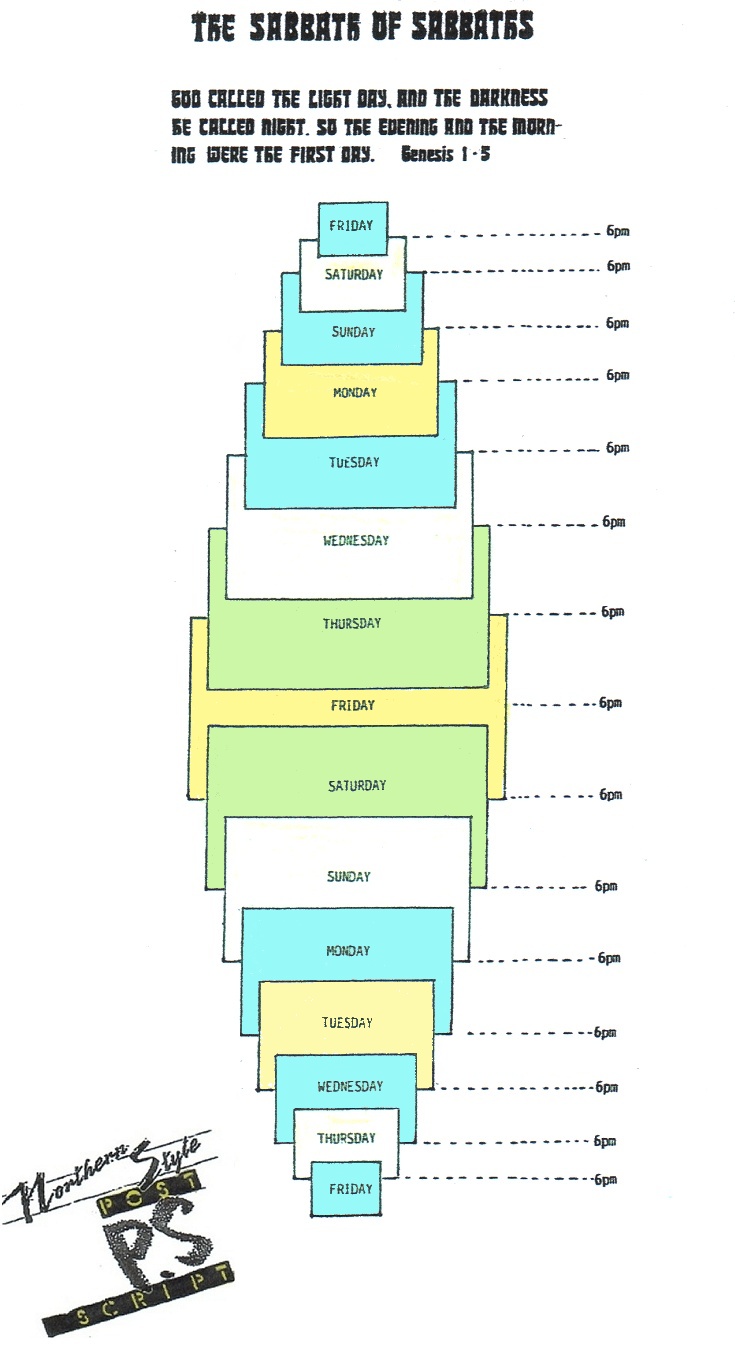
With the Church and the nation of Israel linked together in a parallel walk on their journey to meet the Lord of the Church and the Messiah of Israel, this revival was a move of God amongst His two Covenanted people, the Church and the nation of Israel. We have seen that although the Sabbath is a day to be kept every seven days, the actual Sabbath day is an overlapping eighth day, We have called this `God's Day' - special to Him outside of man's understanding or time. In Scriptural language it refers to a resurrection . . a new beginning . . a day of rejoicing . . and it is linked with other Jewish Feasts such as a wedding celebration or Wedding Supper. Those Kabbalists saw that the Sabbath was `the first in God's planning' even though it `formed the last' day, and from Scriptures which commanded them to `remember the Sabbath day to keep it holy' they saw that it had a special significance to them as a nation called into being by God for His purpose. The writer to the Hebrews (a very Jewish book) also saw the significance of the Sabbath and brings it out in his exhortation: (Hebrews 4:9-11)
" There remains, then, a Sabbath rest for the people of God; for anyone
who enters God's rest also rests from his own work, just as God did from
His. Let us, therefore, make every effort to enter that rest. "
It follows, therefore, that the Scriptures reveal a Sabbath rest for the people of God - that is, the nation of Israel and the Church, for both are the people of God - and unknown to the Kabbalists, who wrote such Songs of Praise as the Lechah Dodi, the Sabbath is indeed a rest for all the people of God. Certainly the Jewish people, including the Kabbalists and the Orthodox Jews, would react against such a thought, and the Church would almost certainly react even more strongly against the same thought. Perhaps both need to see that their journeys are linked and in a real sense they `need each other'! Certainly they need to recognise the purposes of God in each other, and in doing so joyfully outwork those purposes together. The Scriptures clearly point to a coming Sabbath of Sabbaths, an eighth day appointed by God which Israel will indeed enter into through receiving her Messiah, the Beloved, David's Greater Son! Only then will she be restored to her rightful place as the Wife of Yahweh and with great joy be welcomed into that `Sabbath of Sabbaths' - together with the Church of the Redeemed, the Bride of Christ Jesus, Israel's Messiah. At last the total family of God will be united in harmony together at that glorious Wedding Supper, that final special eighth day of God's design, which is pointed to and seen in the Sabbath. For both the nation of Israel and the Church there is only one way to enter into that Sabbath of Sabbaths, and that is through receiving the Messiah Jesus. He alone is the gateway into the Sabbath rest for the two peoples of God - the nation of Israel (the Wife of Yahweh) and the Church of the Firstborn (the Bride).
This would seem to point to the fact that, unknown to the people of Israel (and probably unknown to the `Body of Christ'), the Jewish people, in keeping the Sabbath - and later through such work as the Safed Kabbalists joyfully singing their Song of Praise to welcome Queen Sabbath - have been more faithful in prayer and praise for the coming Wedding Feast than has the Church. But although the Church has been slowly discovering its `Jewish roots' and has at last begun to pray for the Jewish people it may well find that the Jewish people (in welcoming `Bride Sabbath, the Queen of the days') have been more faithful in prayer than they realise. If these words have any truth in them the Church owes the Jewish people a debt that can only be repaid with quiet loving humility at its own blindness, for the Jewish people have been unconsciously praying and rejoicing over the Sabbath since the days of Moses. But the Safed Kabbalists of the 16th century, led by the Spirit of God, saw something more - that it was `the Crown of His handiwork' and joyfully joined it with `David the Beloved', the Messiah, as they sought to enter into the Sabbath rest by their own efforts. Little did they know that at the same time the Holy Spirit was awakening from its deep sleep the precious Bride of `David the Beloved', who together with the nation of Israel will enter into the coming Sabbath of Sabbaths. And so the family of God will be complete at last - the Wife of Yahweh and the Bride of His `Beloved David'!
" Come My beloved with Songs of Praise,
welcome Bride Sabbath, the Queen of the days. "
A Wife and a Bride, joined in a mystical `one flesh' relationship with a Husband and a Bridegroom (through the coming of a Son) at a coming Sabbath Wedding Supper of the Lamb - an eighth day belonging entirely to God!
~ ~ ~ ~ ~ ~ ~ ~
|
You may E-mail us at: derek@northernstyletrust.com or Telephone (01493) 444494 (UK)
Our Web Address: www.northernstyletrust.com
|


