
|
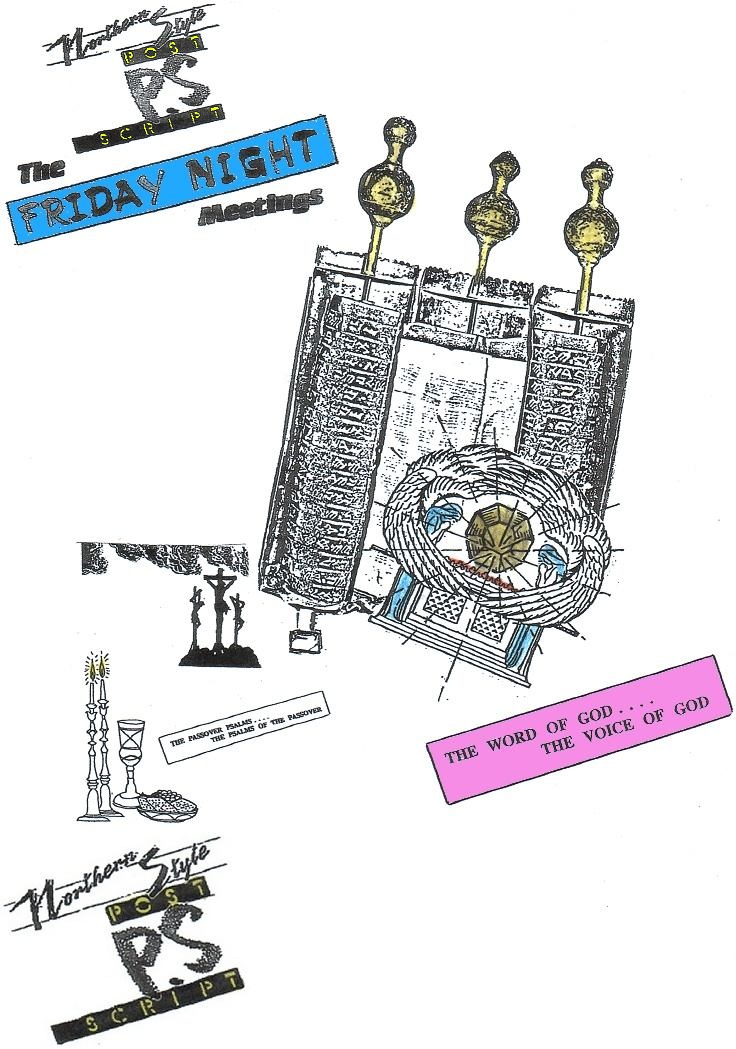 The Passover Psalms
We have often mentioned that the structure of the Books of the Bible speak out their own revelation, and this is particularly so in the Five Books of Psalms which, if read correctly, are highly prophetic. Our subject here concerns the Passover, and in the First Book of Psalms there is a `collection of Psalms' which we have entitled `the Passover Psalms'. They run from Psalm 16 through to Psalm 24 and are part of a total collection which runs from Psalm 16 right through to Psalm 41. This `collection' is divided into two sub-sections which are connected by Psalm 25. Here we are concerned with the first sub-section and the connecting Psalm 25 - giving a total of ten Psalms which we have entitled the Passover Psalms, all of which are of course within the First Book of Psalms. This Book of `the Beginnings', corresponding as it does to the First Book of Torah (Genesis, the Beginnings), reveals that which God intended from the Beginning of Time - the revelation of the Person Who would bring deliverance and salvation. In the second part of this study, as you will see, we consider a group of Psalms from the Fifth Book of Psalms, which we have entitled `The Songs of the Passover' - a slight change of emphasis in the titles of the two sections. This sub-section consists of eight Psalms which speak of those who in accepting The Passover are now ready to enter into the Land of Promise - which corresponds to the Fifth Book of Torah, Deuteronomy: `These are the words which Moses spoke to all Israel on this side of the Jordan'. Thus is the Word of God spoken in Torah, and the Voice of God heard in the Psalms - from the First Book to the Last Book, the Beginnings of His Grace, for it is all of Him!
Before we turn to the Psalms themselves it is worth remembering that in the original Hebrew Scriptures the Psalms are not separated with numbering. The breaks in the narrative come in the form of a change of emphasis in the words or by the insertion of an inscription, thereby turning the thoughts of the reader to a further revelation. Also in the Hebrew lettering there are no specific number symbols. Lettering is used for both words and numbers and the very subtle placing of letters can often give a numerical sense with its own revelation, so forming what is called `the Spiritual Significance of Numbers'. To illustrate this, the number `three' can mean `new life' . . . `five', the number of `grace' . . . `eight', the number of resurrection . . . `ten', the fulness of something and so on. All such numbers should have a repeated Scriptural basis for its use, which under the tutelage of the Holy Spirit can bring new depths of understanding without going into the realms of fantasy. So, then, to the ten Passover Psalms of the First Book of Psalms.
Psalm 16 opens with the inscription `a michtam of David', giving us a meaning of `something cut into, engraved, a sense of permanence'. There are six `michtam' Psalms, and in all cases these Psalms have a sense of being personal and private with the words and thoughts directed to a Person with whom the Psalmist has a relationship. This personal sense reveals David speaking to his God, but in a prophetic sense it reveals David's Greater Son, Jesus, speaking to His God about things which are engraved and permanent according to His Father's will, which He understands as that which is set before Him - the Sacrifice of the Passover and beyond that the Glory of Resurrection Life! We hear this cry in the opening verses: (Psalm 16:v1; 2; 7)
" Preserve Me, O God, for in You do I put My trust.
O My soul, You have said to the LORD, `You are My LORD' . . . . .
The LORD is the portion of Mine inheritance and of My cup . . . . .
Yes, I have a goodly inheritance, I will bless the LORD,
Who has given Me counsel . . . .
My thoughts also instruct Me in the night seasons. "
David, now even more personal and reflective, turns to His walk, `the Path of Life': (v8-9)
" I have set the LORD always before Me;
because He is at My right hand, I shall not be moved.
Therefore My heart is glad, and My glory rejoices;
My flesh shall rest in hope. "
David sees here the Son's work in its fulness, that `the Path of Life' leads through death to resurrection, and although His flesh will suffer death, it is a rest in certain hope - the English word `hope' does not give the absolute certainty of resurrection that follows on from death: (v10)
" For You will not leave My soul in Sheol;
neither will You suffer Your Holy One to see corruption. "
The engraved knowledge of Whom it is Who leads Him on `the Path of Life' causes David's final cry: (v11)
" In Your Presence is fulness of joy;
at Your Right Hand there are pleasures for evermore. "
With the Son's understanding and His acceptance of His call, He now turns to `a Prayer of David in Psalm 17. Once again our English word `prayer' does not convey the true meaning of this inscription, which we must remember does form part of the Hebrew Scriptures and is inserted so as to direct our thoughts `from something to something else'. The Hebrew word is `Tephillah' which is rooted in the word `Halal', meaning `to make a jubliant sound'. The word `Tephillah' softens this understanding into `praise' and in the context of this Psalm it is a Prayer of Praise following the understanding that has come from the previous Psalm. Within that setting we can hear the Son's still very personal praise to His LORD, and we shall use the NIV in this instance: (Psalm 17:1-2)
" Hear, O LORD, My righteous plea; listen to My cry.
Give ear to My prayer - it does not come from deceitful lips.
May My vindication come from You,
may Your eyes see what is right. "
Although aware that `the Path of Life' leads through distress, pain, suffering and eventual death before deliverance into Glory, His Prayer of Praise is not dimmed - there is only a plea to: (V5-6 KJV)
" Hold up My goings in Your paths, that My footsteps slip not.
I have called upon You, for You will hear Me, O God.
Incline Your ear to Me, and answer My cry. "
The Glory that comes from Resurrection is the centre of this Prayer of Praise, for the resurrection of the body is the true inheritance of God's people, as Paul the Apostle writes in to the Romans: (Romans 6:5)
" If we have been united with Him in His death, we will certainly be united
with Him in His resurrection. "
And so the Prayer of Praise finishes with that certainty in the Son's heart: (v15)
" As for Me, I will behold Your face in righteousness;
I shall be satisfied when I awake (in resurrection Glory)
with Your likeness. "
The Psalm concludes by entrusting it to `the Chief Musician' of the Temple, pointing prophetically to the work of the Holy Spirit to complete the LORD's work. As Paul says in writing to the Corinthians: (2 Corinthians 1:21-22)
" He anointed us (in Christ Jesus), set His seal of ownership on us, and
put His Spirit in our hearts as a deposit, guaranteeing what is to come. "
Psalm 18 opens with an illustration of that `Path of Life' that David travelled on, and it corresponds to his Song (of Praise) as recorded in 2 Samuel 22. Whenever the LORD calls His people onto `the Path of Life' for His purposes be assured that the enemies of the LORD will rise up to thwart, and if it were possible to destroy, that Walk. The Son knew it on His `Path of Life' and therefore those in Him who follow on will also know it. The Song of Praise that follows is in the sure knowledge that the LORD has delivered Him from all His enemies: (Psalm 18:1-3; 49-50)
" I will love You, O LORD My strength;
the LORD is My rock and My fortress and My deliverer,
My God, My strength in Whom I will trust . . . . .
I will call upon the LORD, Who is worthy to be praised,
so shall I be saved from Mine enemies . . . . . .
Therefore will I give thanks unto You,
O LORD among the heathen, and sing praises to Your name.
Great deliverance He gives to His King,
and shows mercy to His Anointed.
To David, and to his seed for evermore. "
The certainty of the outcome of His `Path of Life' clearly rings out, for the words in this Psalm are once again entrusted to `the Chief Musician' for Him to keep it safe and ensure its completion.
This understanding is shown in Psalm 19, for the Voice of God bursts out in triumph through David's mouth as he understands the Glory of the Messiah . . . David's Greater Son. It is entitled `a Mizmor of David' with the meaning that not only is it a Song but also a Song to meditate upon as it is being sung - something more than a collection of words set out to a melodic tune, and more of an intense understanding of the Glory of God bursting out in song: (verses 1-3)
" The heavens declare the Glory of God, and the firmament shows His
handiwork. Day after day they utter speech, and night after night
they display knowledge. There is no speech nor language where their
voice is not heard. "
And so the Son continues on His Path of Life, having been assured of His coming Glory through obedience: (verse 14)
" Let the words of My mouth, and the meditation of My heart,
be acceptable in Your sight, O LORD, My Strength and My Redeemer. "
Our thoughts now turn to Psalm 20, a `Mizmor of David'. David, together with his people is gaining understanding of the Messiah's walk of suffering and Glory and now turns to prayer that the Messiah will be strengthened in order to complete His walk on His Path of Life: (verses 1-2 and 9)
" The LORD hear You in the day of trouble, the Name of the God
of Jacob defend You and send You help from the Sanctuary,
and strengthen You out of Zion . . . . .
Save, LORD; let the King hear us when we call. "
Again it is entrusted into the hands of `the Chief Musician'. David now moves from the certainty of the Messiah's coming glory into an outburst of joyful praise, which is the setting for Psalm 21. Once again it is a `Mizmor of David' - a Song of Praise but with an underlying sense of meditating upon what is happening, for as the drama unfolds the intensity increases - as recorded in the Gospels of the events surrounding the Passover Sacrifice of God's choice: (verse 1)
" The King shall joy in Your strength, O LORD,
and in Your salvation how greatly shall He rejoice. "
Once again the English language cannot really express the depth of feeling in the word `strength'. In the Hebrew language it conveys a sense of `prevailing strength', and not (to use a modern expression) `a quick fix' but that which will prevail through the drama that awaits the King. A sense of the Path of Death leading to the Path of Life pervades this Psalm - and this has already been revealed in the inscription `a Mizmor, a meditation Song of Praise': (Verses 4-5 and 13)
" He asked (resurrection) life of You, and You gave it to Him,
even length of days for ever and ever.
His Glory is great in Your salvation; honour and majesty have you
laid upon Him . . . . . .
Be exalted, LORD, in Your own strength,
so we will sing and praise Your power. "
Before we move into the intense and personal drama that awaits David's Greater Son, there is a final outburst of praise and joy. The Path of Life entrusted to the Holy Spirit is seen here in the inscription. Given into the hands of `the Chief Musician' of Temple worship, it concludes `upon Aijeleth Shahar', which has the meaning of `the Day Dawn' - an expression referring to the beams of light from the rising sun which shoot up into the sky as horns, the horns of the coming glory of the sun. There, in this inscription between the Praise of the Son's coming glory and the drama of His death it speaks its own message! And so our thoughts can now turn to Psalm 22.
Although Psalm 22 describes in graphic detail `the Passion and the Crucifixion of the Messiah', it is still `a Mizmor of David', a reflective, meditative Song. The knowledge of the desertion of His disciples; the understanding of His personal pain and suffering; the scorn and derision of His enemies are all held within the knowledge that this is His Father's will - the Path of Life that He willingly walks on which will lead to His Coronation of Glory: (verses 22-25 and 31)
" I will declare your Name to My brethren,
in the midst of the congregation I will praise You.
You that fear the LORD, praise Him; all you, the seed of Jacob,
glorify Him, and fear Him, all you seed of Israel.
For He has not depsised nor abhorred the humiliation of the afflicted;
neither has He hid His face from Him, but when He cried unto Him, He heard.
My praise shall be of You in the great congregation;
I will pay My vows before them that fear Him . . . . . .
For He has done this! "
A Mizmor of David breaks into the narrative and turns our meditation to Psalm 23 - not on a mournful walk `through the valley of the shadow of death', as is the common use of this Psalm, but in thankful praise for His Resurrection Life! `The LORD is my Shepherd' is one of the divine titles of God, and for that we need to briefly turn to the Book of Genesis, where in chapter 21 after Abraham had planted trees in Beersheba he called upon the Name of the LORD, the Everlasting GOD. The title `the LORD' gives us the knowledge that the use of this divine Name reveals His Covenanted Relationship with a person - in this case, Abraham, from whose Root came Israel! `The LORD' compounded with the Name of Everlasting GOD gives this understanding of the Everlasting El, One beyond the reach of men, One Who reveals Himself in a Covenanted Relationship, for those who know Him have that certain hope of His Faithfulness:
" The LORD is My Shepherd . . . (His Path of Life is Resurrection)
I will fear no evil, for You are with Me . . . . . "
Within this Psalm there is spoken or implied seven of the LORD's Divine Names, each one emanating from the Eighth: The LORD is My Shepherd, Who will Provide, Heal, Sanctify, give Peace, impute Righteousness, for He is there, under His Banner. These seven Divine titles, all emanating from the first title, the LORD, reveal the Completeness of the Resurrection Life of the Messiah:
" Surely goodness and mercy shall follow Me all the days of My life,
and I will dwell in the house of the LORD for ever. "
Psalm 24 again opens with `a Mizmor of David', for in all these great Passover Psalms there is always - and always must be - `a Song of Praise', yet coupled with an inward reflective sense of awe and reverence for what is revealed there. That thought is particularly seen in this Psalm, which reveals a Resurrected, Ascended Messiah in Glory: (verses 1;3;4)
" The earth is the LORD's, and the fulness thereof;
the world and they that dwell therein.
Who shall ascend unto the hill of the LORD?
or who shall stand in His Holy Place?
He that has clean hands and a pure heart . . . . "
The historical occasion of this Psalm is the entrance of the Ark into Zion, brought by David, as recorded in 1 Chronicles 15, but here in Psalm 24 it is the Messiah - God's Ark - being brought into the Heavenly Temple in all His Resurrection Glory: (verse 10)
" Who is this King of Glory?
The LORD of Hosts, He is the King of Glory. Selah! "
The Psalm ends on a triumphant note of Praise and a command to stop and give thought to all that is revealed in these Passover Psalms.
And so we conclude the Passover Psalms with Psalm 25, a collection of ten Psalms indicating the fulness of God's Purpose outworked in faithful obedience by His Messiah. The Path of Life lay ahead through the Path of Death and Suffering and on to Glory, and we can hear this understanding in the words of the Apostle Paul centuries later when writing to his beloved Philippians: (Philippians 3:10-11)
" I want to know Christ and the power of His resurrection and the fellowship of sharing in His sufferings, becoming like Him in His death, and so, somehow, to attain to the resurrection from the dead. "
and so it must be for all in Christ Jesus who follow on!
Before we `open up' Psalm 25 we need to look at its structure, for as we have said many times, `structure' often has its own message which then gives information to the narrative. Psalm 25 is an acrostic, which means each verse starts with a succession of Hebrew letters. Of interest in this particular Psalm is the fact that one letter is omitted, leaving us with twenty-one letters instead of twenty-two. We know that this would have been a deliberate omission and not a mistake, for the work of the Massorites (to whom the Sopherim entrusted the sacred Scriptures) was to ensure faithful exactness to the script, and they went to incredible lengths to ensure accuracy. As the omission was deliberate we need to find the message within the script - which points to the central verse eleven where for the first time in these Passover Psalms confession of sin, of iniquity, is spoken of, and linking this confession with Suffering and Resurrection - as seen in the previous Passover Psalms. This understanding of Repentance, Suffering and Resurrection is also seen in the final verse: `Redeem Israel, O God, out of all his troubles'' (and we need to extend the word `redeem' into meaning: `Put forth Your power, O God, and redeem').
We shall now open up this tenth Passover Psalm. Again it opens with `a Mizmor of David', for this Psalm is a connection between the preceding Passover Psalms and the remaining Psalms in this First Book of Psalms, which alone speak of a journey towards Perfection under the tutelage of the Holy Spirit for all who have been `baptised into His death and raised to new life in Him'. Throughout this connecting Psalm 25 there is a reference to the `Path of the LORD' - implying a walk, a journey towards the Glory Paul wrote of in his Letter to the Philippians: (Psalm 25:2)
" O My God, I trust in You, let Me not be ashamed;
let not My enemies triumph over Me. "
This Psalm records: (verses 4-20 in part)
" Show Me Your ways, O LORD, teach Me Your paths.
Lead Me in Your truth and teach Me . . . . .
The meek will He guide in judgement . . . .
All the paths of the LORD are mercy and truth . . . . .
Him shall He teach in the way He shall chose . . . . .
Mine eyes are ever towards the LORD . . . . . .
O keep My soul and deliver Me, let Me not be ashamed
for I put My trust in You. "
As we conclude the last Passover Psalm keep in mind the constant reminder that the Mizmor Psalms of David are Songs of Praise with a sense of awe and reverence, and as we think on them whilst singing we would once more note the inadequacy of the English language and its inability to show the intensity of feeling in these Scriptures. (Usually `Greek thinking' minds read to gain knowledge, but `spiritual' minds should read to give thanks in praise.) Psalm 25 opens with the words: `Unto You, O LORD, do I lift up My soul', but in the concluding verses there is a change of appeal: `O keep My soul, and deliver Me'. The Hebrew word here for soul is `Nephesh', and in the first instance in this Psalm it is used of man exercising his mental faculties - something in which an effort is being made by a person who has come to an understanding of what is required. However in the last rendering of the word in verse 20 the use here is an understanding of the mortality of man awaiting death, who can only be saved and delivered from that by a Person beyond the efforts of man, and seen in relation to the Passover Psalms there is a sure and certain trust in God. We see this understanding in the words of the Apostle Paul, this time writing to Timothy, his `true son in the faith': (2 Timothy 4:6-8)
" For I am already being poured out like a drink offering, and the time has come for my departure . . . . Now there is in store for me the crown of righteousness which the Lord, the righteous Judge, will award to me on that Day . . . . "
Paul, with his knowledge of the Passover Psalms, knew that the crown of righteousness was his because of Him Who had suffered all these things and received the Crown of Glory, and this is for all who have died in Him that they too may live in Him!
The Passover Psalms now lead us on to the Songs of the Passover.
The Psalms of the Passover
As we have said in the preface, we are listening to the Voice of God in the Psalms. Throughout the Five Books of Psalms there can be seen groups of Psalms which need to be `heard' together in order to bring out the true meaning within them. In this grouping the Psalms are to be found in the Fifth Book of Psalms, which corresponds to the principal message found in the Fifth Book of Torah, the Book of Deuteronomy, which in Hebrew is entitled `These are the words . . . which Moses spoke'. Thus are the Word and the Voice joined, for it is through the Word that His Voice is heard by His Spirit - a Scriptural truth we need to be reminded of constantly!
As these eight Psalms are centered on the Passover we would `set the scene' by describing the Jewish practice of Passover. The Feast of Passover developed its own traditions according to Scripture and took the form of a Passover meal for the family at twilight on the fourteenth day of the first month, with various symbolic meanings performed and narrated during the meal. This later became a combining of the Passover and the following Feast of Unleavened Bread. At the time of Jesus the Passover sacrifice was also made at the Temple on the fourteenth day. According to Jewish practices, the day lasts from evening (twilight) of one day until sundown (twilight) of the following day, which according to Levitical (and later, Rabbinical) law came through an understanding of Genesis 1:5:
" And there was evening and there was morning - the first day. "
For thousands of years this Passover meal has not basically changed for the Jewish people hold tenaciously to their traditions, although some items of the Seder (which simply means `order') Table have taken on symbolic meanings. For instance, instead of roast lamb for the main course a symbolic roasted lamb's shank (leg bone) is placed on the table, because with the destruction of the Temple it is not possible for sacrifices to be made. In the same way the Matzah (unleavened bread) has revealed its meaning in a most remarkable way, as we shall see.
The Seder Meal of Passover would centre around the reading of the Haggadah (which simply means `the narraton'). This gives the simple explanaton that this was to be a narration of God's mighty deliverance of His people. The Seder Table would have on it:
2 candle holders and candles
A wine cup and a cup for Elijah
Unleavened Bread (Matzah)
Salt water
A bowl and towel for the washing
Bitter herbs (today it would probably be parsley or celery instead of hyssop
Horse radish
Charoset - which is a clay-like mixture made from apples and other ingredients
Today there would also be a Seder dish on which there would be in addition to what we have already mentioned a lamb's shank and a roasted egg. Although the meal is conducted with a sense of great joy and festivity it is none-the-less a meal full of symbolism and rich ritual. The Seder Meal is conducted by the male head of the family, or in the case of a community, a Rabbi, and he would be dressed in a white ceremonial robe and wearing a mitre on his head. The meal was for the whole family - no-one was to be excluded - and it followed a strictly prescribed form set out in the Haggadah, the Narrator, which in its present form was introduced in the 7th to 8th century. Today the head of the family puts on the robes of authority and teaches his family as a substitutionary priest under authority.
The meal commences with the lighting of the two candles by a woman. Rabbinical tradition has it that, as Eve allowed darkness into the world, so a woman will bring light back into the world! No words of explanation are required here. The meal revolves around several groups of four events, which are:
Four cups of wine
Discussions with four symbolic sons
Four questions and answers
Four special foods
The first cup of wine is blessed - which is called the Cup of Blessing. This is followed by the washing of hands in the basin and the eating of bitter herbs in salt water. All the cups of wine are drunk and the symbolic foods are eaten in a reclining position leaning to the left, apart from the eating of the bitter herbs dipped into the Charoset. Again, tradition says that all slaves eat sitting or standing upright, but freemen eat reclining, so for these symbolic events they, too, eat reclining because the LORD God has delivered them from bondage. Not all the meal is eaten in a reclining position, only the certain parts which have deep symbolic meanings. The eating of the bitter herbs is to remind the Jews of the bitter tears shed in captivity. The dipping of the herbs into the Charoset - a clay-like substance with a basic ingredient of apples - is to remind them of the days of slavery when making bricks for Pharaoh, the apples symbolising the fertility of the fruit which enabled them to continue bearing children until their day of redemption.
There now comes an incredible mystery. The pieces of unleavened bread, the Matzah, are on the table in a special cloth made up of three compartments: First the middle Matzah is removed and broken in two, with one half carefully wrapped in a cloth and hidden away for a later `rediscovery'. The remaining half is then broken, shared out and eaten. Rabbinical tradition has no explanation as to how this form of eating the unleavened bread was introduced into the Seder Meal. All they stipulate is that the bread must be unleavened - there must be no yeast in it - for in Scriptural language yeast typifies `sin'. The unleavened bread must be striped with cuts made in it, and here, on the Seder Table, it is placed in three separate compartments of a napkin. At this point only the middle Matzah is taken out, broken in two and one half wrapped in a cloth and hidden away. The wrapped broken piece of bread - known as the `Afikoman' (a Greek word meaning `a broken piece of bread) - would appear later in the meal. Now comes the blessing of the second cup of wine, called the Cup of Deliverance, and the Seder continues with four questions to the sons or children, a series of four questions and answers, and then the Passover story is told. When they come to the recounting of the ten plagues, at the name of each plague a drop of wine is spilled in remembrance of what they were delivered from through the blood of the slain lamb! The main Seder Meal is now served and eaten with joy, which leads into the blessing of the third cup which is called the Cup of Redemption. Jesus spoke of this in the Gospel of Luke: (Luke 22:20)
" In the same way, after the supper He took the cup, saying,
`This cup is the New Covenant in My Blood, which is poured out for you'. "
This is followed by a search and the discovery of the Afikoman, the broken piece of bread hidden away for a time! It is taken, broken and eaten by all present. Tradition has it that at the original Seder Meal the last part of the meal should be that of the Passover lamb (now represented by a roasted lamb shank) but this has now been replaced, without any explanation, by the eating of the `rediscovered' Afikoman, the broken piece of bread, and the drinking of the Cup of Redemption! Jesus said, `This is My Body; this is My Blood', and at every Passover meal this is enacted by Jewish people everywhere! Surely the time must come soon when at last they `rediscover' the Broken Bread of Life and know the redeeming Blood of the Passover Lamb, Jesus!
The fourth cup is called the Cup of Praise; it is blessed and then the remainder of the Hallel is sung (Psalms 115-118). On the table also stands Elijah's Cup - but not drunk from - a place is laid but with never a guest there - and so the Seder Meal ends on a note of pessimism. There is the drinking of the fourth cup and the words:
" Next year in Jerusalem. "
So why is there pessimism? Well, the Messiah did not come! Elijah did not appear - for he will usher in the Messiah! Well, perhaps next year? Next year in Jerusalem? We read of this in Matthew 26:30:
" When they had sung a hymn (the Hallel) they went out to the Mount of Olives. "
The Seder Meal was over! Now would come the sacrifice of the Passover Lamb! The next morning at 9 am - when the priests slaughtered the first lamb in the Temple - at that same time outside the city gates, on a lonely hill, the soldiers knocked the last nail into place and raised up the Unleavened Bread of Life which was striped and bleeding . . . pierced and wounded . . and they dropped the cross with the Passover Lamb of God nailed to it with a body-sickening thud into its socket!
The Passover was completely fulfilled - in Jesus!
And so we turn to the eight Passover Psalms in the Fifth Book of Psalms.
Psalms 111; 112; and 113 are known as the Halleluiah Psalms - each one beginning with the exhortation to `Praise the LORD', and in each case it is praise to the Person with the Covenanted Name of `the LORD' . . He Who neither slumbers nor sleeps as He watches over His people Israel in accordance with His promises made to Abraham, Isaac and Jacob. In Psalm 111, this first great Hallel Psalm, the LORD is praised for His works, and His works can be seen in verses 7-9:
" The works of His hands are faithful and just;
all His commandments are sure.
They stand fast for ever and ever,
and are done in truth and uprighteousness.
He has sent His redemption unto His people;
He has commanded His Covenant for ever;
Holy and Reverend is His Name. "
This great Outpouring of Praise is centered on the sure and certain knowledge that `He has sent redemption unto His people' and is placed in the Fifth Book of Psalms, the Book of His Grace! This Redemption involves three things . . His Name . . His Covenant . . His people, and the certainty of that, set out in this first Psalm of the Passover, brings forth the cry `Halleluiah'! Psalm 112 brings forth a new `Halleluiah' and is a Psalm of Praise for the purposes and ways of the LORD Himself concerning His people gathered into the fulness of the Land of Promise - which once again is revealed in the Fifth Book of Torah, the Book of Deuteronomy, as Moses gathered the remnant of Israel together and `spoke all the words to the Israelites as they were about to cross over into the Land'. It is here, within the setting of the Family Passover meal, that the second cup, the Cup of Deliverance is blessed and drunk just before the actual Passover meal begins. The importance of these first two Psalms of the Passover can be seen in that they both take the form of an acrostic - that is, each line starts with the succession of letters of the Hebrew alphabet. The praise of Psalm 111 concerns the LORD Himself, whilst Psalm 112 concerns the works of the LORD and are therefore linked as a pair within the three Halleluiah Psalms.
Psalm 113, the third of the Halleluiah Psalms, turns to a final Praise to the LORD Himself:
" Praise ye the Name of the LORD.
Praise, O you servants of of the LORD,
praise the Name of the LORD.
Blessed be the Name of the LORD,
from this time forth and for evermore.
From the rising of the sun
to the going down of the same
the LORD's Name is to be praised. "
And so the family with these Psalms of the Passover ringing in their ears begin the Passover Meal and the blessing and drinking of the third cup, the Cup of Redemption.
Psalms 114 and 115 are reflected in the Haggadah, the narration of the Seder Meal, where they relate Israel's deliverance from Egypt: (Psalm 114:verses 1;3;4;7;)
" When Israel went out of Egypt,
the house of Jacob from a people of strange language . . . .
The sea saw it, and fled; Jordan was driven back.
The mountains skipped like rams
and the little hills like lambs . . . .
Tremble, O earth, at the Presence of the LORD,
at the Presence of the God of Jacob. "
Continuous in these two Psalms is the central cry of praise for the LORD's deliverance from Egypt, at which point the fourth cup, the Cup of Praise, is blessed and drunk. And so the remaining Psalms of Thanksgiving are sung with the remainder of the Passover Meal, with Psalm 115 praising Him for their deliverance from Egypt's idols: (verses 1;3;4;9;18;)
" Not unto us, O LORD, not unto us,
but unto Your Name give glory,
for Your mercy and truth's sake . . . .
But our God is in the heavens . . . .
Their idols are silver and gold, the work of men's hands . . . .
O Israel, trust in the LORD,
He is your help and your shield . . . .
But we will bless the LORD, from this time forth
and for evermore. Praise the LORD. "
Psalm 116 is a Song of Praise for His deliverance . . for His promises . . for Himself alone:
" I love the LORD, because He has heard my voice
and my supplications . . . . . .
Gracious is the LORD, and righteous;
yes, our God is merciful . . . . . .
Return unto your rest, O my soul,
for the LORD has dealt bountifully with you . . . . .
What shall I render unto the LORD,
for all His benefits towards me?
I will offer to You the sacrifice of thanksgiving
and will call upon the Name of the LORD . . . .
Praise the LORD! " (verses 1;5;7;12;17;19)
The Psalms of the Passover and the Seder Meal now finish with Psalms 117 and 118, the Great Hallel: (Psalm 117:1 and Psalm 118:1)
" O Praise the LORD, all you nations,
praise Him all you people . . . . .
O give thanks unto the LORD, for He is good,
because His mercy endures for ever. "
Throughout the Great Hallel His Deliverance can be seen - His Messiah Who has come in reply to their cry, Who will come again, once more in reply to their cry, `Oh, that You would rend the heavens and come down'. And so the words of the Great Hallel are now entwined, compounded into, the Passover Psalms which we looked at in the first half of this Credo. Verse 5 of Psalm 118 says:
" I called upon the LORD in distress,
the LORD answered me and set me in a large place. "
but the Massorite text records this more exactly:
" I called upon Yah in distress;
He answered me with deliverance. "
Verse 17 continues the cry of the Deliverer Who brings deliverance:
" I shall not die but live,
and declare the works (of deliverance) of the LORD.
v18 The LORD has chastened me sore,
but He has not given me over to death.
v19 Open to me the gates of righteousness;
I will go into them and praise the LORD . . . .
v22 The stone which the builders refused has become
the head-stone of the corner.
v23 This is the LORD's doing and it is marvellous in our eyes. "
That Coming of the Deliverer is seen in verse 27:
" GOD is the LORD Who has shown us light;
bind the sacrifice with cords,
even unto the horns of the altar. "
A more accurate translation would read:
" Make ready the festal sacrifice with garlands,
until it is consecrated at the horns of the altar. "
Such vivid imagery takes us straight to the festivities of the Seventh Feast of Leviticus, the Feast of Tabernacles when God will at last dwell amongst His people . . . for ever. And so we finish these Psalms of the Passover with the words:
" O give thanks unto the LORD, for He is good.
His mercy endures for ever. "
~ ~ ~ ~ ~ ~ ~ ~
|
You may E-mail us at: derek@northernstyletrust.com or Telephone (01493) 444494 (UK)
Our Web Address: www.northernstyletrust.com
|


