
|
 The Book of Ezekiel
The Prophets
According to the Hebrew Canon of Scripture they are broken into 2 parts;
The `Former Prophets' - Joshua through to Kings - 4 Books
The `Latter Prophets' - Isaiah through to Malachi - 15 Books (there are 19 Books as Samuel and Kings are counted as 1 Book each)
Our principal object is to look at the structure rather then a detailed chapter-by-chapter study, for the structure and the position of a Book in relation to the other Books often speaks its own prophetic message. You will, however, note that the Book of Daniel is not included in the prophetic Books even though it is highly prophetic in content. It is said that Daniel was not included because he spoke whilst in captivity in Babylon, but so also was Ezekiel - the subject of this study. So it is further possible that Daniel, in relation to the 3 Greater (that is, larger in content) Prophets, Isaiah, Jeremiah and Ezekiel, stands as the Apocalypse, the revelation or the unveiling of the Old Testament as it looks forward to theuniversal future rather than to Zion's future. Thus the Book of Daniel, by its content, separates itself from the Prophets of Israel, for Daniel has as his background the prophetic utterances of those 3 Greater Prophets and unveiled them on a universal scale.
To digress for a moment: Another study asked for was the inter-relation of the Prophets, the chronology of the prophetic Books. The `Latter Prophets' spoke from Jonah (690 BC) through to Malachi (374 BC) a period of some 300 or so years. Malachi, however, is undated, so the date of 374 BC has to be worked backwards from the commencement of Jesus' ministry in 26 AD back through the 400 years of `The Great Probation' to 374 BC. A more profitable study of the Prophetic Books would therefore be in their canonical relationship. Collectively we see in these prophetic Books, first in `the Former Prophets' God's dealings with His people through the Law, whilst in `the Latter Prophets' we see the message of God's Grace. The principal theme throughout Scripture is man's failure and the need for the Law . . . God's faithfulness and man's need of a Saviour . . . Law and Grace are clearly to be seen in the `Old Testament':
The Former Prophets
Joshua: Israel brought into the Land; God keeps His Covenant
Judges: Israel in the Land; man breaks his Covenant
Samuel: Israel in the Land; God shows mercy and appoints Prophets and a King Whose Throne is everlasting
Kings: Israel is expelled from the Land
The Latter Prophets
These reveal God's faithfulness for His purposes and Israel's blessing. In `broad brush' terms we can see that the Prophetic Books are inter-related (and we will stay with the 15 Books of the Latter Prophets for this study):
Isaiah reveals the restoration of David's throne through the priestly work of the Messiah
Jeremiah reveals the political destruction of the Land and the end-time restoration of the 12 tribes
Ezekiel reveals the destruction of the priestly role and of the end-time restoration of the 12 tribes
The 12 Minor Prophets reveal the restoration of the throne of David through the priestly work of the Messiah
So now we can begin to enter the Book of Ezekiel, rarely entered into in depth because of its mysterious and frightening pictures depicting the Glory or Righteousness of God. The canonical order of Ezekiel is logical, not necessarily historical. The word `logical' finds its roots in the Greek word `logike or logos', meaning `to reason' - hence the Book of Ezekiel is canonically `a chain of reasoning'. There are 13 dated years in Ezekiel (and here we need once again to digress). It is common knowledge that Hebrew letters and numbers have the same symbol, and the understanding of numerology plays an important part in Scriptural revelation, but care needs to be taken in using numerology and it should be checked by using the principle of `first use'. For example: The number `13' denotes `rebellion' and the principle of `first use' confirms this in Genesis 14:4 (the first use of the word `rebellion' - `Twelve years they served Chedorlaomer and in the thirteenth year they rebelled'). It goes without saying that to be able to see this clearly we would need to be able to read and understand classical Hebrew or Chaldean, and of course the original scrolls and even the later Books were written without chapter and verse numbering. Therefore we have to trust and rely upon past gifted scholars for our understanding of numerology which can be seen in the words and structure of Scripture.
Numerology can be applied in the 13 dated years of Ezekiel which cover a chronological period of 21 years (3 x 7 period of years). The seventh dated year stands in the middle with 6 dated years on either side. The first 6 years saw prophecies spoken before the Fall of Jerusalem. The last 6 years saw prophecies spoken at and after the Fall of Jerusalem. The central seventh dated year fell in the eleventh year of King Jehoiachim's captivity (and the number `11' speaks of disorder . . one short of God's governmental order). You will find this seventh dated year in chapters 26 through 28 which deal with the fall of Tyre and Sidon, and also in chapters 29 and 30:20 which deals with the sword against Egypt - thus revealing in the 13 dated years a coming final judgement against Jerusalem, the judgement of God against the spiritual ruler over man and the final destruction of Jerusalem. So much for the past which points to the future!
The name Ezekiel has a meaning of `the strengthening of El (God'. The name of the other great Prophet of the captivity, Daniel, also ends with `El', which has a meaning of `God (El) is Judge' and these two different meanings give an indication of the content of each Book. The names of the other two great Prophets, Isaiah and Jeremiah, end with `Jah'. The Divine Name `El' reveals God in all His strength and power, God the Omnipotent, whereas `Jah' springs from `Jehovah' - in a special sense meaning that He has become our Salvation - a covenanted Jah who is faithful to those He has created `who was and is and is to come'.
Chapter 1:
" Now it came to pass in the thirtieth year . . . as I was among the captives by the river of Chebar, that the heavens were opened, and I saw visions of God (Elohim, the Creator El putting His omnipotence into operation). "
First a note regarding the `thirtieth year'. We must remember that the Book of Ezekiel is set out logically not always chronologically. The year 30 is not the succession of 29 previous years, particularly as we see in chapter 29:17-21 `the 27th year' when the visions of chapters 1 and 10 had already been seen. So we need to pay careful attention to the actual words `Now it came to pass in the thirtieth year'. It has been said that this thirtieth year has to do with Ezekiel's age or the beginning of his service as a priest, based on Numbers 4:2-3 `Take the sum of the sons of Kohath . . . from thirty years old'. However this was changed by the LORD's direction to David in 2 Chronicles 31:17 ` . . the Levites from twenty years old . . '. This thirtieth year must therefore refer to something very significant prior to the fifth year of Jehoachim's captivity. This takes us back to King Josiah, the Great Passover and the finding of the Book of the Law - which began a Fourty Year Probation leading to captivity and the destruction of Jerusalem, which is the subject of the dated years of the Book of Ezekiel.
In a most remarkable way (and I hesitate to use the simple word `remarkable') the word `now' shows the inter-relationship of the Prophetic Books and the Righteousness of God in His dealings with His people for His purpose and glory - indeed Law and Grace are not the perogative of the `New Testament' Books! God's Righteousness demands His Judgement on rebellion and also His Grace. This Grace, as we have already said is the centre of the thirteen dated prophecies which deals with the judgement of the King behind the Prince of Tyre: (28:16) "I will destroy thee, O covering cherub, from the midst of the stones of fire" - a foretelling of the coming Messiah as Servant and Judge (the prophetic word in Genesis 3:15).
" The LORD God said to the serpent . . . . He will crush your head,
and you shall bruise his heel. "
And in the fulness of time: (1 John 3:8)
" For this purpose the Son of God was manifested,
that He might destroy the works of the devil. "
Ezekiel was in captivity in Babylon to where he had been transported 11 years earlier (Ezekiel 33:21) and was prophesying the coming desolation of Jerusalem. The first 12 chapters set out in logical order a record of the desolation and judgement which was to come upon a rebellious Jerusalem, linked into terrifying visions of the angelic hosts of the LORD's power and authority.
Chapter 3 breaks into this terrifying picture to record Ezekiel's calling:
v4 " Son of man, go, get thee to the house of Israel,
and speak with My words to them . . . .
v7 But the house of Israel is not willing to listen to you
because they are not willing to listen to Me . . . "
The title `son of man' is used by God one hundred times, always with the literal meaning of `son of man . . son of Adam' . . a foreshadowing of the Son of Man, the Messiah who came from God to fulfill completely that which this `son of Adam' was prophesying.
Chapter 13: God commands Ezekiel to speak judgement on the false prophets
Chapter 14: This continues speaking the same message to the elders
Chapter 15: Judgement is pronounced against the land which has been polluted, and against Jerusalem itself.
Chapter 16: Refers to Israel as an infant: (16:3)
" Thy birth and thy nativity is of the land of Canaan;
thy father was an Amorite and thy mother an Hittite. "
Chapter 17: This speaks of the severity of the Judgement of the LORD against the false prophets, the elders, the political leaders, and against the land itself which is polluted by the rebellion of its inhabitant. It tells of a great Babylonian war, spoken in the form of a riddle: `Son of man, put forth a riddle, and speak a parable to the house of Israel'. Although the Hand of Judgement was to be Babylon under the kingship of Nebuchadnezzar, the person under judgement was Zedekiah, son of Josiah, whom we saw mentioned by implication in the opening words of Ezekiel: `Now it came to pass in the thirtieth year' The opening years of Zedekiah's reign were marked by great unrest against the yoke of Babylon over the whole area. Israel among others was practically a vassal state to the Babylonians. An alliance with Egypt was formed, but this brought immediate retribution against Judah and the surrounding nations with Jerusalem becoming besieged. Pharoah, coming to the assistance of Zedekiah, caused the seige to be lifted, but `on the tenth day of the tenth month of the ninth year of Zedekiah's reign (Jeremiah 52:3) the armies of Nebuchadnezzar once again encamped around the walls of Jerusalem. Zedekiah fled the city but was betrayed and sent to Riblah, where he was reproached by Nebuchadnezzar for breaking his oath of allegiance. His sons were killed, his eyes were gourged out and he was taken in chains to Babylon, where he died. However Chapter 17 does not end in desolation but with the promise of Restoration after the land has been purged, Verses 22 and 23 tell of this:
" Thus says the LORD God (and it is worth noting the name God uses here. It speaks of `Yahweh', the Eternal unchanging Covenanting God in relation to His people Israel), I Myself will take a shoot from the very top of a cedar and plant it (the Restoration of Israel) . . . It will produce branches and bear fruit (the Messiah) . . and plant it on a high an lofty mountain (the Everlasting Kingdom).
v24 " And all the trees of the field shall know that I the LORD have brought
down the high tree, have exalted the low tree, have dried up the green
tree, and have made the dry tree to flourish. I the LORD have spoken
and done it. " KJV
Yet we need to remember that as we continue, the chapters that follow are set not in chronological order but in a logical reasoning sequence of events as Ezekiel continues to speak the words of the LORD.
Chapter 18: Ezekiel uses a series of proverbs to speak to the people, which is a continuation of chapter 17:
v2 " The fathers eat sour grapes, and the children's teeth are set on edge
(but it will not always be so) . . . . . . Yet you say, `Does not the
v19 son bear the iniquity of the father?' Not if the son does what is lawful.
v25 Yet you say, ` The way of the LORD is not equal'. The LORD replies,
`My ways are equal . . . yours are unequal' "
This complaint is recorded again and verse 31 gives the response of a Gracious God: `You need a new heart and a new spirit' - which is filled out in Chapter 36.
Chapter 19::Ezekiel now turns from judgement as he is called to take up a lamentation for the Princes of Israel - referring to the fate of Zechariah and his sons and the destruction brought upon Jerusalem through Zechariah breaking of his oath to Nebuchadnezzar. Ezekiel's words were no harsh words of judgement, for they were tempered with a passionate expression of grief. (Read Jeremiah's Book of Lamentations which records his near unutterable grief at what he saw in the fulfillment of Ezekiel's prophecy.)
Chapter 20: Records the elders coming to Ezekiel `to enquire of the LORD concerning the prophecies spoken against them. `Why', they enquired? The reply is recorded throughout the chapter: `Because of rebellion against Me'. But as always there is mercy in a Righteous God, and His Covenant Promise is again spoken in verses 39-44 `You will go into captivity . . . . and I will bring you again into the land of Israel'. Our numbering of chapters breaks into what is a continuation of the judgement Ezekiel is to speak.
Chapter 21: This continues with symbolic wording of the coming judgement of the Babylonian wars which would engulf the whole region.
Chapters 22-32: These record the utter devastation of not only Jerusalem but the whole region also. But you will note that we have crossed over from the six prophecies before the Fall of Jerusalem into the six prophecies after the Fall of Jerusalem, losing the important seventh prophecy we mentioned earlier which records the Fall of Tyre and Sidon - with the reference to the Prince and the King.
Chapter 28: In the opening verse it is recorded, `Son of man, say unto the Prince of Tyre', and further on verse 12 moves into prophecy against the King of Tyre. The following verses show this to be a prophecy against the spiritual powers who controlled the affairs of the Prince - and by implication the rulers of the people of the earth and a fulfillment of the words spoken in Genesis 3:15 of a Messiah who would come and through His work `destroy the works of the evil one'. And so we move into the Promise of God, the Restoration of His people. Wars, much trouble, disease and pestilence, must come but `like a mighty river' the Righteous acts of God show forth increasingly.
Chapter 33: `When I bring a sword upon a land . . . set a watchman, warn the people. v7 `So thou, o son of man, I have set you a watchman over the house of Israel'. Ezekiel, son of Adam, gives way to the Messiah, the Son of Man. The chapter closes with very poignant words: "You are to them but a pleasant voice . . . but when this comes to pass then shall they know that a prophet has been among them". Such words imply that they refer to the present and the future they are both prophetic and living words!
Chapter 34: continues this understanding; Israel, God's Flock, will no longer be entrusted to false shepherds but will be cared for by the True Shepherd, their Messiah:
v23 " And I the LORD will be their God, and My servant David a prince among
them; I the LORD have spoken it. "
The remaining 14 chapters (and do not attempt to use numerology here as you will recall that chapter numbering is man's insertion) deal with the National restoration of Israel.
Chapters 35;36;37; are all undated prophecies and clearly refer to a time yet to come. We may have seen a partial restoration of Israel but clearly no National Restoration accepting the Messiah. First in Chapter 35 Ezekiel prophesys God's Judgement on the nations surrounding Israel:
v2 " Son of man, set your face against Mount Seir (Edom) and prophesy
v5 against it . . . .. Because you have shed the blood of the children of
Israel by the force of the sword in the time of their calamity. "
There is now a sense of preparing the way for the Restoration. No longer surrounded by enemies, Israel can begin to fully occupy the Land, and the Land, no longer desolate, can begin to bear fruit and grain.
Chapter 36: continues the Restoration of the Land ready to receive its people:
v2 " Because the enemy said, `Aha, even the ancient high places are our . . .
v8 The LORD God said, `But you, O mountains of Israel, you shall shoot
forth your branches, and yield your fruit to My people Israel. "
Verses 24-29 reveal not only what He will do, but how He will do it - echoing Jeremiah's words of a New Covenant to come:
v25 " Then I will sprinkle clean water upon you . . . .
v26 A new heart also I will give you, and a new spirit will I put within you. "
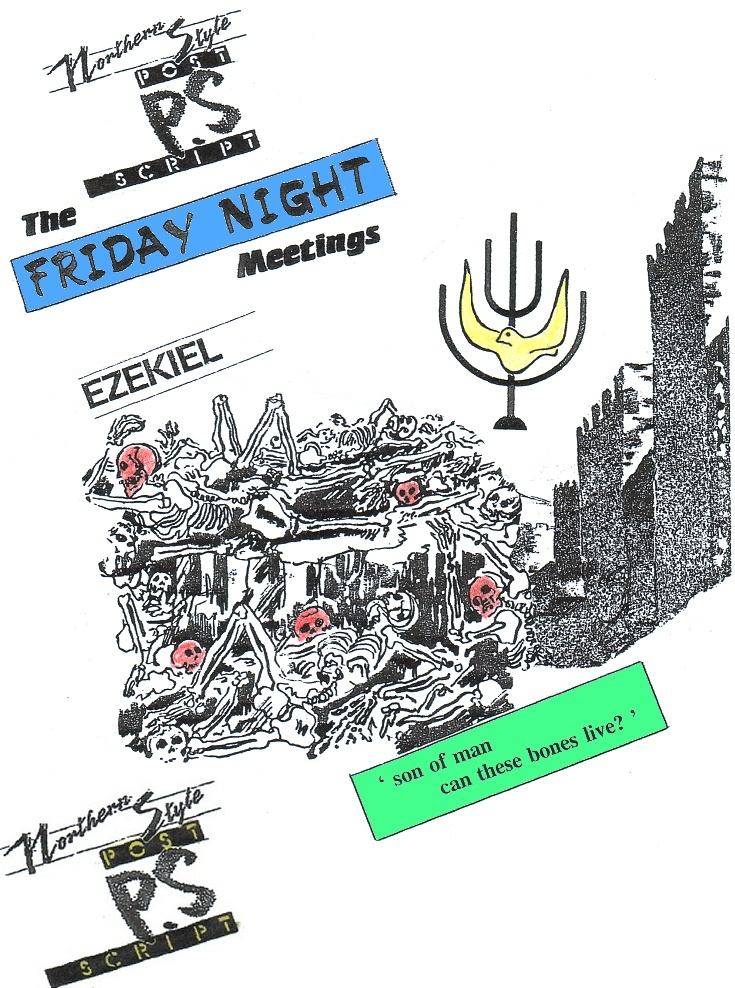
Chapter 37: This brings us to the well-known `Valley of Dry Bones', Ezekiels amazing vision of `a valley which was full of bones':
v3 " Son of man, can these bones live? And I answered, `O LORD God (and
we recall here the meaning behind the title of `God') you know ' . . .
v5 Behold I will cause breath to enter into you, and you will live. "
Clearly these chapters are referring to a future time, the Millenium Kingdom of David's Greater Son, the Messiah of Israel, for verse 11 of this chapter records:
" these bones are the whole house of Israel. " Verses 15-27 confirm this with the parable of `The Sticks', likening them to to Judah and Ephraim `and for all the house of Israel, his companions' . . . .
v24 " And David My servant shall be king over them, and they will all have
one Shepherd . . . . . "
With Chapters 38 and 39 we enter the much-disputed so-called `Ezekiel Wars', which are the subject of much talk and dispute. Both chapters record undated prophecies, and as no historical evidence has recorded such events they are for a future time. Indeed they could well be a `Double Prophecy' similar to that recorded in Chapter 28 which prophesys against the Prince of Tyre and the King of Tyre, who through the death and resurrection of Jesus `destroyed the work of the evil one' and will complete that work at the Great White Throne Judgement recorded in the Book of Revelation. Many are, and have been, the gifted scholars and theologians who have spoken opposing and convincing arguments for these wars to be set in a pre- Tribulation or a Tribulation period of time. Indeed some argue from a `Symbolic Position', denying the actual wars themselves.
We therefore find ourselves in a dilemma: The Book of Ezekiel is one complete Book, recording dated and undated prophecies set in logical order, a reasoning of events rather than a chronological order, which would enable scholars to chart timetables for the LORD God's work. The problem deepens as people argue over the naming of the nations in the confederacy of nations coming against Israel. It is further compounded by plucking chapters of Scripture out of the logical sequence of the whole Book and attempting a contemporary exergesis rather than allowing Scripture to speak for itself within the structure of the Book. On reading these chapters we clearly see that Israel has been gathered into the Land; they are at peace and dwelling as one people enjoying the fruit of the Land - as recorded in the previous chapters 35-37:
v1 " And the word of the LORD came to me, saying - and here we have the
Covenanted Name `Yahweh' - `Son of man, set your face against Gog,
the land of Magog . . . . "
These are either symbolic names for nations north and east of Israel or for the many nations with a hatred for God's people. So continuing in a logical sequence this is the climax of Satan's efforts to overturn the sovereign work of the LORD and destroy Israel as God's people in the Land of God's choice - but it results in the total destruction of `Gog' on the mountains of Israel! Clearly this massive onslaught by so many of God's enemies against Israel will precede the Millenium Kingdom and will occur before the complete Restoration of Israel, for the prophecy is undated! And yet it must remain in logical sequence with the whole Book of Ezekiel, although the historical interpretation and time must remain impossible to determine. It is for the individual to `keep watch and stay quiet'.
The remaining Chapters 40 through to 48 deal with the building of the Temple, the Restoraton of the House of God, the return of the Glory of God and the division of the Land:
Chapter 43: is perhaps the `heart' of the last nine chapters:
v6 " And I heard Him speaking to me out of the house, and the Man
v7 stood by me. And He said to me, `Son of man, (this is) the
place of My Throne and the place of the soles of My feet, where
I will dwell in the midst of the children of Israel for ever . . . "
This is not Solomon's Temple but a new Temple shown in the visions of Chapters 41 and 42. There is no Ark of the Covenant here, for the LORD Himself dwells there. Who is `the Prince' mentioned in these chapters? It has been suggested that he is a resurrected David, serving under his Lord. Scripture does not tell us so there is no need to speculate. Why are sacrifices and oblations performed in the new Temple when God Himself is there? Certainly they are different to those set out in the Mosaic Law. There is a suggestion in Chapter 44 that they are to be as a `Memorial' to the abomination of the earlier priesthood and the righteous requirements of those now in the Kingdom. Outside of unhelpful speculation we must leave these questions to be answered by the LORD Himself!
Chapter 48 concludes the Book of Ezekiel:
" And the name of the city from that day shall be Jehovah
Shamah . . . . . the LORD is there. "
~ ~ ~ ~ ~ ~ ~ ~
|
You may E-mail us at: derek@northernstyletrust.com or Telephone (01493) 444494 (UK)
Our Web Address: www.northernstyletrust.com
|


