
|
 ISRAEL AND THE CHURCH
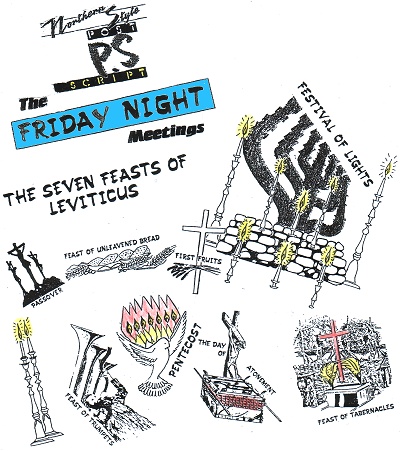
The Seven Feasts of Leviticus
We are told that the Bible is a consistently best-seller and that the book shelves of the western countries are littered with Bibles. Some are in the usual black leather . . others in white with gilded edges for Weddings . . there are special editions for Christenings and Confirmations . . `Special Moments' editions . . and there is even a Reader's Digest of all the interesting parts! Diligent men of God have earnestly translated the Bible into the most diverse and obscure languages known to men, in many cases living with primitive tribes in order to learn their languages, and from this knowledge compiling a written language so that those tribes can have a Bible of their own. But many fierce arguments between dedicated Christians over which translation is the more correct has led to divisions and accusations, causing further splits in the already broken and divided Body of Jesus Christ.
To the curious or casual reader the Bible may appear to be a collection of often uninteresting writings of long-dead men, with the occasional pleasant surprise. The stony-hearted may never open its pages, and yet the Bible will be dismissed by them with firm prejudice. For the disciples of the Lord Jesus, however, it is the Word of God, and men have been burned at the stake and put to death in the most barbaric ways in an attempt to stop the Bible being translated into the language of the common people. A nation has been called `The People of the Book', whilst others have attempted to dilute it with the writings of other men who have long-since died. It has often been described as priceless literature - `our beautiful poetry' - by people who compare it with the writings of such great men as Plato, Socrates, Shakespeare and the like. So what is it that has caused this Book to remain at the centre of mankind's life for so many thousands of years? As disciples of Jesus we believe that it is the living Word which will never pass away. It reveals the heart, love and purposes of God for all mankind, and in it we see the fulfillment of all God's purposes, which are worked out under the direction of God the Holy Spirit. It has been said that even if the Bible had stopped at the first Book of Genesis men could still find God through a thoughtful reading of it. In these notes, however, we shall move to the third Book of the Bible called Leviticus, which deals with the law of the priests, the sons of Levi. The Jews describe it in this way: `A priestly Book which sets forth the way of the priestly approach to God'. It has also been called `the Book of Holiness' and as such is usually read through quickly - or, more likely, it is read once as an obligation and then rarely looked at again!
In particular these notes, and others to follow, will draw on the Seven Holy Seasons of Israel. We believe they show the holiness that God demands of His priests - the individuals who are called to serve in the Tabernacle - which we will draw on in other studies. But the purpose of these notes is to show `the priestly approach to God' in a prophetic timescale which God's Covenanted people, the Jews, have been living out over the centuries without ever seeing the implications of their actions. God's other Covenanted people - those redeemed through the finished work of Jesus - are in a sense `brothers' of the other People of the Book, and Paul warns us in his Letter to the Romans `not to be conceited'! Our attitude should perhaps be that of one helping a brother along a road marked out by God - a brother who has become blind or badly sighted through years of journeying in hardness. He sees but dimly the road on which he walks, but he remembers the early promise of youth. We, in the fulness of the `youth' of Holy Spirit revelation, must at all times be aware that a journey along a hard road can also lead to the same blindness in us if we constantly look at the errors of other blind people. If we can but see the prophetic timescale that God has called us into - and know the promises of God for His people the Jews - this can be a journey of love, for the Word of God says: (Romans 11;26-27)
" And so all Israel will be saved, as it is written: `The Deliverer will come from Zion; He will turn godlessness away from Jacob. And this is My Covenant with them when I take away their sins'. "
It is a journey of love within a timescale known only to God. It is a parallel walk which has one ending - salvation through Jesus Christ, through Yeshua Ha Messiah. In this introduction we do not intend to write in any great depth on the Seven Holy Seasons of Israel for this will come in the following studies as we are led. Here we will set out the framework, look at the progressive outworking of these Holy Seasons and see the consistency of God's love for his chosen people as they act out (even today) the Gospel of God's love which is found in Jesus His Son alone. No explanation, other than that of the Hand of God, can be given for the blindness of His people where the Rabbis diligently study the Scriptures but fail to see the Messiah. If an academic treatise was to be prepared and presented to Gentiles no-one could refute the evidence placed before them. They might be prepared to accept the implications of the treatise, but they could not help but see the logic of it. But Paul, speaking to the Romans, says:
" Israel has experienced a hardening in part until the full number
of the Gentiles has come in. "
And the full wonder of God's promises bursts out of him in what is commonly known as `the Doxology': (Romans 11:33-36)
" Oh, the depth of the riches of the wisdom and knowledge of God! How unsearchable His judgements and His paths beyond tracing out! Who has known the mind of the Lord? Or who has been His councellor? Who has ever given to God, that God should repay him? For from Him and through Him and to Him are all things! To Him be the glory for ever. Amen! "
Leviticus 23 sets out the framework of the Seven Holy Seasons of Israel:
" The LORD said to Moses: `Speak to the Israelites and say to them: These are My appointed Feasts, the appointed Feasts of the LORD, which you are to proclaim as sacred assemblies'. "
v5 Feast of Passover
The LORD's Passover begins at twilight on the fourteenth day of the first month.
v6 Feast of Unleavened Bread
On the fifteenth day of that month the LORD's Feast of Unleavened Bread begins.
v10b Feast of First Fruits
Bring to the priest a sheaf of the first grain you harvest. He is to wave the sheaf before the LORD so that it will be accepted on your behalf; the priest is to wave it on the day after the Sabbath.
v15 Feast of Weeks (Pentecost)
From the day after the Sabbath, the day you brought the sheaf of the wave offering, count off seven full weeks. Count off fifty days up to the day after the seventh Sabbath.
v23 Feast of Trumpets
On the first day of the seventh month you are to have a day of rest, a sacred assembly commomerated with trumpet blasts.
v27 The Day of Atonement
The tenth day of the seventh month is the Day of Atonement.
v34 Feast of Tabernacles
On the fifteenth day of the seventh month the LORD's Feast of Tabernacles begins, and it lasts for seven days.
The Jews, ever a practical people, commence their calendar according to the rhythm of the harvest, and it is closely related to their religious Feasts in acknowledgement of God the Provider. Their religious year begins with the month of Nissan (Abib) and marks their deliverance from the slavery of Egypt: (Numbers 28:16)
" On the fourteenth day of the first month the LORD's Passover is to be held. "
This Feast begins the cycle of the Seven Holy Feasts of Israel, and it fits into the Roman calendar (by which we measure time) during the months of March/April. To the Jews the seventh month (called Tishri or Ethanium) is the most important for it opens up the final great Feasts of the religious cycle, ending with the joyful Feast of Tabernacles. The beginning of the seventh month is also the beginning of their civil year, coinciding with the Feast of Trumpets (which fits into our Roman calendar between September/October) and we therefore see that within the Jewish calendar God has placed His real calendar - the Seven Holy Feasts of Israel.
These Feasts are outworked within a period of seven months, and as we know that numbers play a very significant part in the prophetic Scriptures we see that even here God is showing that His purposes are to be outworked within His perfect calendar of time - seven being the number of `completion': (Genesis 2:2)
" By the seventh day God had finished the work He had been doing;
so on the seventh day He rested from all His work. "
Within these seven months of the Jewish calendar - from Nissan to Tishri - God has placed His calendar of Holy Feasts, and these are broken down into groups. Within the first month three of the great Feasts are performed. They are as follows:
The Feast of Passover
The Feast of Unleavened Bread
The Feast of First Fruits
This points to the truth that, as God had delivered His people from Egypt so in the first month He had provided new life - three being the Scriptural number for new life. Then comes a gap of two months, or to be more accurate: (Leviticus 23:15-17)_
" From the day after the Sabbath, the day you brought the sheaf of the wave-offering, count off seven full weeks. Count off fifty days up to the day after the seventh Sabbath, and then present an offering of new grain to the LORD. From wherever you live, bring two loaves made of two-tenths of an ephah of fine flour, baked with yeast, as a wave-offering to the LORD. "
This brings us to the fourth great Feast, the Feast of Weeks - we know it as Pentecost. So now we have within these three months (new life or new beginnings) four of the Holy Feasts, represented by the number `four' which points to things of the earth where the seed lies, preparing for what will come forth - a preparing and maturing - which coincides with the Grain harvest of Israel. Next comes a long gap of four months, again pointing to a further time of preparation and maturing (after a time of resting in the earth) for the final Harvest to come forth. In the seventh month we have the last three great Feasts, which are:
The Feast of Trumpets
The Day of Atonement
The Feast of Tabernacles
This completes the work of God, within His timescale but outworked in man's `calendar of time'. With the illuminating work of the Holy Spirit we can now begin to see some amazing things - a timescale within a timescale, set out as religious Feast Days, which speaks of God's purposes - and with an understanding of Scriptural numbers we can see what God is saying!
A group of four Feasts is outworked within three months from the day that God provided new life in their delivery from Egypt. There follows a further four months of preparation and maturing, after which the last and most glorious three Feasts are presented within the seventh month - the month of completion of all things - which marks the end of the harvest! Within this cycle of seven Feasts the Jews as a nation were actually `acting out' as though on a stage the purposes and the timescale of God:
Passover
The Lamb of God . . now fulfilled in Jesus.
Unleavened Bread
Bread made without yeast - and in Scripture yeast is seen as a type of sin. This bread is now fulfilled in Jesus . . the Bread of Life without the yeast of sin. In today's ceremony of the Feast of Unleavened Bread the bread must be:
1. Without yeast
2. It must have stripes on it
3.It must be pierced
What other comment needs to be made? All was totally fulfilled in Jesus who was without sin . . who was pierced for our transgressions . . and with His stripes we are healed.
First Fruits
Fulfilled in Jesus . . the First Fruits from the dead.
Feast of Weeks (Pentecost)
Fifty days! Here the numbers five (meaning grace) and ten (meaning fulness) speak of the fulness of grace when the Holy Spirit was poured out on the new believers at Pentecost within the three-month period of new life. At this Feast a second wave-offering of first fruits was made. How can there be two first fruits? Look again at the words of Leviticus: In the Feast of First Fruits the wave-offering had no yeast in the bread - pointing forward to the sinless sacrifice of Jesus, now waved before the LORD. But the first-fruit offering of Pentecost was:
" Baked with yeast as a wave-offering of first fruits to the LORD. "
The first-fruits of Pentecost were those who were raised to new life through the work of Jesus - sinful men made acceptable as a wave-offering through the resurrected life of Jesus! Pentecost was the fulness of grace . . a second wave-offering this time containing yeast was offered and the Church was born! The power of sin was broken in pieces and sinful man was at last made acceptable to God through Jesus.
Then comes a gap of four months, during which time nothing happened, a time for the earth when the seed matures in the ground . . a time of preparation for the final Harvest! Do remember that these Holy Feasts were set within the natural harvest cycle . . ploughing and planting . . sowing and reaping . . heavy rain and abundant showers . . the Autumn and Spring rains before the harvest! Through this natural cycle of life God was speaking spiritual truths to all who had ears to hear and eyes to see. But if we move too quickly to the last three Feasts, all of which are outworked in the perfect seventh month, we shall miss what the Holy Spirit was saying in this seemingly quiet period when nothing appeared to happen. Jesus referred to it: (John 4:35)
" Do you not say, `Four months, and then the harvest?' I tell you, open your eyes and look at the fields! They are ripe for harvest. "
Jesus was speaking of the `calendar of God'. There was to be a period when the Jews would hear nothing from God because of their hardness of heart. `Four months', said Jesus, a time of preparation and maturing for the earth for what would surely come. Jesus knew that the Pentecost was coming when the wave-offering of the first-fruits which contained yeast would be presented to the LORD. Jesus was saying that there were four months and then the harvest. There would come a time when the Church of God would grow to its fulness, but for the Jews there was to be a time of maturing until the perfect fulness of the seventh month - and then would come the harvest! With our eyes now opened by the Holy Spirit we are able to see, but oh how we need to read the Scriptures, both old and new, with Jewish understanding within the context of God's calendar, as seen in these Seven Holy Feasts of Israel.
We have appropriated the blessings, and rightly so, for Peter says in his first Letter:
" Once you were not a people, but now you are the people of God. "
But we also need to understand the Root from which we spring in order to understand: (Romans 11:22)
" The kindness and sterness of God; sterness to those who fell,
but kindness to you, provided that you continue in His kindness. "
In John 4 Jesus was looking beyond the cutting-off of the Jews for a time so that the wild olive branches could be grafted in. He saw the final Harvest when `all Israel will be saved'. This points us to the last three (more new life) Feasts in the seventh perfect month:
The Feast of Trumpets (Leviticus 23:23-24)
Announced by the sounding of the Shofar - the Trumpet of God, calling His people:
" On the first day of the seventh month you are to have a day of rest,
a sacred assembly commemorated with trumpet blasts. "
The Day of Atonement
The tenth day (speaking of fulness) of this seventh month (speaking of completion) is the Day of Atonement. These are the days of the Feast which Paul was speaking of in his Letter to the Romans (11:25-28):
" I do not want you to be ignorant concerning this mystery, brothers, so that you may not be conceited: Israel has experienced a hardening in part until the full number of the Gentiles has come in. And so all Israel will be saved, as it is written:
The Deliverer will come from Zion; He will turn
godlessness away from Jacob. And this is My Covenant
with them when I take away their sins. "
Five days after this Day of Atonement (the number five speaks of grace):
" On the fifteenth day (five speaks of grace and ten speaks of fullness,
the fulness of the Grace of God) of the seventh month the LORD's
Feast of Tabernacles begins, and it lasts for seven days . . . "
The whole passage speaks of God's grace . . His fulness . . His completion of all His purposes!
The Feast of Tabernacles - God dwelling with His people!
This Feast is also called `the Ingathering' - the final Harvest Jesus spoke of in John 4 - and at the end of the Feast, the seven perfect, complete days, there comes the final word in God's calendar: (Leviticus 23:36)
" For seven days present offerings made to the LORD by fire, and on
the eighth day hold a sacred assembly and present an offering made
to the LORD by fire. It is the closing assembly; do no regular work. "
Of these Seven Holy Feasts of Israel the first four have been fulfilled, and the four-month period of the maturing and preparation of the Jewish nation is almost over as the gathering of the Gentiles nears completion. We are therefore standing `on the threshold of the Messiah' - the Day of the LORD! There is coming a total fulfillment of these last great Feasts of Israel:
1 Corinthians 15:51
The mighty blast of `the last Trumpet'.
Zechariah 12:10b
The last Day of Atonement when `They will look on the One they have pierced'.
Hosea 6:11
The final Ingathering of the Harvest.
Hosea 14:9
Who is wise? He will realise these things.
Who is discerning? He will understand them.
The ways of the LORD are right; the righteous
walk in them, but the rebellious stumble in them. "
~ ~ ~ ~ ~ ~ ~ ~
The Feast of Passover
A worldly expression suggests that we live in a strange world, and nowhere is this `strangeness' seen more clearly than in the religious world of God's two Covenanted people, the Jews and the Christians. The Jews, who await the coming of the Messiah, celebrate the Feast of Passover, a time of celebration and feasting which ends on the slightly pessimistic note: `Next year in Jerusalem' - which suggests that as it didn't happen this year perhaps next year? On the other hand the Christians, who have accepted the coming of the coming of the Lamb of God, Jesus, as the full and final substitutional Sacrifice, observe Passover (or, as more generally known, Easter) with a fast of solemnity - but end it by celebrating the triumph of the Risen Lord on what is called Easter Sunday. What a strange world we live in where the understanding of God's Word and His purposes can be so completely misunderstood in its practices. The Festival of Easter is perhaps the best known of the Christian Festivals which has not been secularised in quite the same way that Christmas has been, and yet there seems to be little understanding (or even interest) in the deeper meaning of Passover - other than the central act of Jesus as the substitutionary Sacrifice for the sins of the world. And yet to the Jews and Christians alike it is one of the more important and most mentioned Feasts on the Old and New Testaments. Therefore in order to rectify this we have to understand that all of the Seven Feasts (or Seasons) of Leviticus have to be completely fulfilled in, through and around the finished work of Jesus.
The first four Feasts, beginning with Passover, have been completely fulfilled - and perhaps it is for this reason people no longer look for the deeper meanings contained within these fulfilled Levitical Feasts of Israel. But it is our belief that only as Jews and Christians alike come into full understanding of what they contain can we fully understand what revelation God has placed within them, and only then we can look forward with eager expectation to the complete fulfillment of the last three Feasts of Israel. If nothing else, it will surely lead us into a deeper burden of prayer for the many thousands of Jews who yearly live out the Gospel message in their annual Passover celebrations with the patient hope that this year will see the coming of their Messiah - the Messiah we know to be Jesus, the Lamb of God `who was slain from before the creation of the earth'.
Exodus 12 clearly speaks of two distinct Feasts . . Passover and Unleavened Bread. This is confirmed in Leviticus 23:10 where another Feast is ordained . . a Wave Offering . . `a sheaf of the first grain you harvest' . . which is known as the Feast of First Fruits. These are the first three Feasts of Israel, all to be held in the first month of the Jewish year as God commanded. However by the time of Jesus, as a result of the Levitical and Rabbinic teachings, these three Feasts had been merged into one, and the titles were often interchanged. In Luke 22:7 we read:
" Then came the Feast of Unleavened Bread on which
the Passover Lamb had to be sacrificed. "
Again in Matthew 26:17 we read:
" On the first day of the Feast of Unleavened Bread, the disciples
came to Jesus and asked, `Where do You want us to make
preparations for You to eat the Passover?' "
However, we intend to look at these Feasts as three distinct events which, although they occur in an almost simultaneous way have very important individual implications, and the blending of them into one has removed an important message which God intended His people to know! For the purpose of this study, therefore, we shall approach the Feasts in two different ways. They are:
1. The Scriptural basis.
2. The Jewish practice as it has developed through Rabbinical teaching.
The Scriptural Basis
No words of ours can improve on this record found in Exodus 12:1-3:
" The LORD said to Moses and Aaron in Egypt, `This month is to be for you the first month, the first month of your year. Tell the whole community of Israel that on the tenth day of this month each man is to take a lamb for his family, one for each household'. "
Although God was dealing with `the whole community', we are reminded that a community, a nation or a tribe, is made up of individual people, and the only way to become a member of this particular community that God was going to take for Himself was for `each man to take a lamb for his family' before they could be called into a nation. God was pointing out that first of all there must be an individual response to His Word: (Exodus 12:6-7-11)
v6 " Take care of them (the lambs) until the fourteenth day of the month
when all the people of the community of Israel must slaughter them
at twilight. "
During the time of preparation the lambs were to be inspected and tested to ensure that they were without spot or blemish - indeed perfect lambs!
v7 " Then they are to take some of the blood and put it on the sides and
tops of the door-frames of the houses where they eat the lambs. "
We know that the blood of the sacrificed lambs was to be the Israelites protection as the LORD passed over the land killing all the first-born of men and animals, but it is also important to remember that although the sacrificial lamb was killed, the blood of the lamb had to be applied to each household. No doubt many Egyptians knew that the Israelites were selecting lambs - and no doubt some Egyptians asked them why they were doing it - but unless the blood was applied their curiosity was to no avail when the LORD passed over the land. The Israelites were also told to roast the meat of the sacrifice over a fire, together with bitter herbs and bread baked without leaven (unleavened bread). The whole lamb must be eaten, and if anything was left over it must be burned:
v11 " This is how you are to eat it, with your cloak tucked into your belt,
your sandals on your feet and your staff in your hand. Eat it in haste;
It is the LORD's Passover. "
We next come across the Passover in Leviticus 23:1-2:
" The LORD said to Moses, `Speak to the Israelites and say to them:
These are My appointed Feasts, the appointed Feasts of the LORD,
which you are to proclaim as sacred assemblies'. "
And once again in Numbers 9:3:
" Celebrate it at the appointed time, at twilight on the fourteenth
day of this month, in accordance with all its rules and regulations. "
Something had happened between the recording of the Passover in Exodus 12 and the recordings in Leviticus and Numbers. The whole nation had now been delivered from slavery in Egypt . . they had passed through the Red Sea and had been set free . . the first-born who had been delivered from death were to be given to the LORD. Later they were redeemed with silver and then replaced by the tribe of Levi as priests to serve God on behalf of each family. And so a nation had been born out of individual slaves - order and authority, commands and decrees were being given to the nation (all the tribes who had been brought into being by God). We can now move on to the Book of Deuteronomy in order to see what God had told them through Moses: (Deuteronomy 12:1-17 in part)
" These are the decrees and laws you must be careful to follow in the land that the LORD, the God of your fathers, has given you to possess . . . . You must not worship the LORD your God in their way (the heathen nations around them) but you are to seek the place the LORD your God will choose from among all your tribes to put His Name there for His dwelling . . . . to that place you must go; there bring your burnt offerings and sacrifices, your tithes and special gifts, what you have vowed to give and your freewill offerings, and the first-born of your flocks and herds. There, in the presence of the LORD your God, you and your families shall eat and rejoice in everything you have put your hand to, because the LORD your God has blessed you . . . . you are not to do as we do here today, everyone as he sees fit, since you have not yet reached the resting place and the inheritance the LORD your God is giving you . . . . But you will cross the Jordan and settle in the land the LORD your God is giving you as an inheritance, and He will give you rest from all your enemies around you so that you will live in safety. Then to the place the LORD your God will choose as a dwelling for his Name - there you are to bring everything I command you . . . . Be careful not to sacrifice your burnt offerings anywhere you please. Offer them only at the place the LORD will choose in one of your tribes, and then observe everything I command you . . . . You must not eat in your own towns the tithe of your grain and new wine and oil, or the first-born of your herds and flocks, or whatever you have vowed to give, or your free-will offerings and special gifts. Instead, you are to eat them in the presence of the LORD your God at the place the LORD your God will choose - you, your sons and daughters, your menservants and maidservants, and the Levites from your towns . . . . "
We can therefore clearly see that certain instructions given in Exodus 12 were for one occasion only - for their delivery out of Egypt. One lamb was to be killed and roasted and eaten by each family (the blood applied over the individual family doors) and they were to eat it fully dressed and standing up, ready to move on. God would take these individuals out of a land and build them into a nation in the land He was going to give them, and with the laws and decrees of Leviticus and Numbers He commanded them to keep the Passover Feast in the new way in the place that He would choose. With the building of the Tabernacle God then showed the people the place He had chosen for the sacrifices to be made. But this too was a temporary place, and after the disobedience of the nation - which led to the death of many in the desert - Joshua finally led the nation into the Promised Land: (Joshua 5:9-12)
" Then the LORD said to Joshua: `Today I have rolled away the reproach of Egypt from you'. So that place has been called Gilgal to this day . . . . On the evening of the fourteenth day of the month, while camped at Gilgal on the plains of Jericho, the Israelites celebrated the Passover. The day after the Passover, that very day, they ate some of the produce of the land, unleavened bread and roasted grain. The manna stopped the day after they ate this food from the land; there was no longer any manna for the Israelites, but that year they ate the produce of Canaan. "
Once we are in the Land of Promise we can eat of the fulness of the land that God has given us. The people had arrived in the land but there was still a journey to be made until they found the place where God would choose to place His Name . . the place where He would require them to make their sacrifices . . Jerusalem, the City of Righteousness and Peace! There Solomon's Temple would be built! There the sacrifices would be made! There the full flowering of the nation would be seen! There the nations of the world would come! There the Queen of Sheba would come to marvel . . and yet we read:
(2 Chronicles 35 verses 1 and 18)
" King Josiah celebrated the Passover to the LORD in Jerusalem, and the Passover lamb was slaughtered on the fourteenth day of the first month . . . . The Passover had not been observed like this in Israel since the days of the prophet Samuel; and none of the kings of Israel had celebrated such a Passover as did Josiah with the priests and Levites. "
At the pinnacle of Israel's power - in the days of the glory of Solomon's Temple - apostacy was already creeping in without them realising it. Perhaps bedazzled by so much power and wealth the people had begun to forget that it was the LORD God who had brought them out of Egypt! The Feast of Passover was introduced to remind them of what God had done, and for those who had eyes to see and ears to hear God was showing what He was going to do to redeem His people with His Sacrificial Lamb, the Messiah, whom we know as the Lord Jesus. This is the Scriptural basis for the Feast of Passover, and now we will look at:
The Jewish Practice of Passover
As we have seen, the Feast of Passover developed as God commanded, and it took the form of a Passover meal for the family at twilight on the fourteenth day of the first month, with various symbolic meanings performed and narrated during the meal. This became a combining of the Feast of Passover and the following Feast of Unleavened Bread. The Passover sacrifice was also made at the Temple on the fourteenth day. According to Jewish practice a day commences at evening (twilight) of one day until sundown (twilight) the following day. This, according to Levitical Law - and later Rabbinic Law - came through their understanding of Genesis 1:5:
" And there was evening and there was morning - the first day. "
For thousands of years this Passover meal has not basically changed for the Jewish people hold tenaciously to their traditions, although some items on the Seder (which simply means `order') Table have taken on symbolic menaings. For instance, instead of roast lamb for the main course a symbolic roasted lamb's shank (leg bone) is placed on the table because with the destruction of the Temple it is not possible for sacrifices to be made. In the same way the Matzah (unleavened bread) reveals its meaning in a most remarkable way - as we shall see - and in the light of the knowledge of Jesus the Messiah, all the items on the Seder Table almost `scream' out their message.
By the tenth day of the first month Jerusalem was bursting at its seams as tens of thousands of Jews gathered in accordance with God's command to celebrate the Passover in the place which He had chosen, and this year was to be like any other year! On the tenth day, according to the Law, the sacrificial lambs to be used in the Passover sacrifices in the Temple were set aside for four days to be tested to see if they were without spot or blemish, and it was on this day that Jesus rode into Jerusalem on a donkey: (Matthew 21:8)
" A very large crowd spread their cloaks on the road, while others cut branches from the trees and spread them on the road. The crowds that went ahead of Him, and those that followed, shouted:
Hosanna to the Son of David!
Blessed is He who comes in
the Name of the LORD!
Hosanna in the highest.
When Jesus entered Jerusalem the whole city was stirred . . . . "
Understand what had happened. Jesus, the Sacrificial Lamb of God, was set aside on the tenth day when He entered Jerusalem! The crowds shouted `Hosanna . . save us', and they cut down palm branches and spread them in His path! The priests and the Pharisees knew very well what this meant for palm branches were cut and `Hosanna' was shouted at the Feast of Tabernacles (which would take place seven months later). The crowds were shouting `God is with us! God is in the midst of us! Hosanna! Save us!' - and this was blasphemy to the priests! The people, under the direction of the Holy Spirit, looked beyond the Passover to Tabernacles! They thought that the Kingdom of God was about to be restored; God is to dwell amongst us! (Remember this when you take your palm crosses next `Palm Sunday' and what it signified to the Jews.) The Lamb of God had entered Jerusalem and had been set aside for sacrifice, and for four days He was tested to see if He could be caught out. Read again the Gospel accounts with this in mind, and see the wave upon wave of attacks made on Him by the Pharisees, the Sadducees, the Scribes and the Herodians - all of whom were trying to catch Him out in an attempt to show Him as false and unworthy. But He passed the test and went to the Passover meal, the Seder, with His disciples - a pure and spotless Lamb for sacrifice. This Seder or Passover meal is mentioned in Matthew 26:17:
" On the first day of Unleavened Bread the discipls came to Jesus and asked: `Where do You want us to make preparations for You to eat the Passover? "
The Seder meal of Passover would centre around the reading of the Haggadah (which simply means ` the narration'). This gives the simple explanation that this was to be the narration of God's mighty deliverance of His people. The Seder people would have upon it:
2 candle holders and candles
A wine cup and a cup for Elijah
The unleavened bread (Matzah)
Salt water
A bowl and a towel for washing hands
Bitter herbs (today it would probably be parsley or celery instead of hyssop)
Horse radish
Charoset (a clay-like mixture made from apples and other ingredients)
Today there would also be a Seder dish on which there would be, in addition to what we have already mentioned, a lamb's shank and a roasted egg. Although the meal is conducted with a sense of great joy and festivity, it is nevertheless a meal full of symbolism and rich ritual. The Seder meal is conducted by the male head of the family, or in the case of a community a Rabbi, and he would be dressed in a white ceremonial robe and wearing a mitre on his head.
We can therefore see why the disciples asked Jesus where He wanted to eat the Passover meal. They were submitting to His authority to conduct the Seder as their leader, and when He removed His robes to wash their feet (John 13) it would have been these special robes of authority which He removed. Now we can understand Peter's indignation: (John 13:4-8)
" So He got up from the meal, took off His outer clothing and wrapped a towel around His waist. After that He poured water into a basin and began to wash His disciples' feet, drying them with the towel that was wrapped around Him. He came to Simon Peter, who said to Him, `Lord, are You going to wash my feet?' . . . . `No', said Peter, `you shall never wash my feet'. "
It was customary after dipping their hands into a bowl of water during a ceremonial point in the Seder meal for a woman to step forward to dry their hands - and in the absence of a woman it was the duty of a slave! Peter, orthodox Jew that he was, knew the ceremony, and he had waited for someone to step forward to dry the hands of Jesus. Instead, Jesus demonstrated a deeper truth than ceremony could ever convey: He got up from the table, removed His special robes of authority and knelt - not merely to dry their hands but to wash and dry their feet also - which was the lowliest position of humility. Peter, with great indignation, corrected Jesus for interupting the Seder ceremony, and was taught the greater lesson of the Passover - the lesson of `the Suffering Servant' who came to serve others!
The meal was for the whole family - no-one was to be excluded - and it followed a strictly prescribed form set out in the Haggadah, the narration, which in its present form was introduced in the 7th to 8th century. In the time of Jesus most probably a Levite would have led the Seder meal, for it was a time of instruction and teaching, but today the head of the family puts on the robe of authority and teaches his family as a substitutionary priest under authrority. The meal commences with the lighting of two candles by a woman. Rabbinical tradition has it that, as Eve allowed darkness into the world so a woman will bring light back into the world. No words of explanation needed here! The meal revolves around several groups of four events. They are:
Four cups of wine
Discussions with four symbolic sons
Four questions and answers
Four special foods
The first cup of wine is blessed, which is called the Cup of Blessing. This is followed by the washing of the hands in a basin and the eating of bitter herbs in salt water. All the cups of wine are drunk and the symbolic foods are eaten in a reclining position to the left - apart from the bitter herbs dipped into the Charoset. Again, tradition says that all slaves should eat sitting or standing upright whilst free men eat reclining, and so for these symbolic events they too eat reclining because the LORD God has delivered them from bondage. However not all of the meal is eaten in a reclining position, only the certain parts which have deep symbolic meaning. Eating bitter herbs is to remind the Jews of the bitter tears shed in captivity. Dipping the herbs into the Charoset (a clay-like substance with the basic ingredient of apples) is to remind them of their days of slavery when they made bricks for Pharoah - the apples symbolising their fertility, which enables them to continue bearing children until their day of redemption.
There now comes an incredible mystery. The pieces of unleavened bread (the Matzah) are on the table in a special cloth made up of three compartments. The middle Matzah is removed and broken in two, one half being carefully wrapped in a cloth and hidden away for a later `discovery'. The remaining half is then broken, shared out and eaten. Rabbinical teaching has no explanation as to how this form of eating the unleavened bread was introduced into the Seder meal. All they stipulate is that the bread must be unleavened - there must be no yeast in it for in Scriptural language `yeast' signifys sin. The unleavened bread must be striped with cuts made in it, and here on the Seder Table it is placed in three separate compartments of the napkin. At this point in the meal only the middle Matzah is taken out and broken in two, with one half wrapped in a cloth and hidden away. The wrapped up broken piece of bread, known as the Afikoman (a Greek word meaning `a broken piece of bread) would appear later in the Seder meal. Now comes the blessing of the second cup of wine - the Cup of Deliverance - and the Seder continues with four questions to the children, a series of four questions and answers, and then the Passover story is told. But when they come to the recounting of the ten plagues, at the name of each plague a drop of wine is spilled in remembrance of what they were delivered from through the blood of the slain lamb!
The main Seder meal is now served and eaten with joy. This leads to the blessing of the third cup, which is called the Cup of Redemption! Jesus spoke of this in the Gospel of Luke:
" In the same way, after supper He took the cup, saying:
This cup is the New Covenant in My Blood,
which is poured out for you'. " (Luke 22:20)
This is followed by a search for, and the discovery of, the Afikoman - the broken piece of bread which was hidden away for a time. It is taken and broken and eaten by all present. Tradition has it that at the original Seder meal the last part of the meal should be the Passover lamb (now represented by a roasted lamb's shank) and this has been replaced (without any explanation) by the eating of the `rediscovered' Afikoman, the broken piece of bread, and the drinking of the Cup of Redemption. Jesus said: `This is My Body; this is My Blood' - and at every Passover meal this is enacted by the Jewish people everywhere! Surely the time must soon come when they at last `rediscover' the Broken Bread of Life and know the redeeming Blood of the Passover Lamb, Jesus.
The fourth cup is blessed. This is called the Cup of Praise, and the remainder of the Hallel is sung (Psalms 115-118). On the table there also stands Elijah's Cup, but never drunk from - a place is laid, but with no guest to fill it - and so the Seder meal ends on a note of pessimism. Then comes the drinking of the fourth cup and the words:
" Next year in Jerusalem. "
So why is there pessimism? Well, the Messiah didn't come this time, did He? Elijah didn't appear either, for he is the one who will usher in the Messiah! Next year? Perhaps! Next year in Jerusalem? We read this in Matthew 26:30:
" When they had sung a hymn (the Hallel)
they went out to the Mount of Olives. "
The Seder was over! Now would come the sacrifice of the Passover Lamb. The next morning at 9 am - just when the priests slaughtered the first lamb in the Temple - at that same time outside the city gates, on a lonely hill, the soldiers knocked the last nail into place and raised up the Unleavened Bread of Life . . which was striped and bleeding . . pierced and wounded . . and they dropped the cross with the Passover Lamb nailed to it into the socket with a body-sickening jolt!
Passover was now completely fulfilled - in Jesus!
~ ~ ~ ~ ~ ~ ~ ~
The Feast of Unleavened Bread
As we move into this study on the second of the fulfilled Feasts of Leviticus we need to remember that this second Feast has generally become merged with the Feast of Passover, to the extent that its full meaning has been lost. In separating it back into a distinct Feast we shall attempt to rectify this and show that, in the merging a very important truth (and the application of that truth) has been lost to many Christians - with serious consequences. Many Christians are unconcerned with these Levitical Feasts and view them as inconsequential, particularly as we know they have been fulfilled in Jesus. We maintain, however, that without an understanding of what has already happened it becomes almost impossible to understand what will happen. The Old Testament is fulfilled in the New Testament, and without the old we would have no plumb-line with which to gauge the new. So it is with the Feasts of Leviticus: They show a consistent pattern of events that have been and will be completely completely fulfilled, because of what Jesus accomplished through His death and resurrection. God has placed within the Seven Feasts of Leviticus a time-scale which we need to give heed to - if we are to understand the purpose of God in our time.
The Book of Leviticus records: (Leviticus 23:6-8)
" On the fifteenth day of the month, the LORD's Feast of Unleavened Bread begins; for seven days you must eat bread made without yeast. On the first day hold a sacred assembly and do no regular work. For seven days present an offering made to the LORD with fire. And on the seventh day hold a sacred assembly and do no regular work. "
Here is the Scriptural basis for the Feast of Unleavened Bread. To understand its meaning we have to remember that it is closely associated with the Feast of Passover - it occurs the following day - and only with an understanding of that first Feast can we begin to see the significance of what follows in the second Feast. This is not just academic knowledge; it is of vital importance as we seek to apply in our daily lives what Jesus has accomplished for us. If we believe and apply it there will be nothing passive in our lives in Christ Jesus! It is a walk . . a journey . . into the land of inheritance which God has brought us to, but we have to journey into the fulness of what He has done. We saw this in the last study in Deuteronomy chapter 12 verse 5:
" But you are to seek the place the LORD your God will choose from among
all your tribes to put His Name there for His dwelling. "
This suggestion of a journey is shown also in Hebrews 4:9-11:
" There remains, then, a Sabbath rest for the people of God . . . . Let us,
therefore, make every effort to enter that rest, so that no-one will fall
by following their example of disobedience. "
The merging or blending of these two Feasts developed during the period of the second Temple, which is why we read in such Gospel passages as Luke 22:7:
" Then came the day of Unleavened Bread on which the Passover
Lamb had to be sacrificed. "
As was usual amongst the Jews, once the Rabbis got hold of God's Word they began to argue over the finer points, and in doing so they completely missed the purpose for which the Scripture was meant. But before we begin to critisise the Jews we would do well to remember that there are also Christian `Rabbis' with us today. Let us be careful not to do the same. Behind all divisive arguments there lies the one who seeks to distort God's Word for his own ends. The Bible calls him the Destroyer, the Accuser, the Prince of this world, and he will always seek to distort and confuse God's Word in order to draw our attention away from the truth. Later on we shall see why it was so important for Satan to merge these Feasts so that the message would be hidden. We shall see the development of this Feast just as we earlier saw the development of the Passover Feast. The first recording of this Feast is Exodus 12:17:
" Celebrate the Feast of Unleavened Bread, because it was on this very day that I brought your divisions out of Egypt. Celebrate this day as a lasting ordinance for the generations to come. "
An elementary knowledge of Hebrew is required here to stop us from getting into legalism. As we have said, all Old Testament principles need to be balanced with the New Testament as having been fulfilled in Jesus, without disturbing and therefore destroying the essential truth of the Old Testament. We need to understand and apply the whole Word of God. In the classical Hebrew language, they had no concept of eternity. When we read the English word `everlasting' our Greek-biased minds think of `eternity' as everlasting, whereas the Hebrew mind would think of `an age' or `a period'. For instance, the Hebrews would talk of David's reign as lasting for ever, pointing forward to the Seed of David's Throne lasting for eternity (for ever). But for the Hebrews eternity could only be expressed in such terms as `without end' or `no beginning and no end'. This may help you with certain passages of Scripture which you will come across from time to time, and each must be taken in its context.
In the context of the Feast of Unleavened Bread the passage in Exodus 12, which says: `Celebrate this day as a lasting ordinance' (v17), points to a period (an age . . for a number of generations). The problem was that the Jews did not understand that when Jesus came (in that particular passage) a new age . . a new generation . . was bringing to an end the old age . . the old generation. Perhaps they, like us, were too busy arguing over finer points of `Church Doctrine' instead of fixing our eyes on the Creator of Church Doctrine and seeing everything as within His will and purpose. In Exodus 12 we read: (v18-19)
" You are to eat bread without yeast . . . . For seven days no yeast is to
be found in your houses. And whoever eats anything with yeast in it must
be cut off from the community of Israel. "
This Feast was of such importance that anyone found eating bread with yeast in it was to be cut off (that is, killed) from the community of Israel! We shall see the spiritual implications of this later on. In Numbers 28:17-25 we see the development of this Feast. It has now developed from the household of the family to the Tabernacle (and later, the Temple) of the LORD. In verse 19 an additional requirement is recorded: (v19 and 22)
" Present to the LORD an offering made by fire, a burnt offering of two
young bulls . . . . Include one male goat as a sin offering to make
atonement for you. "
If you read the complete passage you will see that now, as well as eating only unleavened bread, a sin offering was required in addition to the regular offerings. Now we are beginning to see the basis for this Feast: Passover was celebrated whilst the Jews were in captivity . . the blood of the lamb applied to the tops and sides of the door-frames of each individual family home saved them from death as the LORD passed over the land! The Feast of Unleavened Bread celebrated the actual exodus from the land - this was the day they walked free. The unleavened bread was called the Bread of Affliction: (Deuteronomy 16:3)
" . . . because you left Egypt in haste - so that all the days of your life
you may remember the time of your departure from Egypt. "
Many people may well ponder the mystery of the Passover - our Pascal Lamb, Jesus, who died for the sins of the world - but how many will eat the Unleavened Bread of Affliction as they walk in haste out of `Egypt'? You will remember in the study of the Feast of Passover we saw that the bread used in the Seder meal must be unleavened - no yeast at all in it - pointing to the sinless Bread of Life!
It also had to be striped - cuts were made in it: (John 19:1)
"Then Pilate took Jesus and had Him flogged . . "
It also had to be pierced: (John 19:33-34)
" But when they came tp Jesus and found that He was alredy dead, they
did not break His legs. Instead, one of the soldiers pierced Jesus'
side with a spear. "
And in Isaiah 53:5 we read:
" But He was pierced for our transgressions, He was crushed for our
iniquities, the punishment that brought us peace was upon Him, and
by His wounds we have been healed. "
From all this we are beginning to understand the meaning of the Feast of Unleavened Bread - the Bread of Affliction - pointing forward to Jesus. For this we move on to the Book of Hebrews: (9:11-28 and 10:1-18)
" When Christ came as High Priest of the good things that are already here, He went through the greater and more perfect Tabernacle that is not man-made, that is to say, not a part of this creation. He did not enter by means of the blood of goats and calves; but He entered the Most Holy Place once for all by His own Blood, having obtained eternal redemption. The blood of goats and bulls and the ashes of a heifer sprinkled on those who are ceremonially unclean sanctify them so that they are outwardly clean. How much more, then, will the Blood of Christ, who through the Eternal Spirit offered Himself unblemished to God, cleanse our consciences from acts that lead to death, so that we may serve the living God. For this reason Christ is the mediator of a New Covenant, that those who are called may receive the promised eternal inheritance - now that He has died as a ransome to set them free from the sins committed under the first Covenant.
In the case of a will, it is necessary to prove the death of the one who has made it, because a will is in force only when someone has died, it never takes effect while the one who made it is living. This is why even the first Covenant was not put into effect without blood. When Moses had proclaimed every commandment of the Law to all people, he took the blood of calves, together with water, scarlet wool and branches of hyysop, and sprinkled the scroll and all the people. He said:
" This is the blood of the Covenant,
which God has commanded you to keep. "
In the same way he sprinkled with the blood both the Tabernacle and everything used in its ceremonies. In fact, the Law requires that nearly everything be cleansed with blood, and without the shedding of blood there is no forgiveness.
It was necessary, then, for the copies of the heavenly things to be purified with these sacrifices, but the heavenly things themselves with better sacrifices than these. For Christ did not enter a man-made sanctuary that was only a copy of the true one; He entered heaven itself, now to appear for us in God's presence. Nor did He enter heaven to offer Himself again and again, the way the high priest enters the Most Holy Place every year with the blood that is not his own. Then Christ would have had to suffer many times since the creation of the world. But now He has appeared once for all at the end of the ages to do away with sin by the sacrifice of Himself. Just as a man is destined to die once, and after that to face judgement, so Christ was sacrificed once to take away the sins of many people; and He will appear a second time, not to bear sin, but to bring salvation to those who are waiting for Him.
The Law is only a shadow of the good things that are coming - not the realities themselves. For this reason it can never, by the same sacrifices repeated endlessly year after year, make perfect those who draw near to worship. If it could, would they not have stopped being offered? For the worshippers would have been cleansed once for all, and would no longer have felt guilty for their sins. But those sacrifices are an annual reminder of sins, because it is impossible for the blood of bulls and goats to take away sins. Therefore, when Christ came into the world, He said:
" Sacrifice and offering You did not desire, but a body You prepared for
Me; with burnt offerings and sin offerings You were not pleased. Then
I said: `Here I am, it is written about Me in the scroll. I have come
to do Your will, O God'. "
First He said, `Sacrifices and offerings, burnt offerings and sin offerings You did not desire, nor were You pleased with them' (although the Law required them to be made). Then He said, `Here I am, I have come to do Your will'. He sets aside the first to establish the second. And by that will, we have been made holy through the sacrifice of the body of Jesus Christ once for all. Day after day every priest stands and performs his religious duties; again and again he offers the same sacrifices, which can never take away sins. But when this Priest had offered for all time one sacrifice for sins, He sat down at the right hand of God. Since that time He waits for His enemies to be made His footstool, because by one sacrifice He has made perfect for ever those who are being made holy. The Holy Spirit also testifies to us about this. First He says:
` This is the Covenant I will make with them after that time, says the LORD.
I will put My laws in their hearts, and I will write them on their minds'.
Then He adds:
` Their sins and lawless acts I will remember no more'.
and where these have been forgiven there is no longer any sacrifice for sin. "
Within the context of the Feasts of Passover and Unleavened Bread we can now just see what Jesus has accomplished. Hebrews 9:23 tells us that, just as the copies of the heavenly things had to be purified, so too the heavenly things also had to be purified. How were they purified? By the sprinkling of the Blood in the Tabernacle everything in it was cleansed! The sacrifice by itself was not complete until the Blood of the Sacrifice was used to purify it! The Feast of Unleavened Bread pointed forward to the time when Jesus would eat the Bread of Affliction for us, and after offering Himself as the final Sacfirice without sin, He would take His Blood and sprinkle it on the Heavenly Tabernacle to purify it - the Heavenly Sacrifice was not complete until the Blood was applied to the Heavenly tabernacle!
It may be difficult to accept that the Heavenly Tabernacle needed purifyiny. How could this be? We know that Satan himself enters into the presence of God to accuse the Jews: `. . and Satan standing at his right hand to accuse him' (Zechariah 3:1b). But he also enters God's presence to accuse Christians: (Rev:12:10b)
" . . . . for the accuser of our brothers, who accuses them
before our God day and night . . . . "
But we also know that Satan has been overcome: (Rev: 12:11)
" They overcame him by the Blood of the Lamb, and by the
word of their testimony. "
The Accuser's words are empty words because the Blood has been taken by the Sacrifice and He has purified the Heavenly Temple in complete fulfillment of the Feast of Unleavened Bread! But how did sin occur in the Heavenly Tabernacle so that it required purifying? For this we must look in the Book of Ezekiel to see the rebellion which caused sin to appear in the Heavenly Tabernacle: (Ezekiel 28:12-17)
" You were the model of perfection, full of wisdom and perfect in beauty . . . . You were anointed as a guardian cherub, for so I ordained you. You were on the Holy Mount of God; you walked among the fiery stones. You were blameless in your ways from the day you were created until wickedness was found in you . . . . So I drove you in disgrace from the Mount of God . . . . "
The consequence of the rebellion of this mighty covering cherub - the highest of God's created beings, who was created to be the covering cherub of the Holiness of God - tainted the Heavenly Tabrenacle, just as his whispering lies caused God's creations on this earth to sin - which left countless generations of people with the stain of sin.
For an age God provided through the nation of Israel a temporary covering for sin - through its Tabernacle and Temple, its Feasts and sacrifices. But these always pointed forward to the one perfect Sacrifice Who would enter the heavenly Holy of Holies and sprinkle His Blood to purify for all time all who would accept His sacrifice and His poured out Blood. He applied His Blood in the Hevaenly Tabernacle for those who died in faith before He came to earth, and for those who would believe in Him after He had come so that together we might all receive the forgiveness that He alone achieved for eternity for all who believe. And those who are now in Christ Jesus on this earth are still called to keep this Feast of Unleavened Bread - but now in `a new and living way'. Paul the apostle talks of it in 1 Corinthians 5:7-8 when speaking of immorality in the Church. He writes:
" Get rid of the old yeast that you may be a new batch without yeast - as you really are. For Christ, our Passover Lamb has been sacrificed. Therefore, let us keep the Festival, not with the old yeast, the yeast of malice and wickedness, but with the bread of sincerity and truth. "
As these words apply to the Church read for yourselves how the Church, as a `nation', should apply this Feast. As for the individual believer, we see that the old yeast of malice and wickedness is the yeast of rebellion - which made us `objects of wrath' before we came to accept Jesus as Lord and Saviour. Paul is saying: `Don't keep the Feast by putting away that old yeast. That has gone, because of your acceptance of Jesus . . . if He truly is your Passover Lamb. Keep the Feast daily in your lives by eating the bread of sincerity and truth'. So a new understanding and application of the Feast is required for us because Jesus kept the Feast completely. He purged out the old leaven, even from the Heavenly Tabernacle, so that all may enter in. Is that our problem? Have we looked at the Passover sacrifice from a distance and never accepted purification by the Blood? These two Feasts, although separate, can only be made real when both are merged into one - and that One is Christ Jesus . . . His broken Body of Sacrifice . . . His Blood shed, and applied through faith by Grace in these finished Feasts of Passover and Unleavened Bread!
~ ~ ~ ~ ~ ~ ~ ~
The Feast of First Fruits
Now we come to the Feast of First Fruits, the last of the first three Feasts of Leviticus. This is not to infer that this Feast is of less importance, for God in His wisdom commanded the Israelites to keep certain Feasts in a strict order so that, as they were obedient, He would begin to show them that these were but a pattern of better things to come. There would be some who would begin to be bored with the endless sacrifices . . . there would be others who would begin to question the waste of good animals . . . but, as always, God places within a remnant of his people the desire to look beyond the immediate and ask the question: `If God has commanded this, then we will do it. We know that the blood of goats and bulls cannot do what it is supposed to do. However, if God says, `Do it', then we must obey Him'. For those righteous Old Testament saints who died in faith the answer has now come . . . Jesus, the Pascal Lamb, the substitute Sacrifice for all men, His Blood sprinkled in the heavenly Tabernacle so that all can draw near to God! Their reward is in heaven . . . our reward, although legally established by the finished work of Jesus, awaits a time soon to come - our sure and certain hope.
As we have seen, when the number `three' is used in Scripture it points to new life, a new beginning. This can now be seen in the first three fulfilled Feasts of Leviticus, which are all within the first month. The Jews were commanded to observe them in strict obedience, beginning on the tenth day - ten signifying that the fulness of time had come. The first sacrifice must take place on the fourteenth day - speaking of God's perfection, seven days plus seven days. The second Feast lasted for seven days - again speaking of God's finished work. But within these two Feasts there was this unusual third Feast of First Fruits, the timing of which gave the argumentive Pharisees, Sadducees and Rabbis endless opportunities to conduct their unique style of debate. Finally Rabbi Zakki said quite simply:
" Fools, is not one perfect truth to be preferred to your idle chatter. "
Why the argument? Perhaps God was intending to `confound the wise'. But we, now with unveiled eyes, can clearly see the purpose of God which was set out in these Feasts!
We shall not find this Feast of First Fruits named as such in Leviticus 23, and it is not mentioned in Exodus 12, where God commanded the first two Feasts to be kept. We see the reason for this in Leviticus 23:10:
" Speak to the Israelites and say to them:
When you enter the land I am going to give you . . . "
This passage goes on to instruct the Israelites to bring to a priest a sheaf of the first grain of the harvest. However the passage of Scripture in Numbers does give it a name: (28:26)
" On the day of First Fruits, when you present to the LORD an offering of new grain . . "
Clearly, then, we can legitimately use the title `Feast of First Fruits' when considering its implication within the framework of the Seven Feasts of Leviticus. But, as we have already said in the introduction to this study, this Feast of First Fruits has been the source of continuous argument and discussion,and we will spend some time considering this for there are precious truths to be brought out.
The argument between the Pharisees, Sadducees and Rabbis centered around the question of when this Feast should be held. We find recorded in Leviticus 23:9-14 the following words:
" The LORD said to Moses: Speak to the Israelites and say to them: `When you enter the land I am going to give you and you reap its harvest, bring to the priest a sheaf of the first grain you harvest. He is to wave the sheaf before the LORD so that it will be accepted on your behalf; the priest is to wave it on the day after the Sabbath. On the day you wave the sheaf, you must sacrifice as a burnt offering to the LORD a lamb a year old without defect, together with its grain offering of 4.5 litres of fine flour mixed with oil - an offering made to the LORD by fire, a pleasing aroma - and its drink offering of 1 litre of wine. You must not eat any bread, or roasted or new grain, until the very day you bring this offering to your God. This is to be a lasting ordinance for the generations to come . . . . "
In this passage the Feast of First Fruits is clearly linked to the first two Feasts of Passover and Unleavened Bread: `The priest is to wave it on the day after the Sabbath'. But in the Book of Numbers it is recorded: (Numbers 28:26)
" On the day of First Fruits, when you present to the LORD an offering
of new grain during the Feast of Weeks . . . . (we call this Pentecost). "
Clearly here in this Scripture the Feast of First Fruits is linked with the Feasts of Unleavened Bread and Pentecost, even though they are months apart - and we shall see this `link' in the next study. This, together with the arguments which arose over the actual date on which to conduct this Feast, tells us that there is something of God in it! It was not a `mans day', even though they were instructed to keep it, `as a lasting ordinance for the generations to come'. Clearly this Feast does not fall between the other two, neither were the Israelites commanded to hold it at the end of the Feast of Unleavened Bread. The date was announced as `the day after the Sabbath', and it is around this particular point of `which Sabbath' that the controversy has raged. It was either a special Feast to be observed or it was to be overlaid on the two Feasts of Passover and Unleavened Bread. (In other words, whilst these two Feasts were being observed another Feast was also to be observed, which was totally of God and for His purposes!) You will recall that at this time the Jews were almost acting out the Gospel message for a time yet to come, and if we look at the traditions they observed during this time we shall surely see that even these traditions were under the direction of the Holy Spirit. But the Pharisees, Sadducees and Rabbis were so busy arguing over the exact detail of dates that they failed to see what God was pointing to!
Up until the destruction of the Temple in the year 70 AD the tradition which was followed for this Feast of First Fruits was this: On the fourteenth day of Nisan (the Passover) an authorised group of people were sent out by the Sanhedrin into the fields which were ready for harvest. They would gather together a sheaf of wheat and tie it around - without pulling it out of the ground. The next day, on the evening of the fifteenth day (the first day of the Feast of Unleavened Bread) just before the official beginning of the sixteenth day (which begins at sunset) three men would go out to the tied up sheaf of wheat, and each of those men would ask five questions three times. The questions were:
1. Has the sun gone down?
2. With the sickle?
3. Into the basket?
4. On the Sabbath?
5. Shall I reap?
After each question had been answered with `yes' three times, they would then apply the sickle and cut the first fruit of the harvest. Then they would take it back to the Temple where it would be threshed with sticks and put into a fire-pan with holes in it so that each grain would be roasted with fire. After that it would be exposed to the wind and finely ground into flour, and on the sixteenth day of Nisan a tenth would be offered up in the Temple and the rest eaten by the priests.
This tradition obviously ceased after the destruction of the Temple, for the Jews were then scattered in the Diaspora and they had no Temple in which to perform their ceremonies. Also, during the Diaspora the Jews were denied the right to own land and they were forced into other ways of earning their living. Consequently the Feast of First Fruits ceased to be observed. Interestingly, since the foundation of the State of Israel in 1948 many Kibutzim are once again beginning to keep the Feast of First Fruits. They do not have a Temple, and the celebrations are entirely secular, but it would seem that the words recorded in Leviticus 23 are now being outworked under the guidance of the Holy Spirit: (Leviticus 23:9)
" Speak to the Israelites and say to them: `When you enter the land I am going to give you, and you reap its harvest, bring to the priest a sheaf of the first grain you harvest. "
Before we dismiss tradition as not being Scriptural, we must surely see that the tradition which the Jews kept for the Feast of First Fruits during the Feasts of Passover and Unleavened Bread was a very clear picture of Jesus . . the First of the harvest `tied up' on the day of Passover! He was questioned and tested until the actual time He was `cut off' and `offered up' as an offering of First Fruits in the Heavenly Temple, where He sprinkled His own Blood to purify the Heavenly Most Holy Place! Never dismiss tradition without looking for the essential core of truth contained in it. We who are in the New Testament of Grace can look back and interpret the Old Testament of Law with eyes which those Jews did not have. Let us beware lest we become so concerned with our traditions that we fail to see what God is trying to say to us today!
We need to look now at 1 Corinthians 15 to see the full details of this fulfillment of the Feast of First Fruits: (1 Corinthians 15:20-23)
" But Christ has indeed been raised from the dead, the First Fruits of those who have fallen asleep. For since death came through a man, the resurrection of the dead comes also through a man. For as in Adam all die, so in Christ all will be made alive. But each in his own turn: Christ, the First Fruits, then, when He comes, those who belong to Him. "
The fulfillment of that Feast is clearly recorded here! Jesus, the Pascal Lamb, was sacrificed on the Feast of Passover for the sins of the world on the fourteenth day of Nisan. The next day the Feast of Unleavened Bread was kept and only bread which was made without yeast was to be eaten for seven days - signifying the sinless Bread of Life. The bread for this Feast was to be made without leaven and it was to be striped and pierced - pointing forward to the sinless, wounded, pierced Body of the Pascal Lamb of God! Here in 1 Corinthians Paul was recording that Jesus, the Lamb of God, was raised from the dead, the First Fruits of those who had fallen asleep. The offering of the Feast of First Fruits was the resurrection of Jesus, `raised from the dead, the First Fruits'!
But verse 23 signifies that after the First Fruits of the harvest there would be more to come:
" But each in his own turn; Christ the first Fruits, then, when He comes,
those who belong to Him. "
Throughout the Old and New Testaments others too have been raised to life - but this was different! Those who had been raised from the dead were raised to a new natural life - but they would taste death again at a later date. The First Fruits, however, was raised from the dead, a glorious resurrection into a new eternal life, never again to taste death! The First Fruits wss offered up in a Heavenly Temple as a foretaste of more to come, through faith in and acceptance of the finished work of Jesus. This glorious mystery caused the endless debate over the exact date of this Feast - their eyes were taken off the eternal and fixed on the natural. The fourteenth day of the month of Nissan was the day of the Passover sacrifice! The fifteenth day of the month of Nisan was the day of the Feast of Unleavened Bread! The sixteenth day of the month of Nisan was a Sabbath, and Leviticus 23 tells us: `The priest is to wave it (the first fruit of grain) on the day after the Sabbath'.
For three days the Pascal Lamb of God was laid in the tomb, hidden away from man, and on the third day, the seventeenth day of the month of Nissan, on that glorious day two thousand years ago, the First Fruits was waved before God in the Heavenly Temple! The link between the Feast of Unleavened Bread and the Feast of Weeks, therefore, is the Feast of First Fruits: (Leviticus 23:15-16)
" From the day after the Sabbath, the day you brought the sheaf of wave offering, count off seven full weeks. Count off fifty days up to the day after the seventh Sabbath . . . . "
The first three Feasts are therefore all completely fulfilled in Jesus!
~ ~ ~ ~ ~ ~ ~ ~
The Feast of Pentecost
Pentecost - or to give it its Scriptural name, the Feast of Weeks - is a very special Feast in God's sight, and we wonder if we have really begun to understand the joy there was in heaven when God saw the fruit and fulfillment of the work of His obedient Son at the first Pentecost! We have read and re-read the account of this incident in Acts 2:1 but perhaps reading it so often without catching the joy of the Father we have begun to take it for granted. But this was a very special day within the timescale of the fulfillment of the Feasts of Leviticus:
" Count off seven weeks . . . "
Seven weeks of seven days! In Scriptural language this informs us that this was a special `seven of sevens' - the completion of completion! The passage continues: `Count off fifty days' - and even without the aid of the mighty computer we know that seven times seven amounts to fourty-nine. But here the Israelites were instructed to count off fourty-nine days `and then on the fiftieth day . . . .' In Scriptural language this shows us just how God sees this day. Five speaks of grace and ten of fulness, therefore in Scriptural language God is saying:
" This day is the fulness of My grace. "
If we look at Leviticus 25:8 we read of another period of `fifty' which God commanded the Israelites to keep. Scripture sets this out as the Year of Jubilee - this time not of seven weeks of seven days but:
" Seven Sabbaths of years - seven times seven years . . . so that the seven
Sabbaths of years amount to a period of fourty-nine years. "
Then comes the fiftieth year, and a careful reading of this Scripture will reveal that this fiftieth year was not on man's calendar! It began halfway through the fourty-ninth year and finished halfway through the first year of the next `Sabbaths of years'. If you like, it was `layered on' to man's years - it belonged to God, a special year set aside for God and for His purposes alone. But when we look at Leviticus 23:15-16 we see that it does not state this principle of a `layered-on year of God'. Nevertheless we should keep in our minds the principle that this fiftieth day of the Feast of Weeks was a very special day in God's sight, and it gave Him much joy in its fulfillment nearly two thousand years ago in Jerusalem - the place where God `choose to place his Name'! So with this understanding of the joyful Feast of Weeks let us look at Scripture itself, and as we have been looking at the Feasts of Israel in Leviticus 23 perhaps we should start our search there: (Leviticus 23:15-21)
" From the day after the Sabbath, the day you brought the sheaf of the wave offering, count off seven full weeks. Count off fifty days up to the day of the seventh Sabbath, and then present an offering of new grain to the LORD. From wherever you live, bring two loaves made of two tenths of an ephah of fine flour baked with yeast, as a wave offering of firstfruits to the LORD. Present with this bread seven male lambs, each a year old and without defect, one young bull and two rams. They will be a burnt offering to the LORD, together with their grain offerings and drink offerings - an offering made by fire, an aroma pleasing to the LORD. Then sacrifice one male goat for a sin offering and two lambs, each a year old, for a fellowship offering. The priest is to wave the two lambs before the LORD, together with the bread of the firstfruits. They are a sacred offering to the LORD for the priest. On that same day you are to proclaim a sacred assembly and do no regular work. This is to be a lasting ordinance for the generations to come, wherever you live. "
We find the first time this Feasts is recorded is in Exodus 23:16:
" Celebrate the Feast of Harvest with the firstfruits of the
crops you sow in your field. "
Later, when the Covenant was confirmed, we read in Exodus 34:22:
" Celebrate the Feast of Weeks with the firstfruits of the wheat
harvest, and the Feast of Ingathering at the turn of the year. "
Further instructions concerning the way this Feast was to be conducted are recorded in Numbers 28:26-31. From these various Scriptures we can see that, as God took the people into the land so His purpose was revealed in more detail. Surely this is a lesson for all of us to learn - that God will only give us what we need day by day. When He first begins to draw us to Him we are only dimly aware of His will and purpose for us, and it is only as we begin to walk . . perhaps even stumble . . in obedience to what we understand, that He gradually unfolds and deepens His ultimate will for us. So often we want it set out like a clean textbook, all paged and numbered, but that is not God's way! He calls us to walk on in faith, trusting that He is able to lead us step by step as we walk in obedience.
From these various Scriptures we can begin to see something of what this Feast points to. From Leviticus 23 it is very difficult to even give the Feast a title, and tradition has drawn upon the other Scriptures to call this Feast `The Feast of Weeks', or `The Feast of the Harvest', or `The Feast of the Firstfruits'. Rabbinic tradition has entitled this Feast `The Closing Festival', or `The Closing Festival of the Passover', or even `The Giving of the Law', for tradition has it that on this day Moses was given the Law. In the New Testament the title of Pentecost has been given from a Greek word meaning simply `fiftieth'. From this we can begin to see God's requirements: On the fiftieth day the Israelites were required to present themselves at the Temple - the place where God had chosen to place His Name - to offer up two loaves of bread made from the harvest and baked with yeast. The offering was to be waved before the LORD in addition to the other regular offerings, and a sacrifice of one male goat for a sin offering (an atonement) was to be made. This was to be the Feast of Harvest . . . of the Firstfruits . . . of the Ingathering! Four important points stand out here:
1. There were to be two loaves of bread waved before the LORD.
2. They were to be baked with yeast.
3. They were to be the firstfruits of the harvest.
4. There was to be an animal of sacrifice for atonement.
You will remember that all the seven Feasts were centered on and around the harvest cycle, but here we have the mention of two Feasts of Firstfruits within a space of seven weeks. This appears to be a contradiction, but we also know that the Feasts commanded in the month of Nisan (the first month) were centered around the Barley Harvest. (Incidentally, you will find some of these months called by different names - for instance, the first month is called both Nisan and Abib. Abib was the name given before the Babylonian captivity and Nisan was the name given after the captivity.) Now, fifty days later, came the ingathering of the Wheat Harvest, and the Israelites were commanded to offer the firstfruits of each harvest. The significant difference here is that the first Feast offering was made with unleavened bread, but for the second Feast the bread was to be made with yeast . . leavened bread. Just as there were two natural harvests to thank God for (the barley and the wheat harvests) here we see God revealing that there would one day be a Sinless Offering, the Unleavened Firstfruits, His Son Jesus, who would prepare the way for another firstfruits ingathering of the harvest of sinful man - bread baked with yeast!
Up to the year 70 AD the whole Feast was conducted with a sense of great joy, and it was a Feast that God commanded all the men to attend every year. The day before the Feast farmers would begin to gather in the towns surrounding Jerusalem with the firstfruits of the harvst. Early each day processions would set out from the various towns with the harvest, and sometimes with beasts from the fields, and the men would be singing psalms and rejoicing to the Lord of the Harvest. This great throng of people would crowd into Jerusalem, and then into the Temple where they would be met by the Levites who would respond with the singing of more psalms. The Temple floor would be strewn with leaves and other signs of the harvest, and it would be a time of enormous rejoicing before the LORD for the Ingathering of the Harvest. The priests would then offer on a single sheet two loaves made with yeast as a wave offering. Then the sacrifices would begin for, as always, the only way that God could allow sinful people to approach Him was through the blood of a sacrifice made for atonement. For this purpose a goat would be set aside, a reminder that even in the midst of this joyful celebration a price was demanded - and as we look at this with our opened eyes we know that this price was paid in full by Jesus, who was the Firstfruits Offering of the first Harvest. The Feast would then continue with readings from the Torah (the Rabbis taught that Moses had received the Law on this day) and from the Book of Ruth. From this background you can get the picture - a great and joyful gathering of people, yet in the midst of it all was a sacrifice for sin! You may well ask why the Israelites could not see what God was revealing to them, but we have the benefit of looking back from the New Testament to see the beauty of the Old Testament fulfilled. The Old Testament may well point forward, but we need to remember the words of Jesus, as recorded in the Gospel of Luke: (Luke 24:44-45)
" This is what I told you while I was still with you. Everything must be fulfilled that is written about Me in the Law of Moses, the Prophets and the Psalms. Then He opened their eyes so that they could understand the Scriptures. "
Without the revelation of the Holy Spirit the minds of those people had remained closed - and we would do well to remember, when we are speaking to closed minds, that it is the sovereign work of God which has opened our minds: (Ephesians 2:8)
" For it is by grace you have been saved, through faith - and this is
not from yourselves, it is the gift of God. "
We quickly move on to draw out the fulfillment of this joyful Feast of Pentecost. We know that the Firstfruits of the Wheat Harvest . . . bread made with the yeast of sin . . . was fulfilled at this time when the Church was conceived, and we read the account of this in the Book of Acts 2:41:
" . . . and about three thousand were added to their number that day. "
What a harvest! With this background set out we can fix in our minds the scene at that Feast of Pentecost! The city was full of farmers mixed with sophisticated city-dwellers - `God fearing Jews from every nation under heaven: (Acts 2:3)
" They saw what seemed to be tongues of fire that separated and came to
rest on each of them. All of them were filled with the Holy Spirit and
began to speak in other tongues as the Spirit enabled them.
What a sight as the Holy Spirit swept with His heavenly sickle the Ingathering Harvest of the Firstfruits of the Church of Jesus Christ. This was no modern-day Pentecostal `speaking in tongues'! These were the languages of:
" Parthians, Medes and Elamites; the residents of Mesopotamia, Judea, and Cappadocia, Pontus and Asia, Phrygia and Pamphilia, Egypt and the parts of Libya near Cyrene. We hear them all declaring the wonders of God in our own tongues! Amazed and perplexed, they asked: `What does this mean?' "
What did it mean? God had gathered the Jewish nation, together with Jewish people from every nation and tribe and tongue, to witness the first Fruits of the Ingathering of the Wheat Harvest. In Scriptural language wheat signifies evangelism and salvation, and those `First Fruits' would go out into every nation of the world with the Good News of Salvation - Jesus! Matthew 13:24-30 records the Parable of the Weeds, where Jesus talks of wheat being `brought into My barn' - an ingathering of the harvest of souls into the Kingdom of God. John 4:35-36 records Jesus saying:
" . . . four months more and then the harvest? I tell you, open your eyes and look at the fields. They are ripe for harvest. Even now the reaper draws his wages, even now he harvests the crop for eternal life, so that the sower and the reaper may be glad together. "
In Matthew 3:11-12 John the Baptist talks of the one who will come:
" One who will baptise you with the Holy Spirit and with fire . . . who will
gather the wheat into His barn, burning up the chaff with unquenchable fire. "
Here again we see the wheat spoken of in the context of evangelism (ingathering) and salvation (My barn) - the firstfruits which are seen in the fulfillment of the joyful Feast of Pentecost. But there is still more to this Feast! The wave offering was two loaves of bread baked with yeast. The Firstfruits of the Ingathering were the Jewish believers who were gathered in Jerusalem: (Acts 2:14)
" Then Peter stood up with the Eleven, raised his voice and addressed
them. `Fellow Jews and all who are in Jerusalem'. "
Here were the two loaves baked with yeast - Jews and Gentiles caught up in the mighty Ingathering! Inside the Temple two loaves were waved before the LORD on a single sheet; Outside the Temple Jews and Gentiles were waved before the LORD on the single sheet of Jesus . . and so the Ingathering began with about three thousand being added to thir number! What a joyful Pentecost there was in heaven that day: (Acts 4:1-2)
" The priests and the captain of the Temple guard and the Sadducees came up to Peter and John while they were speaking to the people. They were greatly disturbed because the apostles were teaching the people and proclaiming in Jesus the resurrection of the dead. "
They were disturbed! Why? Jews and Gentiles? Jesus resurrected from the dead? What was happening? So . .
" They seized Peter and John, and because it was evening they
put them in jail until the next day. "
Their reasoning was this: The Law had been given to the Jews . . . the promises of God to the Patriarchs . . . the blessings of God were for the chosen people! Jesus? He had been crucified! They were disturbed, but this Pentecost was for all people - it was God's Day for the Firstfruits of the Ingathering!
Paul, the apostle to the Gentiles, picks up this theme in his Letter to the Ephesians: (2:11-20)
" Therefore, remember that formerly you who are Gentiles by birth and called `uncircumcised' by those who call themselves `the circumcision' (that done in the flesh by the hands of men) - remember that at that time you were separate from Christ, excluded from citizenship in Israel and foreigners to the Covenants of the Promise, without hope and without God in the world. But now in Christ Jesus you who were once far away have been brought near through the Blood of Jesus. For He Himself is our peace, who has made the two one, and has destroyed the barrier, the dividing wall of hostility, by abolishing in His flesh the Law with its commandments and regulations. His purpose was to create in Himself one new man out of the two, thus making peace, and in this one body to reconcile both of them to God through the cross, by which He put to death their hostility. He came and preached peace to you who were far away and peace to those who were near. For through Him we both have access to the Father by one Spirit. Consequently, you are no longer foreigners and aliens, but fellow-citizens with God's people and members of God's household built on the foundation of the apostles and prophets, with Christ Jesus Himself as the chief corner-stone."
This was the final fulfillment of Pentecost - neither Jew nor Greek, slave or free, but all one in Christ Jesus! The two loaves baked with yeast and waved before the LORD! Halleluia!
The priests were greatly disturbed! They knew that the Covenants of God, which He had given to the Patriarchs, could only be appropriated by aliens and foreigners if they fully embraced Judaism and the Mosaic Law. The Covenants, and the full blessings whch flowed from them, were given by God to the nation of Israel. A temporary `Mosaic' Covenant had been given - which was to be `the middle wall of partition' - thereby making it impossible for foreigners and aliens to enter into these Covenants without embracing the Mosaic Law and all its regulations and circumcision. In Galatians 3 Paul writes that this middle wall of partition . . this dividing wall of hostility . . this Mosaic Law:
v24 " . . was put in charge to lead us to Christ that we might be justified by faith. Now that faith has come, we are no longer under the supervision of the Law v19 What, then, was the purpose of the Law? It was added because of transgressions until the Seed to whom the promise referred had come . . . .
v22 But the Scripture declares that the whole world is a prisoner of sin, so that what was promised, being given through faith in Jesus Christ, might be given to those who believe. "
On that day of Pentecost, that joyful day in Jerusalem nearly two thousand years ago, the middle wall of partition . . . the dividing wall of hostility . . . the Mosaic Law which was put in charge to lead us to Jesus Christ . . . was broken down in Him! For those who believed, Jews and Gentiles together, two loaves of bread baked with yeast were waved on a single sheet before the LORD. The Sin Offering was made for atonement (the removal of sin) by Jesus, the Lamb of God!
On that day of Pentecost the Church was conceived . . . the Ingathering of Jews and Gentiles into the Body of Christ. How do we know? The apostle Paul, writing to the Corinthians, talks of the Body of Christ: (1 Corinthians 12:13)
" For we were all baptised by one Spirit into one Body - whether Jews
or Greeks, slave or free - and we were all given one Spirit to drink. "
Our Scriptural basis for believing that amazing remark is recorded in Acts 2:32-33:
" God has raised this Jesus to life, and we were all witnesses of the fact. Exalted to the right hand of God, He has received from the Father the promised Holy Spirit and has poured out what you now see and hear. "
The promised Holy Spirit was poured out: (Acts 2:4)
" And all of them were filled with the Holy Spirit and began to
speak in other tongues as the Spirit enabled them. "
We therefore know the basis for this experience, but what is the evidence for this mighty Baptism in the Holy Spirit? It is this: `They began to speak in other tongues'. But what was the fruit of the mighty Baptism into one Body, the Ingathering of the Firstfruits of the Wheat Harvest? The answer to this lies in Acts 2:41-47:
" Those who accepted his message were baptised, and about three thousand were added to their number that day, They devoted themselves to the apostles' teaching and to fellowship, to the breaking of bread and to prayer. Everyone was filled with awe, and many wonders and miraculous signs were done by the apostles. All the believers were together and had everything in common. Selling their possessions and goods, they gave to anyone as he had need. Every day they continued to meet in the Temple courts. They broke bread in their homes and ate together with glad and sincere hearts, praising God and enjoying the favour of all the people. And the Lord added to their number daily those who were being saved."
Legally salvation has been purchased for all men - but not all men will receive it!
Legally baptism into the Body has been poured out - but not everyone will receive it!
Those people who are recorded in Acts 2:41-47 knew legally and experientially that they were baptised into one Body by this outpouring life of the Holy Spirit - by the evidence and the fact. That is the reality of this part of the Feast of Pentecost. The evidence is that they praised God in other tongues . . the fruit is that those who had received continued to meet in one accord, cutting across denominational and cultural barriers, continuing steadfastly `in the apostles' teaching, in fellowship, and in the breaking of bread and in prayer . . . and the priests were greatly disturbed'. But in heaven there was joy at this fulfillment of the Feast of Pentecost, and today there is continued joy in heaven as disciples of Jesus legally and experientially continue to receive this Baptism in the Holy Spirit into one Body!
~ ~ ~ ~ ~ ~ ~ ~
The Feast of Trumpets
We now come to the perfect month of God, the seventh month, and placed within this perfect month are the last three Feasts of Leviticus, beginning on the first day `with trumpet blasts', or, as it is usually known, the Feast of Trumpets. The various Feasts all fall within a harvest cycle, and four months had passed since the Feast of Weeks - the Ingathering of the Wheat Harvest. For four months the `seed' of God's purpose had lain within the soil of human history, and now comes the final outworking of His purposes within the harvest cycle of seven months. The past four Feasts of Leviticus have all been fulfilled - and yet they are still being fulfilled. The last three Feasts have yet to be fulfilled - and yet they have begun to be fulfilled. Surely this is God's paradox: (Ephesians 1:11b)
" . . . the mystery of Him who works out everything
in conformity with the purpose of His will. "
The fact that history has confirmed what God has written in the Scriptures gives us the certainty, the sure knowledge, that history will certainly continue to be conformed to the purpose of His will. As we have said previously, that which we call `history' - that which is discussed in urgent, earnest voices in countless Current Affairs television and radio programmes, economic reviews and various other media outlets - is but the outworking of God's will and purposes, and these are seen to be outworking in His two Covenanted peoples, the Jews and the Church. One is a natural nation, the other is a spiritual `nation' but all is set within an historical time-scale which is revealed within the framework of the Seven Feasts of Leviticus.
As the remaining three Feasts have yet to be completely fulfilled, we cannot give an exact time for their complete fulfillment. Jesus Himself said: (Matthew 24:36 and 42)
" No-one knows about that day or hour, not even the angels
in heaven, nor the Son, but only the Father. "
He then went on to say:
" Therefore keep watch, because you do not know on what
day your Lord will come. "
Keep watch! For what do we watch? Jesus then tells His disciples what to watch for: (Luke 21:29-31)
" Look at the fig-trees and all the trees. When they sprout leaves, you can see for yourselves and know that summer is near. Even so, when you see these things happening you know that the Kingdom of God is near. "
Summer is near! The end of the final Harvest is near! Jesus said watch! The cycle of the Feasts of Leviticus shows the framework within which all human history is being outworked. Within this framework, Jesus said, look at the fig-tree - a symbol of the nation of Israel. When you see what is happening you know that summer . . . the end of the harvest . . . the Kingdom of God . . . is near.
The main Scripture references for this Feast are found in Leviticus 23:
" The LORD said to Moses: `On the first day of the seventh month you are to have a day of rest, a sacred assembly commemorated with trumpet blasts. Do no regular work, but present an offering made to the LORD by fire. "
And we find a further reference to this in the Book of Numbers 29:1
" On the first day of the seventh month hold a sacred assembly and do
no work. It is a day for you to sound the trumpets. "
There are references to this Feast in the Psalms, and also in the Books of Ezra and Nehemiah where Scripture begins to give us understanding of what God is saying in this Feast. In Ezra and Nehemiah we see this Feast commemorated as the Israelites gave thanks to God for their return to their land and then began to rebuild the Temple. The Feast of Trumpets was held as the nation was once again regathered into the Land: (Ezra 3:1-6 in part)
" When the seventh month came and the Israelites had settled in their towns . . . . On the first day of the seventh month they began to offer burnt offerings to the LORD. "
After the completion of the building of the walls: (Nehemiah 8:1-12 in part)
" On the first day of the seventh month, Ezra the priest brought the Law before the assembly . . . . Ezra praised the LORD, the great God, and all the people lifted their hands and responded and said, `Amen! Amen!' . . . . `This day is sacred to our LORD. Do not grieve, for the joy of the LORD is your strength'. Then all the people went away to eat and drink, to send portions of food and to celebrate with great joy, because they now understood the words that had been made known to them. "
From this passage of Scripture we can see what God had commanded for the Feast of Trumpets.
It was to be:
1. A sacred day.
2. A day of rest.
3. A day of sacrifices, including a male goat sin-offering
for atonement.
4. This was in addition to the other sacrifices and offerings,
and was to be announced with the sound of trumpets.
5. It was to be day of great joy.
The Hebraic meaning throughout it all was that it was to be a day of triumph . . . a day of shouting for joy . . . and in reading these passages from Ezra and Nehemiah we see this joy expressed. Nehemiah, Ezra and all the Levites said:
" Do not grieve. This day is sacred to the LORD your
God. Do not mourn or weep. "
And so the people went away to celebrate with great joy. This is the Scriptural basis for the Feast of Trumpets. It is a day of rejoicing and triumph . . a day for shouting with joy . . a day for blowing trumpets! The Holy Spirit was demonstrating through these natural actions that this month which commenced with such joy was very special - it was to be announced with trumpets and shouts of joy! This was the one Feast they were commanded to keep without receiving any information as to why they should keep it. All the other Feasts were commanded because . . because . . because! The Jews must search their hearts for a meaning for this Feast, but as they searched they were to announce it with trumpets and with joy. And yet there was still a reminder of the Holiness and Righteousness of God within this Feast - the sin-offering of a male goat for atonement! In the midst of the joy and jubilation a sombre note was always there - the sin-offering for atonement! There was no way of ignoring the fact that all was given through the grace of God, and whenever the nation was called together the sin-offering was there to remind them of this.
But people being people - and in particular Jews being Jews - even if God had not given them a reason for holding this Feast they would have found one, and so the liturgy and ceremonial pagentry of this Feast was built up. But even in this we can see the guiding hand of the Holy Spirit as God `works out everything in conformity with His will and purpose'. It has often said been that nature abhors a vacuum - dig the garden and the weeds will soon spring up! So it is with religious people! The thought of four months without a special religious festival filled the priests and scribes with dismay. The past Feasts, filled with liturgy and lavish ceremonies, had satisfied their religious needs. Therefore, they reasoned, if this Feast of Trumpets was such a special day, the month before it would become a month of preparation. So during the sixth month, the month of Elul, they prepared for the first day of the seventh month (Tishri) by blowing the trumpet on most of the days of that month. The reason given was that this would arouse the people from spiritual apathy, but then they began to include the days after the Feast of Trumpets leading up to the Day of Atonement, which is on the tenth day of the seventh month. But, strangely, as they began to include the days after the Feast of Trumpets leading up to the Day of Atonement (Yom Kippur) the liturgy began to take on a more sombre note, and an element of the thought of judgement began to emerge. Talmudic teaching reminded the Jews that the blowing of the trumpets was for three things:
1. It was a call to repentance - from the day of the first blowing all of them
began to pass under judgement.
2. It was a reminder of God's Covenant relationship with them.
3. It was done to confuse Satan, because they believed (on the basis of their
interpretation of Zechariah 3:1) that on this day Satan appeared before God
to accuse the Jews.
And so throughout the developing liturgy there was a sense of a call to prepare for something, an arousal of the fear and awe of God because of impending judgement, a regathering of the people of Israel, and reflected in their Torah readings on those days there was a deep sense of resurrection, of going through a sacrifice knowing that resurrection would follow. Reflecting all this developing liturgy, the days following the Feast of Trumpets became known as The Awesome Days The Rabbis taught that this was the time when three books were opened in heaven. They were:
1. The Book of Life - those whose names were written therein were assured of
new life.
2. The Book of Death - those whose names were written therein were assured of
death.
3. Finally, the Book for those who were not sure which Book they were in -
and as most people's names were thought to be in here they had ten days to
repent before the Day of Atonement.
The Awesome Days in between these two Feasts therefore led to much religious fervour, repentance and forgiveness - and, as with most religious fervour, it lasted for the duration of the ceremonies only! This, then, is the background of the development of the Feast of Trumpets, which had become a call to repentance because of impending judgement before a final regathering.
Following the destruction of the Temple in AD 70 the Rabbinical teachers took a firm hold on the pople, but nevertheless we need to remember that it is God who `works out everything in conformity with the purpose of His will'. Around the mid 1100's AD an interesting development began to emerge through the well-respected Rabbi Solomon Ben Isaac - better known as Rashi. His commentaries on the Talmud began to reinterpret the Scriptures, and he came to the understanding that Isaiah 53 pointed not so much to the Messiah who was to come, but to the sorrows that were to come upon the nation of Israel. Through this re-interpretation there came a developing but dramatic change of emphasis for the Feast of Trumpets, which by then had developed into a two-day Feast (within those two days there being a Special Sabbath of Repentance, with another seven days leading up to the Day of Atonement or Yom Kippur.
The sounding of the trumpet during the Feast also had a prescribed precedure of one hundred blasts during the day. The final blast which announced the Feast was in the form of a single prolonged even blast, but during the day it became three shorter soundings of three blasts, which then developed into short trillings of blasts. The day ended with the Great Blast, as it was known, which lasted until all the breath in the lungs had been expelled. The Feast of Trumpets had therefore come to mean `a sounding of the trumpet for the regathering of the people into the land' for a purpose. That purpose was for them to experience the Awesome Days of preparation for the Day of Atonement, with the underlying understanding of impending affliction for the nation of Israel rather than the affliction of the Messiah - as seen in Isaiah 53. As this Feast has yet to be completely fulfilled, we can only look at what has happened, understand the development of this Feast and then, as the Holy Spirit opens our eyes and gives us revelation in the Scriptures, begin to understand what God is saying to us. In a sense all the Feasts were set in motion through the action of the fulfillment of the first Feast, the Feast of Passover, for it is because of that Feast that all the others have to be fulfilled within the timescale of God's choosing.
In that sense, the first loud call of THE Feast of Trumpets has been sounded as we remember that this Feast is seen as the Regathering - not the Ingathering but the Regathering - of the nation of Israel into their land ready for affliction before a Day of Atonement. We can also see that three short blasts of the trumpet have been sounded through the regathering of the nation of Israel out of various captivities over the past centuries. This will take us to the point in history where this Feast is being fulfilled - in short trilling blasts, indicating a continuous regathering of the nation back into the land. This can be seen in the recent shaking of the Eastern European nations which has led to the return of Jews in their hundreds of thousands from Russia, Hungary, Romania, Ethiopia, Albania and many other countries. We are therefore now waiting for further `trillings' on the Shofah horn as the LORD God regathers His people from the North, South, East and West! Then, at a time known only to God, there will sound the final loud, long blast of the Great Blast - or `The Last Trump' as it is more commonly known. This is often spoken of by people in a mocking way, but unfortunately for some it will be the last trumpet call of the impending judgement that is surely coming!
What does all this mean for the Christian and for the Church? First of all we need a Scriptural basis for what has been said. The foundation is seen in both Leviticus 23 and Numbers 29 - and all that is required now is a Scriptural `filling out'. In the Book of Deuteronomy 30:3-4 we see clearly foretold a regathering of God's people:
" Then the LORD your God will bring you back from captivity and have compassion on you and gather you again from all the nations where He scattered you. Even if you have been banished to the most distant land under the heavens, from there the LORD your God will gather you and bring you back. "
We see it again in Isaiah 27:13 where the whole chapter deals with a coming deliverance of Israel;
" And in that day a grat trumpet shall sound. Those who were perishing
in Assyria and those who were exiled in Egypt will come and worship
the LORD on the holy mountain in Jerusalem. "
This, then will be the fulfillment of the Feast of Trumpets, which will be seen in the final regathering of the Jews into the land for The Awesome Days and for the affliction of the nation of Israel!
If we may now consider its application for the Church we shall begin to understand the continuous moves of the Holy Spirit in His dealings with the Christians. For nearly two thousand years He has been `regathering' the Church from where it has been scattered over the centuries through various schisms - through the various denominations of Catholic, Orthodox and a whole multitude of Protestant churches of all kinds and flavours. The Holy Spirit has been quietly regathering the Church of God into its land - one nation and one Church - and over the past twenty to thirty years the trumpets blasts have been more noticeable as the Feast of Trumpets has entered its short, sharp `trilling blast' period. This signifies the nearness of the end of this Feast, which is announced by the last Great Trump. With this background now in place we can turn to Paul, writing in his Letter to the Corinthians. Now we can understand more clearly what he was saying, for remember he had been a Pharisee of Pharisees and he was steeped in the Scriptures, and in instructing the Corinthian Church he was working through the Feasts of Leviticus.
In 1 Corinthians 5:7b he talks of the Feast of Passover:
" For Christ our Passover has been sacrificed. "
In 1 Corinthians 5:8 he talks of the Feast of Unleavened Bread:
" Let us keep the Festival, not with the old yeast . . . "
In 1 Corinthians 15:20 he talks of the Feast of Firstfruits:
" But Christ has indeed been raised from the dead
the Firstfruits of those who have fallen asleep. "
In 1 Corinthians 12:13 he talks of the Feast of Weeks (or Pentecost):
" For we were all baptised by one Spirit into one Body. "
Finally, in 1 Corinthians 15:51 he talks of the Feast of Trumpets:
" Listen, I tell you a mystery. We shall not all sleep,
but we will all be changed - in a flash, in a
twinkling of an eye, at the last trumpet.
For the last trumpet shall sound, and the dead will
be raised imperishable . . . . "
This, then is the work the Holy Spirit is undertaking. It is the regathering of the people of God through the mystery of the Feasts of Trumpets over the past two thousand years, and now in this day and age He is calling us with an ever-increasing urgency. The purpose?
1. The regathering of Israel for affliction.
2. The regathering of the Church when the true Bride of Christ will
be caught away out of that affliction with the sounding of the
Great Blast - the Last Trumpet.
We read it again in 1 Thessalonians 4:16:
" For the Lord Himself will come down from heaven, with a loud command,
with the voice of the archangel and with the trumpet call of God. "
At a soon-to-come Feast of Trumpets Jesus will descend from heaven into the air above the earth and will call His Bride to meet Him in the air. This will lead into the seven years of the Great Tribulation and the Affliction of Israel (the Time of Jacob's Trouble) as a prelude to the establishment of the Messianic Kingdom of God on earth. These great regatherings of Israel and the regathering of the Church are the outworking of these trumpet blasts of the Feast of Trumpets, and as we approach the end of the age the blasts become more frequent and become a kind of `trilling' or a `staccato' type of blasts. In history they are synomymous with great geographical, economical and social upheavals which shake the natural people of God free and regather them into the land of Israel. In the spiritual realm, the Holy Spirit shakes the religious systems through outpourings of Himself on the people of the Church to regather them into the true Church to prepare them to be caught away to meet their Bridegroom in the air.
What follows these upheavals is a huge spiritual `backlash' of demonic fury as Satan sees the Day of Judgement approaching. But many Jews and people in the Church will not respond to the trumpet blasts and be regathered into their lands, and so `the love of many will grow cold'! This means that as we approach the time of the final Feast of Trumpets each year will be marked with increasing upheaval in the world - with wars, famines, droughts and pestilence being used to shake the people of God (both natural and spiritual) into the regathering into the land of their inheritance. Those in the Church who rejoice in seeing the regathering of the Jews back into Israel must also prepare themselves for their own regathering into the land of their inheritance, for they too will experience the violent shakings which will lead up to the period of the Great Tribulation. There are many who may well refuse to heed the clear warnings of Scripture concerning what lies ahead, The true Bride of Christ, drawn out of the religious Church system, will be caught away to be with her Bridegroom, but only God knows who will be the Bride of Christ, for He alone knows the hearts of men! But the Bride is not preparing for the Tribulation - she is preparing for union with her Lord! The true Church of God will escape the fire! It will be caught away! But for the remainder there lies ahead the dreadful days of which the Bible speaks so clearly!
This, then, is the Feast of Trumpets. It starts with a joyful assembly, but at the heart of it lies a sombre note. Those who will not receive Jesus as their Lord and Saviour through a life-changing personal meeting with Him - and so become part of the true Bride to be caught away to be with Him - will face The Awesome Days of the Great Tribulation. Jews and Gentiles alike will face the wrath of God - but out of that terrible time all Israel will be saved to greet the Messiah for His Millenium reign of Peace and Righteousness.
~ ~ ~ ~ ~ ~ ~ ~
The Day of Atonement
We now approach the climax of the Seven Feasts of Leviticus and shall begin to see the incredible accuracy of God's timing and everything conforming to the purpose of His will. With our modern-day worldly attitudes to broken promises - seen in broken marriages and business partnerships, which often end in them being at loggerheads in the courts, and politicians being `pragmatic', which usually means that their policies are adapted to suit the circumstances - it is good to remind ourselves that we are not of the world and that our standards must be God's standards. This is not legalism but a continuous walk of repentance to God and forgiveness towards each other for the times when we fall far short of the ways of God. Sadly, we know that the same broken promises are seen just as much in the Church as in the world, with our broken promises, schisms and divisions.
Here in this study on the Day of Atonement we shall see that once God has made a Covenant with His people that Covenant is unbreakable and will be fulfilled. Even if the fulfillment comes by way of chastening and discipline it is because God alone knows that those dark days of chastening are worth while in order that we might enjoy His presence more when they are over. In the difficult days which are beginning to break out all around us it is well worth reminding ourselves that it is God who is doing the shaking and it is His hand on world events. We would also do well to remember that it is the hand of love for His beloved people - the nation of Israel and the redeemed people of the true Church of God. Let us learn to embrace the suffering as well as the blessings, for in them we will find the work of God in drawing His people to Himself!
The Feast of Atonement - or Yom Kippur as it is often known - is first found in the Book of Leviticus: (Leviticus 23:26-32)
" The LORD said to Moses: `The tenth day of this seventh month is the Day of Atonement. Hold a sacred assembly and fast, and present an offering made to the LORD by fire. Do no work on that day, because it is the Day of Atonement, when atonement is made for you before the LORD your God. Anyone who does not fast on that day must be cut off from his people. I will destroy from among his people anyone who does any work on that day. You shall do not work at all. This is to be a lasting ordinance for the generations to come, wherever you live. It is a Sabbath of rest for you, and you must deny yourselves. From the evening of the ninth day of the month until the following evening you are to observe your Sabbath'. "
There is a further recording of this in Numbers 29:7-11, but the full details of this Feast are seen in Leviticus 16:1-34. It is from this passage that we can see the full picture of what God required, and it presents an incredible pattern which we need to hold in perspective of the seven-month scenario of the Holy Feasts or Festivals. It's name `Yom Kippur' means Day of Atonement, and it is also called `the Sabbath of Sabbaths'. No other Feast day is called such, apart from the Sabbath itself, and in Jewish eyes it is the most important Feast of the Seven Feasts of Leviticus. This Sabbath of Sabbaths - this seven of sevens - speaks of the perfection of God's creation, the day He rested from His work of creation. From this we understand that this Feast, the Sabbath of Sabbaths, speaks of some finished work that God has set within this time-scale of seven months. In Leviticus 23:26-27 we see:
1. It was to be a sacred assenbly. It was obligatory for all male Jews that they must afflict their souls. This was not just a self-denial, or a fast, but an earnest call to repentance - a pouring out of their souls in repentance.
2. It was to be a special Sabbath - no work to be done.
3. Sacrifices were to be offered to remind them of sin and the Atonement which was needed to cover over their sin, both individually and as a nation.
In Leviticus 16 these three main points are again recorded, together with very clearly specified details for the preparation of the actual sacrifices which were to be made. Looking at these details in Leviticus 16 we can see that God intended this Feast to be concluded as no other Feast before it.: (v2)
" The LORD said to Moses: `Tell your brother Aaron not to come whenever he chooses into the Most Holy Place behind the curtain in front of the Atonement Cover on the Ark, or else he will die'. "
There was to be no casual wandering into the Presence of God! This was a Sabbath of Sabbaths - a Day of Atonement - the only time the High Priest could come into the Most Holy Place: (v4)
" He is to put on the sacred linen tunic with linen undergarments next to his body; he is to tie a linen sash around him and put on the linen turban. These are sacred garments; so he must bathe himself with water before he puts them on. "
Here we see the authority which God vested in Aaron . . a special meeting with God required the special garments of a High Priest: (v6)
" Aaron is to offer the bull for his own sin offering to make atonement for himself
and for his household. "
Even though Aaron had the authority of the High Priest, he was reminded that before he could minister to God on behalf of the nation of Israel he too must make atonement for his sins and those of his own household: (v7-8)
" Then he is to take the two goats and present them before the LORD at the entrance to the Tent of Meeting. He is to cast lots for the two goats - one lot for the LORD and the other for the scapegoat. "
Next was required a sin offering on the Bronze Altar for the sins of the people of Israel, then came the first implication of a substitute sin offering that would take away the sin of the people - albeit for a season. With the second goat being set aside alive for the LORD to take away the sins of the nation - away, outside the camp - we have a clear picture here of the sacrifice of Jesus which was to come: (v11)
" Aaron shall bring the bull for his own sin offering to make atonement for himself
and his household. "
He was to take the blood of the sacrifice into the Most Holy Place and sprinkle it seven times before the Atonement Cover in the Ark of Testimony: (v15)
" He shall then slaughter the goat for the sin offering for the people and take its blood behind the curtain and do with it as he did with the bull's blood. "
Now that Aaron's sacrifice had been accepted he could carry out his priestly duty of making atonement for the nation, but in the following verses we see that this atonement went beyond the people! The Tabernacle, the Most Holy Place, even the Altar itself, had to be cleansed and consecrated `from the uncleaness of the Israelites'. In God's sight everything was contaminated and required cleansing by the blood. Nothing was excluded, including the Most Holy Place where God's Presence was manifested: (v20-21)
" When Aaron has finished making atonement for the Most Holy Place, the Tent of Meeting and the Altar, he shall bring forward the live goat. He is to lay both hands on the head of the live goat and confess over it all the wickedness and rebellion of the Israelites - all their sins - and put them on the goat's head. He shall send the goat away into the desert. "
Only after the atonement sacrifice had been made by the High Priest and the people could the sins of the nation be laid upon the scapegoat - the goat was called `Azazel' which means `remove and send outside the camp' - bearing upon it all the wickedness and rebellion of the nation. This was a clear pattern of the Perfect Sacrifice which was to come when Jesus was led outside the city wall to death, bearing upon Himself the sins of the world! (v27 and 29)
" The bull and the goat for the sin offerings, whose blood was brought into the Most Holy Place to make atonement, must be taken outside the camp; their hides and flesh and offal are to be burned up . . . . On the tenth day of the seventh month you must deny yourselves and do no work . . . "
It was usual for the priests to retain part or even all of the sacrifices as their portion, but on this occasion . . after the blood had been spilled for the atonement . . after the scapegoat had been sent out . . the entire sacrifice, both of the High Priest and the people, must be taken outside the camp and burnt, all of it. This was to be an all-consuming sacrifice - the sins of the people placed upon Azazel. The sins of the people and the sacrifices were all to be taken or sent outside the camp - the removal of sin from the nation! And as a lasting ordinance they were to afflict their souls (not just their flesh through fasting and self-denial) but a heart affliction of repentance for sins of wickedness and rebellion.
We can now see more clearly what the writer to the Hebrews was expounding in major parts of his letter, where he was describing in great detail the Day of Atonemnet and pointing out that this was all now revealed in Jesus:
Hebrews 4:14
" Therefore, since we have a great High Priest Who has gone through the heavens "
Hebrews 5:5-6
" So Christ also did not take upon Himself the glory of becoming a
High Priest. But God said to Him:
` You are a priest for ever in the order of Melchizedek' "
Hebrews 7:11
" If perfection could have been attained through the Levitical priesthood
(for on the basis of it the Law was given to the people) why was there
still need for another priest to come - one in the order of Mechizedek,
not in the order of Aaron. "
Hebrews 8:1-3
" The point of what we are saying is this: We do have such a High Priest, Who sat
down at the right hand of the Throne of the Majesty in heaven, and Who serves in the
Sanctuary, the true Tabernacle set up by the Lord, not by man. "
Hebrews 8:8-13
" The time is coming, declares the Lord, when I will make a new Covenant with the
house of Israel . . . . By calling this Covenant `new' He has made the first one
obsolete, and what is obsolete and ageing will soon disappear. "
Hebrews 9: 1:6:11:12:28
" Now the first Covenant had regulatons for worship and also an earthly sanctuary . .
When everything had been arranged like this, the priests regularly entered . . . . but
only the high priest entered the inner room, and that only once a year and never
without blood . . . . When Christ came as High Priest of the good things that are
already here, He went through the greater and more perfect Tabernacle that is not
man-made . . . . He entered the Most Holy Place once for all by His own Blood,
having obtained eternal redemption . . . . So Christ was sacrificed to take away the sins
of many people . . . . "
Hebrews 10:11-12
" Day after day every priest stands and performs his religious duties; again and again he
offers the same sacrifices, which can never take away sins. But when this Priest had offered
for all time one sacrifice for sins, He sat down at the right hand of God."
Hebrews 13:11-13
" The high priest carries the blood of animals into the Most Holy Place as a sin offering,
but the bodies are burned outside the camp. And so Jesus also suffered outside the city gate
to make the people holy through His own Blood. Let us, then, go to Him outside the
camp, bearing the disgrace He bore. "
We shall now see why the Day of Atonement is also called the Sabbath of Sabbaths. In this Feast there are now brought together the first three Feasts of the month of Nissan, which, as we have previously seen, were already completely fulfilled in the work of Jesus. Now in this `perfection of perfection' of Feasts - together with Passover, Unleavened Bread and Firstfruits - there is `brought together' one glorious Feast . . Yom Kippur, the Day of Atonement . . now so richly expounded in the Letter to the Hebrews. Here the writer is urgently encouraging the Jewish believers in Jesus to leave behind the old Levitical ceremony with its limited atonement of a temporary nature, because the more perfect and eternal Sacrifice has been made! His perfect Blood had been sprinkled in the Heavenly Tabernacle and His perfect Body had bourne away - taken away - the sins of the people outside the camp. The writer is telling them to join Jesus outside the camp - to make a complete break with the old Levitical sacrifices and embrace fully the perfect Sacrifice of Jesus!
We have now, therefore, the legal Scriptural basis for the fulfillment of the Day of Atonement, this Feast which has yet to be completely fulfilled when - as described in Zechariah 12:10: `they will look on Him whom they have pierced'. We can begin to see the nearness of this fulfillment when we look at the Talmudic Jewish practices in this Feast. With the destruction of the Temple in 70 AD - and in the following Diaspora - certain things had begun to change:
1. They exchanged the affliction of their souls, that is, a heart-cry of repentance for an affliction of the flesh - substituting repentance of the heart with prayer and fasting.
2. They were not able to offer sacrifices and sprinkle the blood on the Mercy Seat for atonement, so the sacrifices were replaced by self-denial - shown in the form of charity which is still a hall-mark of Jewish communities; abstaining from food and drink, even from personal washing and bathing and applying hand and face creams instead; abstaining from sexual relations, and even giving up the wearing of leather footwear so that they might feel the dust of the earth.
In simple terms we see that the heart-rending repentance and sacrifices with shed and sprinkled blood were totally replaced with `self-works' as a means of atonement, together with prayers and reading from the Scriptures. However, even in this the Holy Spirit was in total control of events. Jewish legends have retained two important sayings which clearly show which way this Feast was developing. The first legend concerns the sending out of the scapegoat. Talmudic legend has it that it was customary for a red ribbon to be tied around the neck of the scapegoat, and as it was taken out into the desert to bear away the sins of the nation the ribbon would turn white - referring to Isaiah 1:18:
" Though your sins be as scarlet, they shall be white as snow. "
It is said that fourty years before the Temple was destroyed in 70 AD the red ribbon no longer turned white and therefore God was no longer removing Israel's sins through the scapegoat. Little wonder, for on that same day in 30 AD God's Scapegoat, Jesus, was led outside the camp, bearing forever the sins of the people! Remember that these are Jewish Rabbinic legends, not Jewish believer's legends, but still they did not stop to ask why.
The second legend has a more dramatic understanding to it. From our reading of Leviticus chapter 16:8 concerning the casting of lots to choose the scapegoat, legend has it that from 30 AD the lots stopped falling to the goat on the right-hand and started falling to the goat on the left-hand - indicating that from this date the sins of the people had fallen on another. With eyes yet unopened they began to reinterpret Isaiah 52 and 53 and teach that God's wrath was no longer falling on the scapegoat but on Israel as a nation because of her sins. With this understanding of how the Rabbis read these chapters from Isaiah we can begin to understand how the final Day of Atonement will be fulfilled.
The Rabbis' teaching began to replace the Messiah as the Suffering Servant of Isaiah 53 with the nation of Israel, and just as they had begun to replace the affliction of their souls on the Day of Atonememnt with the affliction of the flesh, so this re-interpretation of the Scriptures began to have a significant effect as they read the Scriptures from this point of view:
Isaiah 52:13
" See My servant (Israel) will act wisely . . . "
Isaiah 52:14
" Just as there were many who were appalled at him (Israel) - his (Israel's) appearance was so disfigured beyond that of any man and his (Israel's) form was marred. "
Isaiah 53:2
" He (Israel) grew up like a tender shoot . . . "
Isaiah 53:3
" He (Israel) was despised and rejected by men. "
Isaiah 53:4
" . . . . yet we considered him (Israel) stricken by God, smitten by Him and afflicted. "
and here is the key verse
Isaiah 53:5
" But he (Israel) was pierced for our transgressions; he (Israel) was crushed for our iniquities; the punishment that brought us (the Jews) peace was upon him (Israel) and by his (Israel's) wounds we (the Jews) are healed. "
Isaiah 53:6
" We all (the Jews), like sheep, have gone astray, each of us has turned to his own way, and the LORD has laid on him (Israel) the iniquities of us (the Jews) all. "
Here we can begin to see the dramatic change in the Jews' thinking, and their confusion over these passages, particularly during the Day of Atonement! They were admitting that the afflictions which they, as a nation, were suffering were a direct result of the iniquities and rebellion of the individual Jews - a confusion that confirms their legend that since 30 AD God has chosen another goat other than the scapegoat to bear away their sins and iniquities - and they confess that this other goat is Israel! But what they cannot yet see is that by replacing the Messiah with the nation of Israel as the scapegoat all the crushing weight of the nation's rebellion, iniquitiy and sin is indeed being placed upon them - but that was never God's intention! The scapegoat ceremony during the Feast of Atonememt was but a foreshadowing of the Scapegoat which God would eventually provide through the person of Jesus. But as yet the nation of Israel is unable to accept that the Messiah must first come as a Suffering Servant to bear the sins of the nation - and only then to return to reign as their King. With their understanding of Isaiah 53 they are now anticipating the Tribulation, which as a nation they will enter into, but by substituting themselves as the scapegoat which carries away the sin out of the camp they have rejected God's final Scapegoat - Jesus the Messiah!
This points us to the fulfillment of the final Day of Atonement. With their replacing of the Messiah with themselves and a turning of the command to afflict their souls on the Feast Day into an affliction of the flesh, God will allow a complete affliction of the flesh to come about through what we all The Great Tribulation. During this time the Holy Spirit will pour out a Spirit of Grace and Supplication and their eyes will be opened to see `the One Whom they have pierced' and so the final Day of Atonement will be turned into an affliction of the soul! There will be real heart-rending cries of repentance for the blindness of the nation over the centuries - so bringing about the fulfillment of the Day of Atonement. We see this recorded in Zechariah 12:10:
" And I will pour out on the house of David and the inhabitants of Jerusalem the Spirit of Grace and Supplication. They will look on Me, the One they have pierced, and mourn for Him as one mourns for an only child, and grieve bitterly for Him as one grieves for a firstborn son. "
Also in Zechariah 13:1 we see:
" On that day a fountain will be opened to the house of David and the inhabitants of
Jerusalem, to cleanse them from sin and impurity. "
If you will now read Isaiah 52:13 through to Isaiah 53:12 with this understanding you will begin to understand more clearly what is happening around us in what we call Current Affairs. Eyes that are as yet blinded by God, until the Times of the Gentiles are fulfilled and the Church of Jesus is fully gathered in, will remain closed for a while longer, and as you read Isaiah 52 and 53 you will read of the suffering that is soon to come upon the people of Israel as they are drawn back into their land.
There is, however, one other point to consider. As the `Church' is walking in an historical parallel with the nation of Israel - one the spiritual people of God, the other the natural people of God - this has obvious consequences. As we have seen in the previous study, the final Great Trumpet call of the fulfillment of the Feast of Trumpets will see the true Bride of Christ caught away to meet with her Lord in the air. She will leave behind an unbelieving and apostate Israel and an unbelieving and apostate Church to face and to go through the refining fires of The Great Tribulation. But in this terrible time God will pour out a Spirit of Grace and Supplication on all who call to Him with a true affliction of their souls. But as we wait now for the soon-fulfillment of the final Day of Atonement we are told (Hebrews 12) to fix our eyes upon Jesus, the author and finisher of our faith. Finally we read: (Hebrews 12:1:
" Therefore, since we are surrounded by such a great cloud of witnesses, let us throw off
everything that hinders and the sin that so easily entangles us, and let us run with
perseverance the race marked out for us. "
~ ~ ~ ~ ~ ~ ~ ~
The Feast of Tabernacles
At last we reach the climax of the cycle of the Seven Feasts of Leviticus, the Feast of Tabernacles. It began on the fifteenth day of the seventh month and lasted for seven days. It was a time of great rejoicing by all the poeple of Israel, and according to Deuteronomy 16:16 it was one of the three Feasts which all the men of Israel were commanded `to appear before the LORD your God at a place He shall choose'. As we have seen earlier numbers speak as loudly as words in Scripture, and here we see the completion of God's purpose. Set in the seventh month, and lasting for seven days, this last of the great Feasts was also known as the Feast of the Ingathering, a time of joyful thanks for the Ingathering of the Final Harvest, and pointing to the words of Jesus we read: (John 4:35)
" Do not say, `Four months and then the harvest'. I tell you, open your
eyes and look at the fields. They are white unto harvest. "
He saw with His spiritual eyes the final ingathering of the harvest of the world - for which there will be great rejoicing at a future Feast of Tabernacles. However the Feast of Tabernacles had a further special day added to it, as recorded in Leviticus 23:36:
" For seven days present offerings to the LORD by fire and on the eighth
day hold a sacred assembly and an offering made to the LORD by fire.
It is the closing assembly. Do no regular work. "
In Scriptural language the number `eight' speaks of resurrection, a new beginning. This gives us the understanding that after these great Feasts have been completed at some time in the future there will be a complete fulfillment, which will then lead to a full restoration of the nation of Israel, a new beginning for the people of God - a Kingdom brought about by the Messiah for His eternal reign with His people!
We know that over the past ten to fifteen years there has been an increasing awareness amongst Christians concerning this Feast, and the numbers of Christians jouneying to Israel to join with the Jews for this great Feast are steadily increasing year by year. The Holy Spirit is drawing His redeemed people from the nations of the world to join with His other people, the Jewish people, for this joyful Feast. The Jews are therefore beginning to question why this should be so, but as yet they cannot see that these Christians are representative of the spiritual ingathering of the harvest they have prayed for for thousands of years in their ceremonies and Feast days! How much longer will their eyes be closed? How much longer will it be before the Holy Spirit `makes (made) mud with His saliva and puts it on the man's eyes and says: Go, wash in the Pool of Siloam. So the man went and washed and came home seeing' (John 9:6). By the signs of the times and the ever-increasing number of people who are drawn to attend this Feast in Israel - the Feast when God tabernacles (dwells) amongst them - it will not be long!
We first read of this Feast in Exodus 23, where God commands this Feast to be kept by all the men. Later on in Deuteronomy 16 they are instructed to assemble for this Feast `at the place the LORD will choose' - indicating that this nation of Israel, which God was forming, was to undertake a journey. They were to walk into the Land of Promise, and God's command to them to journey three times a year for these Feasts `to the place where the LORD would choose' was to keep their past always in remembrance before them. We find this Feast first in the Book of Exodus: (Exodus 23:16)
" Celebrate this Feast of Ingathering at the end of this
year when you gather your crops from the fields. "
Within the framework of the Feasts of Leviticus we see again the development of this command to keep the Feast: (Leviticus 23:33-34)
" . . . on the fifteenth day of the seventh month the LORD's
Feast of Tabernacles begins, and it lasts for seven days. "
This passage of Scripture continues with details of the sacrifices to be offered which are to be in addition to the regular sacrifices. The Feast was to commence with the first day, a day of sacred assembly in which no work was to be done, and there is an unusual instruction in verse 36:
" . . . and on the eighth day hold a sacred assembly and present
an offering made to the LORD by fire. It is a closing assembly.
Do no regular work. "
Although the Feast of Ingathering (or Tabernacles) was to last for seven days (speaking of God's completion, the day on which He rested from all His work) the nation of Israel was instructed to keep an additional eighth day as a closing assembly (speaking of resurrection, a new beginning). Looking back from our position as New Testament believers we can see the incredible richness of what God was pointing forward to. It started in the Council of God and was outworked through a nomadic tribe of Hebrews who were called out of slavery in Egypt to be formed into a nation of priests and kings: (Leviticus 23:40 and 42)
" On the first day you are to take choice fruits from the trees, and palm fronds, leafy branches and poplars, and rejoice before the LORD . . . . Live in booths (tabernacles) for seven days. All native-born Israelites are to live in booths so that your descendants will know that I made the Israelites live in booths when I brought them out of Egypt. I am the LORD your God. "
In Numbers 29:12-40 this command is repeated with a continuing development of the sacrificial requirements. As we have seen, this is again recorded in Deuteronomy 16 and in verses 14-15 it says:
" Be joyful at your Feast - you, your sons and daughters, your menservants and maidservants, and the Levites, the aliens, the fatherless and the widows who live in your towns. For seven days celebrate the Feast to the LORD your God at the place the LORD will choose. For the LORD your God will bless you in all your harvest and in the work of your hands, and your joy will be complete. "
From these passages of Scripture we can draw a clear picture. It was called the Feast of Ingathering - the Feast of Tabernacles - and above all it was to be a joyful Feast and would include everyone who was gathered into the land. It was to be held for seven days, with a final eighth day as a closing sacred day. Throughout the Feast sacrifices were required in addition to the normal offerings, and choice fruits and branches from the trees were to be waved before the LORD in joyful assembly. The people were instructed to build booths, or tabernacles, and to dwell in them for seven days to remind them of the time spent in the desert - a reminder of their insecurity in their own efforts and their total reliance upon God that He would lead them into the Land of Promise!
This cycle of the Feasts of Leviticus, built around the harvest time, with its complex system of sacrifies and `reminders', prayers and recitations, was to build into the Jewish people a knowledge of the faithfulness of God and a total reliance upon that faithfulness. No matter what troubles and afflictions came upon them, there was always the sense, the sure knowledge, that `the day of new beginnings' would come. It was ingrained in their very being . . resurrection through death, travail and trouble . . but always a new beginning. Through this knowledge there came the longed-for sure and certain hope of a coming Messiah who would establish the Kingdom of Israel as an everlasting Kingdom, and through its Temple ceremonies and Rabbinic teaching the Jewish thinking developed that this Messiah would come at a future Feast of Tabernacles to establish that Kingdom. This has been their sure and certain hope throughout the long centuries since their coming out of the land of Egypt.
With this background knowledge we can read the Gospels with new understanding. In Matthew 16 we read of Peter's confession: `You are the Christ (the long-awaited Messiah), the Son of the Living God'. Later in Matthew 17 we read that Jesus took Peter, James and John up on a high mountain, and we are told: (Matthew 17:2)
" There He was transfigured before them. His face shone like
the sun and his clothes became white as light. "
For a brief moment the Shechinah Glory of the Divinity of Jesus shone through His earthly body, giving those disciples a brief glimpse of the future Glory that Jesus will have when He comes back to rule over the Kingdom of God. Peter was not out of his mind . . he was not bewildered when he remarked: (Matthew 17:4)
" Lord, it is good for us to be here. If You wish, I will put up
three shelters - one for You, one for Moses and one for Elijah. "
Peter was not out of his mind when he made those remarks, for his whole Jewish thinking was based on the knowledge that the Messiah would come to establish His Kingdom at a Feast of Tabernacles! His remark that he (Peter) would build three tabernacles was a natural reaction after his recent confession that Jesus was the long-awaited Messiah. Seeing the Divine Glory bursting through the body of Jesus brought forth the desire to build booths (tabernacles) because he thought this was the time for the fulfillment of the Feast of Tabernacles. Peter thought that Jesus would immediately set up the long-awaited Kingdom of God in Israel, but the fact that this was during the time leading up to the Feast of Passover showed that although Peter had understood correctly, he had got the time wrong. However this was within the purpose of God, and later Peter would understand that before Jesus could be King of the Messianic Kingdom He must first suffer as the Passover Lamb for the sins of the people. With this understanding of the cycle of the Feasts of Leviticus we read in Matthew 21 of the triumphal entry of Jesus into Jerusalem: (v8-10)
" A very large crowd spread their cloaks on the road while others cut branches from the trees and spread them on the road. The crowds that went ahead of Him and those that followed shouted:
` Hosanna to the Son of David.
Blessed is He who comes in the Name of the LORD.
Hosanna in the highest. '
When Jesus entered Jerusalem the whole city was stirred. "
In Mark 11:8-10 we also read:
" Many people spread their cloaks on the road, while others spread branches they had cut in the fields. Those who went ahead and those who followed shouted:
` Hosanna (save us now).
Blessed is He who comes in the name of the LORD
(to establish His Kingdom).
Blessed is the coming Kingdom of our father David.
Hosanna in the highest'. "
These people were not just enjoying themselves at the sight of Jesus riding a colt into Jerusalem. They recognised Him as their Messiah, and cutting down the branches and spreading them before Him was in obedience to God's command in Leviticus 23:40 for the Feast of Tabernacles when God would dwell among them! We read in Matthew 21 `when Jesus entered Jerusalem the whole city was stirred'. Do you not think that Peter, James and John had already told the others about the Shechinah Glory they had seen bursting out of Jesus on the mountain top? Do you think that Peter of all people could have kept quiet about his confession that Jesus was the Messiah? The crowds forcing their way into Jerusalem for the Feast of Passover shouted for joy:
" Hosanna. Blessed is the coming Kingdom of our father David. "
and they waved palm and other branches in anticipation of the setting up of the Kingdom of God! As with Peter, they understood exactly who Jesus was and what His coming meant, but they had also got the timing wrong! The entry into Jerusalem was indeed to establish the Kingdom of God . . the palms were waved correctly before the Lord . . the cries of `Hosanna', `Save us now', `Blessed is the coming Kingdom of our father David' were in order. But first must come the Feast of Passover! First must come the cross! First the Passover Lamb of God must be sacrificed outside the city gates on a lonely hill called Golgotha! Only then could He come as King at a future Feast of Tabernacles. Little wonder that with such a misunderstanding the cries of `Hosanna' later turned to cries of `Crucify Him'. Their disappointment was great because they had been so certain that this was the time for the Messiah to usher in the Kingdom of God in Israel. Their thinking was this: `If this Jesus was a false Messiah (and there had been many) well then, crucify Him'. But through it all was: (Ephesians 1:11)
" the plan of Him who works out everything in conformity
with the purpose of His will. "
What rejoicing there will be at that final Feast of Taberncales when the Jews at last understand the size and complexity of the Ingathering which God has been undertaking for the last two thousand years! Up to the time of the destruction of the Temple this Feast of Tabernacles would have been conducted in an atmosphere of celebration and joy. It is difficult for us to imagine the scene in Jerusalem. The nearest our minds can get to it would be to imagine a great Bank Holiday Festival . . or a gathering in a great cathedral . . but this would be nowhere near the mark of this great religious Festival which lasted for eight days. The whole city would have been bursting at the seams with people whose very thinking was bound into the religious ceremonies centered around the harvest cycle. At the time of Jesus the magificent Temple of Herod was the central point of this joyful gathering. It is difficult for the western mind to understand the deep emotional joy of this gathered nation, particularly at the time of the Feast of Tabernacles, which would one day usher in the glorious Kingdom of God when their Messiah would reign over them for ever!
The ceremonies were centered around the Temple, and there was rejoicing over the giving of the Law. There would be heady emotion at the slaughter of the sacrifices, the fires of the burnt offerings and the waving of the special branches which were held together in a special way to signify spiritual truths - the meaning of which has been sadly lost in the splendour of the ceremonies. They had been told to cut and wave before the LORD branches of the works of the earth. This had come to mean branches of the palm tree (called the Lulav), the myrtle tree and the willow tree. These branches would be set in holders, with the palm branch at the highest point because this tree produced fruit but no fragrance. Next would come the branch of the myrtle tree, because it produced fragrance but no fruit. Last would be the branch of the willow tree, because it produced neither fruit nor fragrance. These fronds or branches would be waved in joyful procession around the Torah scrolls - the Law of Moses - and would be offered together with `the fruit of a choice tree'. This had come to be the fruit of the citron tree, because it had both fruit and fragrance and had become the symbol of the nation.
The prayers and recitations became joyful thanks for the ingathering of the harvest, and also a cry for the future harvests. One name for part of this Feast was `the Seventh Day of the Willow', which took the form of beating willow branches for the return of the rain for the next harvest. But even in this ceremony the Rabbis taught that it was not just rain they were praying for but a pouring out of the Holy Spirit to bring to birth the Messianic Kingdom. This centered around the pouring out of water in the Temple compound. The ceremony would begin with the priests going to the Pool of Siloam and filling golden flasks with water, and then with great joy and singing they would ascend the steps to the Temple compound. On each step they would stand to sing one of the Songs of Ascent (Psalms 120-134) with the final outpouring of the water in the Temple compound being accompanied by trumpet blasts and rejoicing for the forthcoming pouring out of the Holy Spirit and the establishment of the Kingdom of David. This was based on their understanding of the Scripture found in the Book of Amos: (Amos 9:11)
" In that day I will restore David's tent. I will repair its broken
places, restore its ruins, and build it as it used to be. "
The other ceremony was centered around the lighting of the Lights. In the Temple the single great lampstand of the Tabernacle of Moses had been replaced by many magnificent lampstands. These were brought out into the Temple compound and were kindled to demonstrate the Shechinah Glory of God which would one day be seen in the restored Kingdom. All around in the magnificence of the Temple, with its gold and precious stones, with the colour of the priests robes reflected in the brilliance of the lamps now set alight, there was a foretaste of the glory that was to come in the Messianic Kingdom.
Into this glorious setting came Jesus! John 7:37 tells us:
" On the last and greatest day of the Feast, Jesus stood and said in a loud voice: `If a man is thirsty, let him come to Me and drink. Whoever believes in Me, as the Scripture has said, streams of living water will flow from within Him'. By this He meant the Spirit, whom those who believed in Him were later to receive. "
At the height of this great Feast of Tabernacles - with the priests pouring out the water libations which they had brought up from the Pool of Siloam amidst great singing and rejoicing - Jesus stood up and said in a loud voice: `I am the living water'! Imagine the outcome! But the Bible merely records: (John 7:40-44)
" On hearing His words, some of the people said, `Surely this man is the Prophet'. Others said, `He is the Christ (the Messiah)'. Others said, `How can the Messiah come from Galilee?' . . . . but some wanted to seize Him. "
Later on in the Gospel of John we read that Jesus spoke again to the people: (John 8:12)
" When Jesus spoke again to the people, He said, `I am the Light of the world. Whoever follows Me will never walk in darkness, but will have the Light of Life'. The Pharisees challenged Him. "
Referring to the ceremony of the Lighting of the Lights during the Feast of Tabernacles, Jesus said: `I am the Light'! (John 8:20)
" He spoke these words while teaching in the Temple area near the place where the offerings were put. Yet no-one seized Him, because His time had not yet come. "
Even later (still within the Feast of Tabernacles) Jesus forcibly demonstrated what He had been saying: (John 9:1)
" As He went along He saw a man blind from birth. His disciples asked Him, `Rabbi, who sinned, this man or his parents, that he was born blind?' "
The Rabbis taught that the sins which produced leprosy, dumbness and blindness were so great that only the Messiah could heal or deliver people from them. It was therefore no accident that the miracles Jesus performed included the healing of the lepers, the casting out of a deaf and dumb spirit . . . and now the healing of the blind man! These and other mircles were not performed just to titilate the crowd's curiosity, but were signs to establish His authority as the Messiah. He was watched all the time, and as He confronted the priests and the Pharisees with His teaching and the miracles that established His teaching and authority, so their anger and hostility grew. Now in John 9:1 comes the miracle which the Rabbis themselves taught could be performed by the Messiah alone. It was not just the healing of the blind man which was important, but the place and the time at which it occurred. The man, born blind, now stood before the Light of the world: (John 9:6-7)
" He (Jesus) spat upon the ground, made some mud with the saliva, and put it on the man's eyes. He told him, `Go, wash in the Pool of Siloam'. So the man went and washed and came home seeing. "
A little earlier, during the Water Celebrations, the priests had drawn water from the same pool to carry it to the Temple compound to pour it out - asking God for the Holy Spirit to be poured out and for His Kingdom to be established. Jesus had cried out during that ceremony:
" I am . . . . whoever believes in Me . . . . streams of living
water will flow from within him. "
He was speaking of the coming fulfillment of the Feast of Pentecost, when the mighty Baptism in the Holy Spirit would occur - we later read that as the man who was born physically blind washed the natural earth from his eyes in the Pool of Siloam, not only was he physically restored to sight but he was also spiritually restored to sight. (John 9:38-39)
" Then the man said, `Lord, I believe,' and he worshipped Him. Jesus said, `For judgement I have come into this world, so that the blind will see and those who see will become blind'. "
Read again the ninth chapter of John with this understanding and you will begin to understand the rage of the priests and the Pharisees. Jesus was not only confirming His Messiahship with a miracle - He was also showing the blindness of the priests and Pharisees who had taken part in the great Water Libations. The words and actions of Jesus were stating that, even though they were celebrating the Feasts in the very Temple of God, the `mud' in their eyes, which blinded them to the real promise of God, needed to be washed from their eyes through the washing of the water of the Holy Spirit so that they could see Jesus the Messiah! Read again through chapter ten and see the anger of those Jews and understand that it was little wonder that these men plotted to kill Him. (At one future Feast of Passover they succeeded and the purpose of God was fulfilled at that Passover, which set in motion the fulfillment of the other six great Feasts of Leviticus).
And now we come to the fulfillment of this Feast of Tabernacles . . a time when God will at last dwell with His people . . a time of the bringing in of the Messianic Kingdom, which we call the Millenium. The Feast itself is seen as a time of rejoicing after the afflictions of the soul on the Day of Atonement. As we have seen, the final Day of Atonement will be after the seven years of the Tribulation, the time of great affliction for the Jewish people in order to bring them to the place of the affliction of their soul, and through repentance:
" They will look on Me, the One they have pierced, and mourn for Him
as one mourns for an only child. " (Zechariah 12:10)
Through this awful fulfillment of the Day of Atonement, after the years of the Great Tribulation are over, there will come the joyful fulfillment of the last great Feast of Tabernacles: Acts 1:11 records:
" `Men of Galilee,' they said, `why do you stand here, looking into the sky?
This same Jesus, who has been taken from you into heaven will come the
same way you have seen Him go into heaven'. "
When did they see this happen? Verse 12 tells us:
" Then they returned to Jerusalem from the hill called the Mount of Olives. "
When the disciples . . those who had seen the Divine Glory breaking out through the body of Jesus on that mountain top . . when those who had witnessed the mircles that even the Pharisees taught could only be performed by the Messiah . . when those who had been present at the Feast of Tabernacles when Jesus stood up and cried out: `Whoever comes to Me will never thirst' were now told that this same Jesus would return to this same Mount of Olives, they knew exactly what it meant! For earlier they had asked: (Acts 1:6)
" Lord, are You at this time going to restore the Kingdom to Israel? "
They went in quiet obedience to Jerusalem to wait for the outpouring of the Holy Spirit, the mighty Baptism in the Holy Spirit which was symbolised in the ceremony of the pouring out of the Water Libation at the Feast of Tabernacles. They did not go back to Jerusalem as worried and frightened people - as is so often suggested. They went to wait for what they knew would happen - they went to wait for the fulfillment of the Feast of Weeks (known as Pentecost). They were also just as certain of what those two men dressed in white had said to them on the Mount of Olives. They knew Zecharaiah 14:4:
" On that day His feet will stand on the Mount of Olives,
east of Jerusalem . . . "
They knew that a future Feast of Tabernacles would finally establish the Kingdom of God in the land of Israel and the return of their Lord as King of that nation:
" Then the survivors from all the nations that have attacked Jerusalem (during the time of the Great Tribulation) will go up year after year to worship the King, the LORD Almighty, and to celebrate the Feast of Tabernacles . . . . On that Day Holy to the Lord will be inscribed on the bells of the horses, and the cooking pots in the LORD's House will be like the sacred bowls in front of the altar . . . . Every pot in Jerusalem and Judah will be holy to the LORD Almighty, and all who come to sacrifice will take some of the pots and cook in them. And on that Day there will no longer be a Canaanite in the House of the LORD Almighty. " (Zechariah 14: verses 16; 20; 21)
On that Day will be the fulfillment of the last of the Seven Feasts of Leviticus - and on that glorious seventh Day God rested from all His work! Amen!
~ ~ ~ ~ ~ ~ ~ ~
The Festival of Lights
Although we have finished our studies on the Seven Feasts of Leviticus there remains one other Festival to consider. Its Hebrew name is Chanukkah - or Hanukkah, as it is sometimes written. There is no Scriptural basis for it and yet it appears in the Gospel of John as the Festival of Dedication - although in Orthodox Judaism it is never referred to as a Feast but merely as a time of praise and thanksgiving. To find the background for this Feast we need to study some of the books of the Apocrypha, and in particular the Book of the Maccabees. It is also referred to in prophetic language in the Old Testament in the Book of Daniel, but although it is a facinating historical study this does not solely justify spending the time to set out the background. The fact that it is recorded in the Gospel of John tells us that it has certain spiritual lessons to be drawn from it: (John 10:22)
" Then came the Feast of Dedication at Jerusalem.
It was winter and Jesus was in the Temple area. "
This passage of Scripture shows that even though this Festival of Dedication was not a Levitical Feast, nevertheless Jesus Himself kept it by attending the Temple celebrations - and by that act He confirmed that it was worthy to be observed! It is also known as the Festival of Lights, and although this name does not appear in Scripture it forms the title for this study. The title of Festival of Lights comes from the writings of Josephus Flavius. He was a well-known Jew who switched sides from the Romans to the Jews and back again when it suited his purpose, and it is from his writings that Bible scholars draw much of their background material for this period. Josephus no doubt obtained his information from mystical Jewish teachings of this period, which undoubtably refer to it as the Festival of Lights. It is observed on the 25th day of Kislev, which corresponds to somewhere in our month of December - and before anyone jumps to the wrong conclusions the 25th day of Kislev is a Hebrew date and not from the Julian dating which forms the basis for our calendar. Therefore it does not correspond to our Christian Festival of Christmas.
The title Festival of Lights comes from Jewish legends surrounding the revolt of the Maccabees under the leadership of Matthathias Maccabeus and his sons, of whom Judas Maccabeus is more well known through the oratorial works of Handel and the poetry of Longfellow. He assumed leadership of the revolt on the death of his father in 166 BC and legend has it that when Judas Maccabeus and his army recaptured the desecrated Temple on the defeat of Lysias, he said: (1 Maccabees 4:36-56)
"Behold our enemies are crushed; let us go up to cleanse the sanctuary and dedicate it. So all the army assembled and they went up to Mount Zion. And they saw the sanctuary desolate, the altar profaned, and the gates burned. In the courts they saw bushes springing up as in a thicket or as on one of the mountains. They also saw the chambers of the priests in ruins. Then they rent their clothes and sprinkled themselves with ashes. They fell face down on the ground, and sounded the signal on the trumpets and cried out to heaven. Then Judas detailed men to fight against those in the citadel until he had cleansed the sanctuary. He choose blameless priests devoted to the Law, and they cleansed the sanctuary and removed the defiled stones to an unclean place. They deliberated what to do about the altar of burnt offering, which had been profaned. And they thought it best to tear it down, lest it bring reproach upon them, for the Gentiles had defiled it. So they tore down the altar, and stored the stones in a convenient place on the Temple hill until there should come a prophet to tell them what to do with them. Then they took unhewn stones, as the Law directs, and built a new altar like the former one. They also rebuilt the sanctuary and the interior of the Temple, and consecrated the courts. They made new holy vessels, and brought the lampstand, the altar incense, and the table into the Temple. Then they burned incense on the altar and lighted the lamps on the lampstand, and these gave light in the Temple. They placed the bread on the table and hung up the curtains. Thus they finished all the work they had undertaken. Early in the morning on the twenty-fifth day of the ninth month, which is the month of Kislev, in the one hundred and fourty-eighth year, they rose and offered sacrifice, as the Law directs, on the new altar of burnt offering which they had built . . . . So they celebrated the dedication of the altar for eight days. "
The legend is built into these events. It goes on to say that when they had rebuilt the altar and placed the candlestick upon it they found that they had only one day's supply of oil. As it would take eight days to prepare a new supply they decided to go ahead and burn this one day's supply - and found that it lasted for eight days! From that legend comes the title `The Festival of (eight days) Lights'. We would say again that this legend has no Apocryphal, Scriptural or Rabbinic basis but is one of the many legends that spring up in a period of national restoration. Nevertheless it is found in the Talmudic writings, which Josephus probably used when writing his `Antiquities of the Jews'. Naturally it did not take long for the Rabbis to begin the question the legend and say that if there was one day's supply of oil, which lasted for eight days, then the miracle was not for eight days but for seven! This was in turn countered by other Rabbis, who said that the one day's supply of oil was separated into eight equal parts - and so it was indeed a miracle of eight days. On such legends are religious ceremonies determined, even to this day!
However it would seem that the basis of the thinking of Judas Maccabeus in instituting the Festival of Dedication was based on his understanding of the Feast of Tabernacles - a time of thanksgiving and praise after the affliction of the Day of Atonement. In this case the affliction was caused by the wars against the Seleucid army which ended in the defeat of the army of Lysias, as we have seen recorded in 1 Maccabees 4. The fact that the Dedication was to last for eight days and was to be accompanied by the lighting of candles on the newly-built altar, and was also to be a time of praise and thanksgiving for the restoration of the kingdom of Israel, all point to Judas Maccabeus' understanding of the purpose of the Feast of Tabernacles - which was an eight-day Feast. You will recall that the central act of this Feast was the lighting of the candles in the Temple compound and the pouring out of the Water Libation, signifying the long-awaited outpouring of the Holy Spirit to bring about the Kingdom of God and the coming of the Messiah. We see this in the Gospel of John where it is recorded: (John 10:22)
" Then came the Feast of Dedication at Jerusalem. It was winter and Jesus
was in the Temple area, walking in Solomon's Colonade. "
The whole of the preceeding chapters 7, 8 and 9, were concerning the details surrounding Jesus at the Feast of Tabernacles, where He cried out on the last day of the Feast:
" If any man is thirsty let him come to Me and drink. I am the Light
of the world. Whoever follows Me will never walk in darkness but
will have the light of life. "
Judas Maccabeus was believing that what happened at the dedication of the altar was in some way connected with the fulfillment of the purpose contained in the Feast of Tabernacles, and now in 1 Maccabees 4:59 he records:
" Then Judas and his brothers and all the assembly of Israel determined that every year at that season the days of the Dedication of the altar should be observed with gladness and joy for eight days, beginning with the twenty-fifth day of the month of Kislev. "
Before we turn to the Scriptures to fit this into the historical and prophetic timescale, in order to look at its significance we would take time to look at the Jewish practices and ceremonies of this Festival - which in themselves give an indication of what the Holy Spirit was saying in this Festival of Dedication. There are of course no sacrifices and offerings as this Festival is not found in Scripture. This eight-day Festival is centered around prayers, Scripture readings, and the kindling of the lights which has become the central theme of the Festival. Interestingly, the lights ceremony consists of eight lights - which are intended to be seven actual lights and one `Servant' light from which the other lights are lit. And as we have said, this is conducted throughout with prayers and recitations from Torah, the Prophets and the Writings. The entire Festival is one of praise and thanksgiving, and has led to the custom of giving presents at this time - very often called the Hanukkah Lelt, or money gifts. Probably this custom evolved to offset the `Christian's custom of giving presents at their Christmas Festival. The customs extend to special foods, always fried in oil to remind them of the legend of the `miracle' of the oil which lasted for eight days - and to playing certain games such as spinning tops and playing cards which, according to the Rabbis' teaching, is the only time they are allowed to gamble. From this we can see that the prevailing atmosphere is one of praise and thanksgiving and as such is closely modelled on the Feast of Tabernacles - although in Orthodox Jewish circles it is never called a Feast as it is not commanded in Scripture.
Turning now to the Scritpures we can begin to place it in its historical and prophetic setting in order to arrive at a conclusion as to why this Festival has survived in a people who have based their customs and religious ceremonies on the Old Testament writings. Although the Rabbis and Scribes hold the Oral Law in as much reverance as the Written Law, it is true to say that the Oral Law and the various Talmudic writings which are at the centre of Judaism are still based on the written Scriptures of the Old Testament We now need to look at certain passages of Scripture as recorded in the Book of Daniel: (Daniel 8: v1-13 in part)
" In the third year of King Belshazzar's reign, I, Daniel, had a vision . . . . As I was thinking about this, suddenly a goat with a prominent horn between his eyes came from the west, crossing the whole earth without touching the ground . . . . The goat became very great, but at the height of his power his large horn was broken off, and in its place four prominent horns grew up towards the four winds of heaven . . . . Out of one of them came another horn, which started small but grew in power to the south and to the east and towards the Beautiful Land . . . . It set itself up to be as great as the Prince of the host; it took away the daily sacrifice from Him, and the place of His Sanctuary was brought low. Because of rebellion, the host of the saints and the daily sacrifice were given over to it. It prospered in everything it did and truth was thrown to the ground . . . . Then I heard a holy one speaking, and another holy one said to him, `How long will it take for this vision to be fulfilled - the vision concerning the daily sacrifice, the rebellion that causes desolation, and the surrender of the Sanctuary and of the host that will be trampled under foot?' "
The interpretation of this vision is given later on in the chapter, so we need not speculate as to whom it refers: (v16-27 in part)
" And I heard a man's voice from the Ulai calling: `Gabriel, tell this man the meaning of the vision' . . . . `The shaggy goat is the king of Greece, and the large horn between his eyes is the first king. The four horns that replaced the one that was broken off represent four kingdoms that will emerge from his nation but will not have the same power. In the latter part of their reign, when rebels have become completely wicked, a stern-faced king, a master of intrigue will arise. He will become very strong, but not by his own power. He will cause astounding devastation and will succeed in whatever he does. He will destroy the mighty men and the holy people. He will cause deceit to prosper, and he will consider himself superior. When they feel secure he will destroy many and take his stand against the Prince of princes. yet he will be destroyed, but not by human power. The vision of the evenings and mornings that has been given you is true, but seal up the vision, for it concerns the distant future'. I, Daniel, was exhauted and lay ill for several days. Then I got up and wemt about the king's business. I was appalled by the vision. "
We now turn back for a moment to the Apocrapha. In 1 Maccabbees 1 we read of the same events: (verses 1-10)
" After Alexander, son of Philip, the Macedonian who came from the land of Kittim, had defeated Darius, king of the Persians and the Medes, he succeeded him as king. (He had previously become king of Greece.) He fought many battles, conquered strongholds, and put to death the kings of the earth. He advanced to the ends of the earth, amd plundered many nations. When the earth became quiet before him, he was exalted, and his heart was lifted up. He gathered a very strong army and ruled over countries, nations and princes, and they became tributary to him. After this he became sick and perceived that he was dying. So he summoned his most honoured officers, who had been brought up with him from youth, and divided his kingdom among them while he was still alive. And after Alexander had reigned twelve years, he died. Then his officers began to rule, each in his own place. They all put on crowns after his death, and so did their sons after them for many years; and they caused many evils on the earth. From them came forth a sinful root, Antiochus Epiphanes, son of Antiochus Epiphanes, son of Antiochus the king. "
Without wanting this study to turn into a history lesson, what is being described here in the Apocrpha is historical fact but it had been described in the Book of Daniel as a result of a prophetic vision in 551 BC! This part of the vision described the incredible rising star of Alexander the Great, who burst into world history for a brief blaze of glory which lasted for twelve years. On his death, and after much fighting, the kingdom of Greece was finally divided into four kingdoms:
Thrace and Asia Minor was given to Lysimachus
Macedonia was given to Cassandra
Syria was given to Seleucids
Egypt was given to Ptolemy
In this study we are concerned only with Egypt, under the rule of Ptolemy (called in Bible language, the king of the South) and Syria, under the rule of Seleucid (called in Bible language, the king of the North). Israel lay in the path of these warring nations, and God used this geographical fact to constantly chasten His people. This whole period of history for these nations was one of wars and treachery, intrigue and power as the warring factions of the once-mighty Greek empire sought to dominate each other. This is particularly true of the kings of the North and South - and in the background was the emerging power of Rome!
Out of the inter-fighting and intrigue of the Seleucids arose Antiochus the Fourth, `the stern-faced king, a master of intrigue' of Daniel 8:23, who was to bring about an awful era of persecution for the Jewish nation. He took the title of `Antiochus Epiphanes' which means `manifest' - referring to himself as `God made manifest'. (The word which we use for the religious season of Epiphany and which is related to the appearance of Jesus comes from the same word!) Antiochus Epiphanes became a byword for terror as his armies sought to conquer the king of the South, and in his defeat he turned his wrath on the nation of Israel which lay in his path back to the north. We see this recorded in Daniel 11: (v25-31 in part)
" With a large army he will stir up his strength and courage against the king of the South. The king of the South will wage war with a large and powerful army . . . . The king of the North will return to his own country with great wealth, but his heart will be set against the Holy Covenant (natural Israel). He will take action against it and then return to his own country . . . . At the appointed time he will invade the south again, but this time the outcome will be different from what it was before . . . . Ships of the western coastlands (Rome) will oppose him and he will lose heart. Then he will turn back and vent his fury against the Holy Covenant (Israel) . . . . His armed forces will rise up and desecrate the Temple fortress and will abolish the daily sacrifice. Then they will set up the abomination that causes desolation. "
This whole period of history is an interesting historical study, recorded as it is in the Bible and confirmed through later historical writings. It involves many historical names which you will remember from your schooldays . . from the kings of Egypt to Roman generals . . from Cleopatra to the Seleucid kings. But we are particularly interested in this part of history as it sets out the background for the Festival of Lights - or, as it is recorded in the Gospel of John, the Feast of Dedication. We know that the man Antiochus Epiphanes is recorded in Scripture as a type of the Antichrist who will arise in the last days. He can be seen in the prophetic writings of Daniel 11 from verse 36 to the end of the chapter, and Jesus also speaks of him in Matthew 24:15. The details of the desecration of the Temple can be read in 1 Maccabees 1:54:
" Now on the fifteenth day of Kislev, in the one hundred and fourty-fifth year, they erected a desolating sacrilege upon the altar of burnt offering. They also built altars in the surrounding cities if Judah . . . "
Through these atrocities there arose a rebellion under the leadership of the Maccabeus family, and as we have shown earlier, they repulsed the invaders. In 1 Maccabees 4:52-53 and v56 (3 years after `the desolation of abomination') we read:
" Early in the morning on the twenty-fifth day of the ninth month, which is the month of Kislev, in the one hundred and fourty-eighth year, they rose and offered sacrifice, as the Law directs, on the new altar of burnt offerings which they had built . . . . So they celebrated the dedication of the altar for eight days, and offered burnt offerings with gladness; they offered a sacrifice of deliverance and praise. "
What conclusion can we therefore draw from these recorded events which have a Scriptural basis and yet are not included in the prescribed Feasts of Israel? 1 Maccabees 4:59 tells us:
" Then Judas (Maccabeus) and his brothers and all the assembly of Israel determined that every year at that season the days of dedication of the altar should be observed with gladness and joy for eight days, beginning with the twenty-fifth day of the month of Kislev. "
There was a clear association in their minds with the Feast of Tabernacles, which itself lasted for eight days. The ceremonies included the pouring out of the Water Libation as a symbol of the pouring out of the Holy Spirit on the restored Kingdom of Israel, and the kindling of the lamps in the Temple compound was a symbol of Israel as the light of the world - of both Jews and Gentiles. In the mind of Judas Maccabeus there was the certainty that the Kingdom of Israel would be restored, and the lights of the candlesticks on the newly built altar were a token of this certainty. But what Judas Maccabeus did not know - because it was not to be for many years into the future - was that the Holy Spirit was poured out on an `altar' and the light of faith was kindled in the heart of a young woman called Mary at another Festival of Lights! Nine months later, at another Feast (Tabernacles) Jesus was born - God dwelling (Tabernacling) amongst us! The Light of the world had come into a dark place, but Jesus, Who was to be nailed to a cross with the title `King of the Jews' nailed above his head, was indeed the One who will return at the appointed time as King of the Messianic Kingdom!
This, then, is why the Festival of Lights finds its place in the Feasts of Israel. One year, on the twenty-fifth day of Kislev, during the Feast of Dedication, the angel announced to Mary: (Luke 1:35)
" The Holy Spirit will come upon you, and the power of the Most High will
overshadow you. So the Holy One to be born will be called the Son of God. "
Nine months later, at the Feast of Tabernacles, at the birth of Jesus, God had indeed come to tabernacle amongst us! This, then, is the greater miracle of the Festival of Lights!
The rebuilding of a stone altar and a lampstand placed upon it, signifying the outpouring of the Holy Spirit over a restored Kingdom of Israel, was indeed worth observing `with gladness and joy for eight days'. But the Holy spirit outpoured His precious gift upon the `altar' of Mary's womb and she conceived the miracle of the Light of te world - Jesus the Messiah - the King of the Jews!
~ ~ ~ ~ ~ ~ ~ ~
Postscript:
These notes were prepared and printed during the actual time of the 1991 Feast of Hanukkah. We were very much aware of the fact that at this same time countless millions of Jews across the world were lighting their Hanukkah candles from the servant candle, without knowing the Servant to whom this was pointing. Our prayer then was, and still is, that one day soon God will remove the scales from their eyes and they will hear Him say:
" I will call them `My people' who are not My people; and I will call
her, `My loved one' who is not My loved one. "
and they will look and see Yeshua Ha Messiah - Jesus the Messiah: (Romans 11:33-36)
" Oh, the depth of the riches of the wisdom and knowledge of God!
How unsearchable His judgements, and His paths beyond tracing out!
Who has known the mind of the Lord? Or who has been His councellor?
Who has ever given to God, that God should repay him? For from Him,
and through Him, and to Him are all things. To Him be the glory for ever.
Amen. "
~ ~ ~ ~ ~ ~ ~ ~
|
You may E-mail us at: derek@northernstyletrust.com or Telephone (01493) 444494 (UK)
Our Web Address: www.northernstyletrust.com
|


