
|
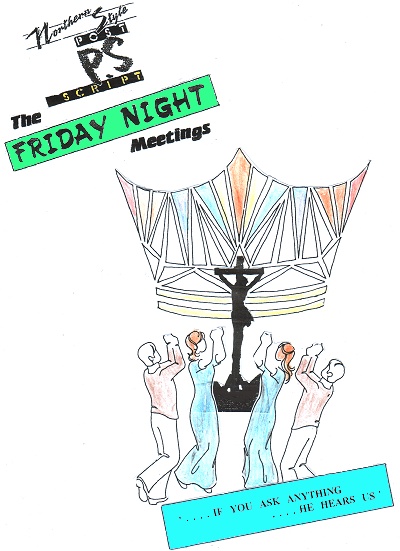 `. . . if we ask anything according to His Will, He hears us . . '
The title of these Reflections comes from the First Letter of John, wherein he sets out in a powerful yet practical way life in the knowledge of the Light through the Love of God - God is Light . . . Light is Truth . . . Truth is Righteousness . . . Righteousness is Love - and here in the fifth chapter we come in our Reflections to the Mystery of Prayer: (v14-15)
" This is the assurance we have in approaching God; that if we ask any-
thing according to His Will, He hears us. And if we know that He hears
us - whatever we ask - we know that we have what we asked of Him. "
In place of the Scriptural title we could have used instead `The Mystery of Prayer', for indeed the subject of prayer has occupied the teaching of many ministries over the long centuries. In modern times there have arisen such ministries as `House of Prayer', `Schools of Prayer', and others, drawing upon the experiences of Rees Howell in the mid 20th century in his Bible College which he founded in Wales. And yet we wonder: How can a relationship be taught, let alone a relationship with God through the Holy Spirit? The word `relationship' speaks its own meaning - an intimate knowledge between people, unique to them alone, which releases spontaneous speech, silent or audible, for such is the relationship that audible speech is not always needed . . . and that with God `Who alone is immortal and Who lives in unapproachable light, Whom no-one has seen or can see . . .' truly the Mystery of Prayer!
But first we draw upon a chorus from `Songs of the Kingdom of God', which was composed in an age which many will recall where such songs of praise had beauty and majesty in their words and music:
" When I look into Your holiness;
when I gaze into Your loveliness . . . .
When I've found the joy of reaching Your heart,
when my will becomes enthroned in Your love . . .
I worship You . . . I worship You . . . "
Those who remember singing this song will recall the intimacy that came with it as it drew all into that relationship which is `the Mystery of Prayer'. For that we draw upon the line: `When my will becomes enthroned in Your love' and so turn to Psalm 22. This Psalm is set within the First Book of Psalms, which in turn draws us back to the First Book of Torah, Genesis, where the Word says: `In the beginning God created'. Genesis is the `seedbed' of all further Scriptural Revelation, for in it can be seen the whole Purpose of God and the Promise of His Love for all who would know Him in a relationship that transcends time and space. Following the disobedience of Eve in the Garden in Eden, the Promise comes: (3:15) " And I will put enmity between you (the serpent) and
the woman, and between your seed and her Seed;
He will crush your head, and you will strike His heel. "
Now we can return to the Voice of God in Psalm 22 to see the outworking of this verse in the Word of God. Although the First Book of Psalms is complete in itself in revealing God's Purpose for all mankind, there are several small groupings of Psalms within this Book that bring out a deeper understanding. One such group can be found in Psalms 22, 23 and 24. Psalm 22 clearly shows the details of the words recorded in Genesis 3:15. of `the enmity between you and the woman, and between your seed and her Seed'. Psalm 22 reveals the Promised Messiah in His suffering and death, with Psalm 23 revealing the glorious Resurrection of the Messiah: `You anoint My head with oil and My cup runs over', To complete this group of three Psalms Psalm 24 reveals the Resurrected Messiah, now Glorified: (v7)
" Lift up your heads, O you gates;
be lifted up, you everlasting doors;
that the King of Glory may come in. "
But for our purpose in looking at `the Mystery of Prayer' we would return to Psalm 22 and the Messiah in His suffering and death, for it is in this Psalm that we find the `mystery' outworked - the outworking seen in the Gospels where the words of Jesus in prayer in the Garden of Gethsemane can be summed up: `not what I will but what You will'.
And so we draw back to verse 3 of Psalm 22 which, in the context of the Psalm, is a cry of the Messiah in His desertion that His trust is in the Promise of God for His Resurrection. The words in the King James Version are: `O You, Who inhabits the praises of Israel', which in themselves do not bring out the full meaning, for the use of Metonymy is in these words so that the verse requires `filling out' into:
" O You, Who inhabits and is enthroned in the Temple,
where the praises of Israel are offered up. "
Such words bring us back to the Psalmist, who is drawing upon his knowledge of a King of Israel, seated upon the Chariot Throne of the cherubim in the Most Holy Place, ruling and dispensing justice for the people of Israel. The Psalmist, knowing this and understanding the `pattern' of the Temple in Heaven and on earth, cries out his prayer to the God of Israel who dwells enthroned in Heaven to remember His Promise to David, that his throne will last for ever: (v23-24 in part)
" You that fear the LORD, praise Him;
all you, the seed of Jacob, glorify Him;
and fear Him, all you the seed of Israel . . .
but when He cried unto Him, He heard Him. "
Now it is time to return to our song from `The Songs of the Kingdom of God':
" When I've found the joy of reaching Your heart,
when my will becomes enthroned in Your love. "
There are two important words in the second line, which are, `my will' and `Your love', and of the two we look first at `Your love'. In the Hebrew Scriptures there are many words recorded as describing love (which in English are merely shown as `love', leaving the context to reveal any deeper meaning). However there is one word which is used more than any other, that of `Awhab' (or `Ahabah'). Whereas the other words used for love express delight, compassion or desire in their meanings, the word `Awhab' mentioned contains all these emotions which are placed within the context of an unconditional, affectionate love within a family - whether in marriage or through children, natural or adopted. Awhab love therefore covers the whole extended family, and with this understanding you hear the words of Paul the Apostle with his Jewish mind when writing to the Ephesians: (Ephesians 3:14-18)
" For this reason I kneel before the Father, from whom His whole family in heaven and on earth derives its name . . . . And I pray that you, being rooted and established in love, may have the power, together with all the saints, to grasp how wide and long and high and deep is the love of Christ . . . "
If Paul had been writing his Letter in Hebrew he would have used the words Awhab or Ahabah, meaning God's unconditional, affectionate love for His family.
We need now to bring this understanding into our Greek mindset, for the Letters and Epistles of the Bible were written in Greek. We are all familiar with Bible teachers, in their desire to point us towards the highest form of love, moving from `Eros', depicting sensual love, to `Philio', a virtuous love between brothers, and on to `Agape', an unconditional love of the will which only the Holy Spirit can form in us. This is best seen in the famous `Plato's Symposium', a philosophical work by Plato. The Greek word `symposium' simply means a drinking party during which men gave speeches on the subject being discussed. In the case of Plato's Symposium it was a party hosted by the poet Agathon consisting of speeches extolling and developing the virtue of love, moving onwards and ever upwards to the heavenly agape of the gods on Mount Olympus. Such symposiums were an important part of Greek social life which Plato used to develop his understanding of love. It was with this understanding that the translators of the `New Testament' moved away from the concept of Hebrew love, which is of the heart and emotions, and into a Hellenistic thought-pattern of the mind and intellect, leaving the Father of our Lord Jesus Christ high and unapproachable in Agape (Love) yet calling us to express the same Agape (Love) to the brethren with an unconditional act of the will. Paul, writing in the Spirit, wrote of a natural yet deeply spiritual love the Father has for His own, not an etheral intellectual love of will-power.
However there is a fourth Greek word for love (Storge), which is totally in line with the Hebrew words Awhab or Ahabah, for it includes the full meaning of Eros, Philio and Agape in the one word, and expresses a natural affection exclusively depicting family love. There is no requirement of worthiness in this word - it is totally outgoing and therefore it overcomes any form of rejection or unattainable acceptance. It is this love, Storge, that is expressed to all who belong to the Family of God, not a cold, unemotional act of the will but a natural affection coming from an acceptance of a Father's love. Paul, and others, in writing their Letters and Epistles, were writing in Greek with their minds, but their whole beings, their wills and emotions were Jewish, and it is this that the translators and Bible teachers have missed! You can hear Paul's understanding of Storge, when in writing to the Galatians he wrote: (Galatians 4:4-7)
" But when the time had fully come, God sent His Son, born of a woman,
born under Law, to redeem those under the Law, that we might receive
the full rights of sons. Because you are sons, God sent the Spirit of His
Son into our hearts, the Spirit Who calls out, `Abba, Father'. So you
are no longer a slave, but a son; and since you are a son, God has made
you also an heir. "
And so we now turn to `our will' - and for that we can turn again to Paul's Letter to the Galatians: (Galatians 2:20)
" I have been crucified with Christ and I no longer live, but Christ lives
in me. The life I live in the body, I live by faith in the Son of God,
Who loved me and gave Himself for me. "
Those who have subjected their will and been baptised by the Holy Spirit into Jesus Christ have been enthroned in His love and raised to new life and adopted into His Family. Paul, this time writing to the Ephesian Church, states this clearly: (Ephesians 2:4-6)
" But because of His great love for us, God, Who is rich in mercy,
made us alive with Christ even when we were dead in transgressions -
it is by Grace you have been saved. And God raised us up with Christ
and seated us with Him in the Heavenly Realms (the Heavenly Temple)
in Christ Jesus . . . . "
This is an `Awhab', a `Storge' Love, a Love that chose and called a people into His Family! It is a family love, a covenanted, unconditional love as for a Bride and a Wife, a love of the heart not of the will! With this in mind, and with `our will enthroned in His love', we can join with the Psalmist who, speaking for a `David' to come, offered prayers with assurance:
" O You, Who inhabits and are enthroned in the Temple,
where the praises of Israel are offered up. "
And so we bring these Reflections to a close with the words of Jesus, speaking to His disciples, who at that time could not fully understand what their Lord was saying. In the Gospel of John we hear the words of Jesus speaking just before His arrest and crucifixion:
John 16:22-24
" So with you: Now is your time for grief, but I will see you again and you will rejoice, and no-one will take away your joy. In that Day (when you will see Me and witness My ascension into the Heavenly Temple, and the promised Holy Spirit comes upon you) you will no longer ask Me anything. I tell you the truth; My Father will give you whatever you ask in My Name (which is My Will enthroned in the Father's love). Until now you have not asked for anything in My Name (for My work is not yet completed). Ask and you will receive, and your joy will be complete. "
The Mystery of Prayer:
`When our will becomes enthroned in His love': Baptised by the Holy Spirit into that Love who is Christ Jesus our Lord, we can ask of the Father with assurance and know that our prayers have been heard and answered!
Selah
~ ~ ~ ~ ~ ~ ~ ~
|
You may E-mail us at: derek@northernstyletrust.com or Telephone (01493) 444494 (UK)
Our Web Address: www.northernstyletrust.com
|


