
|
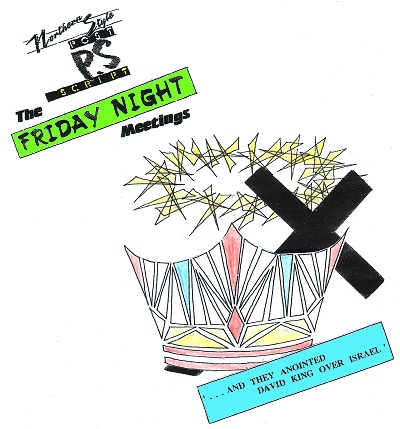 THE THREE ANNOINTINGS
` . . . .and they anointed David king over Israel '
The title comes from the Second Book of Samuel, where in chapter 5 we read `all the tribes of Israel came to David at Hebron'. But first we make a digression into history in order to bring understanding of what a daunting prospect it is for those who have kingship thrust upon them. In the early years of these British Isles, at the time of the Saxons, such a time came for a young Saxon nobleman following the death of an adult relation from the royal line of Wulffs, a Saxon dynasty whose kingdom extended from the European continent to the East of England. This kingdom now passed to this young fourteen year old youth whom we now know as Edmund. Journeying over the sea he landed at a remote settlement in the far north-west of Norfolk, where he was anointed as king over the land of East Anglia. But now would come the battles to establish his kingdom, and although he was finally martyred at a settlemnt now called Attleborough, Edmund's seat of power was established in what is known today as Bury St Edmunds in Suffolk. Today it is a place for tourists, a quiet peaceful market town of great charm, but the young man of fourteen would have had no knowledge of this as he battled on the long journey from Hunstanton to Bury St Edmunds to establish his kingdom. And so it was with David, a young shepherd boy: (1 Samuel 16:12)
" Now he was ruddy, and of a beautiful countenance, and good to look at.
And the LORD said. `Arise, anoint him, for this is he'. "
A long journey awaited him also - much bloodshed, intrigue and deception, and then Three Anointings lay ahead of him before his kingdom was established.
The Three Anointings of David are well recorded in Scripture, and all three are in the Books of Samuel. His journey began in the First Book of Samuel after Samuel had delivered the word of the LORD to Saul, the people's choice of king, saying: (1 Samuel 15;28; 34-35)
" The LORD has rent the kingdom of Israel from you this day, and has
given it to a neighbour of yours who is better than you . . . . . Then
Samuel went to Ramah and came no more to see Saul until the day of
his death. Nevertheless Samuel mourned (as for one dead) for Saul. "
Chapter 16 opens with a mild reproach for Samuel from the LORD: (Verse 1)
" How long will you mourn for Saul, seeing I have rejected him from reigning
over Israel? Fill your horn with oil and go, and I will send you to Jesse,
the Bethlehemite, for I have provided Me a king from among his sons. "
And so we come to the first of the Three Anointings of David, the LORD's choice of king over His people Israel. In verse 13 we read:
" Then Samuel took the horn of oil and anointed him (David) in
the midst of his brethren. And the Spirit of the LORD came upon
David from that day forward. "
Need we remind our readers that the Hebrew word for David (Dawveed) springs from the word `Dodi', with its meaning of `well beloved', and that the letters also speak of the number `14', that is, 2 times 7, with the meaning of a separation of something or someone for spiritual perfection. And so here in chapter 16 of the First Book of Samuel we see David anointed as prophet to all Israel as the Spirit of the LORD came upon him.
We move now into the Second Book of Samuel for David's Second Anointing. But first there would come many battles, with long and bitter opposition from Saul. David was hunted by Saul's men in the deserts of Ein-Gedi and Ziph . . . he despaired over the invasion of his stronghold at Zikvah . . . he lamented the death of Saul, which gives us the poetic jewel of `The Lamentation of the Bow', as recorded in the opening chapter of the Second Book of Samuel . . . and finally he came to his Second Anointing. But the Second Anointing of David saw him as king over a nation divided by war, and we read in 2 Samuel 2:4:
" And the men of Judah came (to Hebron), and there they
anointed David king over the House of Judah. "
Yet still more battles lay ahead, for we read in chapter 5 that he ruled over Judah for seven and a half years until his Third Anointing: (verses 3;4)
" All the elders of Israel came to the king at Hebron, and King David made a league (that is, he solemnised a Covenant, cut a Covenant, for that is the meaning of `league') with them in Hebron before the LORD, and they anointed David king over all Israel . . . . And David took the stronghold of Zion, the same is the City of David . . . . David was thirty years old when he began to reign and he reigned for fourty years. "
No doubt the earnest reader will have noticed that both the Second and Third Anointings of David were at Hebron, where upon his Third Anointing David `solemnised a Covenant' with the elders of Israel. Hebron and its encompassing area is a place of great importance in the history of Israel. To the north lay a mountainous area and to the south lay the low places and a wilderness. Abraham had dwelt there in the plains of Mamre, and on returning from the battle against Chedorlaomer he met there:
" Melchizedek king of Salem (who) brought forth bread and wine . . .
and he blessed him and said, `Blessed be Abram of God Most High,
possessor of heaven. " Genesis 14:18-19
It was here in the encompassing plains of Mamre around Hebron that Abraham received the promise of a son by a barren Sarah, and it was here that Abraham purchased a field:
" And after this Abraham buried Sarah his wife in a cave in
the field of Machpelah before Mamre, the same is Hebron in
the land of Canaan. " Genesis 23:20
In the fulness of time Abraham was also buried here, and it was here in Hebron that David, a son of Abraham, ruled as king over Judah for seven and a half years before he was anointed in Hebron as king in Jerusalem and over all Israel: (2 Samuel 6:1; 17-18)
" David gathered all the chosen men of Israel . . . . And they brought in
the Ark of the LORD and set it in its place in the midst of the Tabernacle
that David had pitched for it, and David offered burnt offerings and peace
offerings before the LORD. And after David had offered burnt offerings
and peace offerings he blessed the people in the Name of the LORD of Hosts. "
Here, following the Third Anointing as king over all Israel, David stood as prophet, priest and king and `blessed the people in the Name of the LORD of Hosts' - and a new Dispensation had begun for Israel!
Now we turn our thoughts to the Three Anointings of David's Greater Son Jesus, the Prophet, Priest and King over all Israel. The fulness of this is yet to come when `the elders of all Israel will come to the King, who will solemnise a Covenant and rule and reign in Jerusalem over all Israel'. Three Anointings lay ahead for `Jesus Christ, the Son of David, the son of Abraham', and for the First Anointing we turn to Matthew 3: (Verses 1-2)
" In those days came John the Baptist, preaching in the wilderness of
Judea, and saying, `Repent, for the Kingdom of Heaven is at hand'. "
Verse 13 continues: `Then came Jesus from Galilee to the Jordan, unto John, to be baptised of him'. The story of the baptism of Jesus is of course well known, as is John's outburst at such a request, only to be told: `Let it be so for now; it is proper for us to do this to fulfil all righteousness'. Here Jesus was announcing the fulfillment of the LORD's righteous Covenanted promise to Israel that He would send the Promised Messiah, and as Jesus rose up from the waters: (Matthew 3:16-17)
" Heaven was opened and He saw the Spirit of God descending like a
dove and lighting on Him. And a voice from heaven said: `This is
My Son, whom I love; with Him I am well pleased'. "
Here was the first of the Three Anointings of David's Greater Son, anointing Him as Prophet to Israel, and as it was with David's First Anointing - when the Voice of the LORD spoke to Samuel saying `Arise, anoint him for he is the one . . . and the Spirit of the LORD came upon David from that day forward' - so it was for Jesus also.
The Second Anointing of Jesus can be seen in Matthew 17 where we find: (verses 1-2)
" Jesus took Peter, James and John up a high mountain apart, and was
transfigured before them; His face did shine as the sun, and His
raiment was white as the light. "
To fully understand this Second Anointing we need to read the account of the anointing of Aaron and his sons: (Exodus 28:1-2)
" And take Aaron your brother, and his sons with him . . . . that he may
minister unto Me in the priest's office . . . . And you shall make holy
garments for Aaron your brother for glory and for beauty. "
On that high mountain Jesus was anointed as High Priest after the order of Aaron the High Priest, and before His three disciples He was seen clothed in holy garments for glory and for beauty! And so with this Second Anointing we see Jesus as Prophet and High Priest - and as David's Greater Son, a King waiting (as David had been) for a future seven and a half years to pass before His Third Anointing as King over all Israel. It is usual at this point for those writing on the Three Anointings of Jesus to point to the crucifixion and resurrection of Jesus as His Third Anointing. However we would question this for those events do not correspond with the Three Anointings of David, therefore it is time to step away for a moment from those Anointings and reflect.
Jesus anointed as Prophet revealed Himself to be the long-awaited Messiah. Jesus anointed as High Priest in holy garments was now ready to offer Himself as the Final Sacrifice for sinful mankind. In this Sacrifice He offered Himself to His Father, clearly revealing this to be the Final Heave Offering to God alone for the building of the new Temple, This Final Sacrifice was also a Final Wave Offering, which when offered was to be waved to and fro and presented to the four quarters of the earth. This was seen in the inscription nailed to the Cross in Aramaic, Latin and Greek - the `four quarters' of the then-known world! (We have recorded this in an earlier Study based on Exodus 25 `This is the Pattern'.) The resurrection of Jesus from the dead was the acceptance by God of that Final Sacrifice, the Heave Offering of Jesus. The Letter to the Hebrews records this: (Hebrews 1:2-3)
" (Jesus) whom He has appointed heir of all things, by whom He also made the worlds. Who being the brightness of His Glory, and the express image of His Person, and upholding all things by the word of His Power, when He had by Himself purged our sins, sat down on the right hand of the Majesty on high. " (Awaiting His earthly Anointing and Enthronement in the Millenium Kingdom of God.)
We also see from this Letter that He ascended into Heaven to sprinkle His Blood on the heavenly Pattern: (Hebrews 9:23)
" It was therefore necessary that the pattern of things in the Most Holy
Place should be purified with these (the old Temple sacrifices), but the
heavenly things with better sacrifices than these. "
Therefore the way was opened up for all who would believe in Him to enter into His Death and Resurrection to become the Temple for this Apostolic Age - His Body on this earth. These events, therefore, were not the Third Anointing but a move into the present Apostolic Age. As it was with David, who although anointed as prophet and priest had to wait seven and a half years ruling and reigning in Hebron before his final Third Anointing as king over all Israel, so too David's Greater Son waits `at the right hand of the Majesty on high' that during the Time of Jacob's Trouble His people will come to Him for His Third Anointing as King over all Israel.
But first must come a cosmic history lesson, for the description of Ezekiel's `Land and Temple' bears no resemblance to the geographical area of present-day Jerusalem. Idol `worship' is a common occurrence throughout the past and present world. However we would suggest that the word `worship' is misplaced when concerning religion, for the modern concept of worship is towards someone we would aspire to for their appearance. Rather we would use the expression `idol sacrifice' for in the religious context the objective is to appease the offended one rather than show affection for it. Not so for Christians, for the `appeasement towards the offended One' was completed with the Final Sacrifice of Jesus and we worship the one True God with thankful hearts for a mighty salvation grounded in love - first seen in Deuteronomy chapter 6 for the people of Israel and then for all those who have been grafted into that `Olive Tree': (verses 4-5)
" Hear, O Israel: The LORD our God, the LORD is one.
Love the LORD your God with all your heart and with
all your soul and with all your strength. "
Throughout the history of the earth there has been an acknowledged system of religious idolatry practised in the lives of all settled communities and sacrifices offered to the gods in sky in their religious ceremonies. Clearly then, their ingrained fear was of destruction coming from the sky, together with an obvious fear of the withholding of rain in a prolonged season of solar activity which would affect food and shelter for the people. Scripture itself records these sacrifices that were used to appease not only the sun but also the `starry hosts'. In 2 Kings we read that during the time of King Josiah's reforms: (23:4-5)
" The king ordered . . . . removal from the Temple of the LORD all
the articles made for Baal and Asherah and all the starry hosts . . . . . .
those who burned incense to Baal, to the sun and moon, to the
constellations and to all the starry hosts. "
Through historical texts, through traditions, myths, heroic poems, inscriptions on old astronomical plaques and charts, through engravings on architectural finds, there is evidence of a fearful expectation of the wrath of the heavenly bodies. This fearful expectation was common within communities throughout the world, and their religious sacrifices were offered in the hope that what had happened in the memory of those people would not re-occur. Today we read of such heroic epics in the works of Homer's Iliad and Odyssey, but in the era of the 2nd century one `classical writer' noted of Homer:
" Indeed, it is the conjunction of Venus and Mars that created the poetry of Homer. "
Homer was a contemporary of the Biblical Amos and Isaiah, and you can hear `echos' of those cosmic events in their prophetic pronouncements - indeed the Psalms contain more than an echo. But this is enough of `cosmic history', suffice to say that in the recorded history of religious communities throughout the world of antiquity there were recorded catastrophic events between a comet and a planet in the 7th and 6th centuries BC. These caused cataclysmic changes in the earths lithosphere, its surface enveloped by tidal waves that swept across the earth's surface; mountains were raised up and others destroyed; devastating hurricane winds swept the surface of the earth as the rotation of the earth changed; cities - even civilisations themselves - were totally destroyed and the face of the earth was totally changed as it was forced out of its regular rotation by the tail of the approaching comet as it swept across the earth's atmosphere before moving on to eventually form itself into a planet, whilst on its way to this final formation colliding with other planets, causing further destruction. Little wonder that idolatrous sacrifices were offered in the hope of appeasing such forces!
Such catastrophic events were firmly planted in the `memory banks' of `primitive' communities but not fully understood by more `advanced' communities living nearly three thousand years later until in 2004 a new word entered the world's vocabulary when a tsunami struck a holiday beach, affecting the lives of people from practically every country in the world. But this 2004 tsunami, although terrifying in its destructive natural earthly power, was insignificant compared to the cosmic power which struck the earth all those centuries ago. But since then the stability of the starry hosts of heaven has remained constant and the idolatry based on these starry hosts has remained constant also - apart from a few minor adjustments - and we have been lulled into a belief that such events are the stuff of Hollywood Blockbusters based on the myths of primitive peoples.
If we are to understand the Book of Ezekiel, which is expounded more fully in the Book of Revelation, then such cosmic catastrophies will happen again, for chemical weapons, nuclear wars and man-made climate changes will not cause the changes recorded in Scripture. In an earlier Study we wrote that Ezekiel is written in a logical sequence of unfolding events yet to come and cannot be fully understood without embedding Ezekiel into the Book of Revelation so that the two Books are completely interwoven. The momentous symbolic events of Revelation are more specifically identified in Ezekiel, and both culminate in the sighting of a new Temple and the Millenium Kingdom of God established on earth. Therefore, the wars described in Ezekiel chapters 38 and 39 should not be seen in isolation from the concluding chapters of this Book. Indeed, the earlier chapters concerning the oracles and laments of the countries surrounding Israel, the chapters concerning `the Shepherd and the Sheep' and the vision of `the Dry Bones' are all describing events of `the Last Days', culminating in the enthronement of Israel's King over His Kingdom on earth!
And so finally with these comments as a `backcloth' we can turn to the concluding chapters of Ezekiel, which, as we have said, are outworked in a land unrecognisable from what we see in our present time, caused by cosmic catastrophies beyond our imagination. We shall leave the construction of the new Temple for we are concerned in this Study with the Three Anointings of David and His Greater Son Jesus - which directs us to chapters 45 and 46. The first thing we notice is that these two chapters set out the duties of the priests in this new Temple, with a constant reference to `the Prince' for: (45:16-17_
" All the people of the land shall give this oblation for the Prince in Israel.
And it shall be the Prince's part to give burnt offerings, and meat offerings,
and drink offerings. "
We also need to see that in this chapter four oblations are mentioned - that is, a Heave Offering, which is first seen in Exodus 25 as an offering given totally towards the LORD, that which is His alone. Thus in verses 16 and 17 this Heave Offering is to be made by the Prince on the Feast of Passover as a national offering for the People of the Nation, `to make reconcilliation for the House of Israel'. Verse 25 then records that:
" In the seventh month, in the fifteenth day of the month, He shall do the
like in the Feast of the Seven Days, according to the sin, the burnt and
the meat offerings, and according to the oil. "
This was, of course, the Feast of Tabernacles, the time when the ancient kings of Israel were enthroned, sitting upon the Chariot Throne in the Temple to rule and reign and extend their kingdom. This can be seen in chapter 46 verse 3 where `the people of the land shall worship at the door of this gate before the LORD in the sabbaths and the new moons', because the Prince has offered a Heave Offering for the reconcilliation of the people to the LORD and is now enthroned and reigning amongst them. If a problem arises with this it lies entirely in the translation of the word `Prince' from the Hebrew word `Nasi', which has the meaning of `to lift up, to elevate, to magnify' (even to meaning to lift a foot from the floor). But the context of this word Nasi within these chapters of Ezekiel indicates the elevating of a person, called in the Book of Ezekiel `a Prince' or `King' - one who is exalted and magnified and enthroned on the Day of Tabernacles as King over all Israel. This Prince is the `Prince of Peace', - the lifted up One (seen in Isaiah 9:6-7) and `of the increase of His government and peace there will be no end' in His Millenium Kingdom as He rules and reigns on the Chariot Throne in the Temple. This Prince is the LORD their God and David is their King `whom I will raise up for them '.
And so we draw to a close `the Three Anointings of David' - seen in David's anointing by Samuel as a prophet to Israel . . and then by the `men of Judah as king and priest . . and finally by `the elders of Israel' as king over all Israel. This is now completed by Jesus the Messiah, anointed by the Holy Spirit as Prophet . . anointed and `clothed in holy garments' as High Priest and prepared for His Final Sacrifice . . finally anointed, elevated, lifted up as King of kings and Lord of lords, enthroned in the Millenium Temple - and as we know:
The name of that city from that time on will be
Yahway Shammiah - the LORD is there.
~ ~ ~ ~ ~ ~ ~ ~
|
You may E-mail us at: derek@northernstyletrust.com or Telephone (01493) 444494 (UK)
Our Web Address: www.northernstyletrust.com
|


