
|
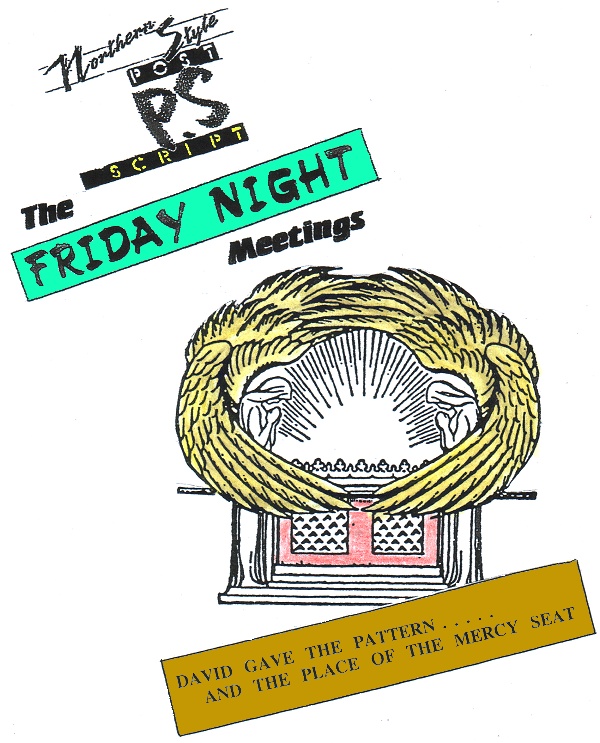 `And David summoned the princes of Israel . . . . and David
gave the pattern of the Porch . . . . and the place of the Mercy Seat'
The title of this Study comes from 1 Chronicles 28, recording how David entrusted to his son Solomon the pattern for the Temple which he, Solomon, would build. Before we begin to look at that pattern, and the purpose for building the Temple exactly as laid down in the pattern, we will look first to the Psalms - and eventually to Psalm 80. As readers of our Studies will know, the Psalms are separated into five Books corresponding to the five Books of Torah. Each Book of Torah, together with the corresponding Book in Psalms, speaks its own distinct message, yet so tightly conjoined as to reveal the full revelation of God's Will and Purpose . . . in Torah, His Word . . . in the Psalms, His Voice.
And so to the Third Book, the `Levitical' Book of Psalms, in which Psalm 80 is set, which is wholly concerned with the Sanctuary of God, the Holy of Holies within His Temple according to the pattern given to David. As we have previously written, the first Psalm of each of the five Books reveals the central message of the whole Book, whereas the second Psalm of each Book breaks abruptly into the central message and is seen as a direct attack against God's will, thus causing a separation. It is also known that within the Hebrew alphabet there is no distinction between letters and numbers, therefore often revealing in our translations a message in what we know as `Scriptural Numerology'. Care needs to be taken lest we play with numbers, and so the principle of First Usage needs to be applied in the use of numerology. Thus, in opening this second Psalm, and likening it to a `separation', we see the first use in Genesis 1 verses 6 and 7 where a separation is recorded `between the firmament and the waters' - thus revealing an Almighty God who dwells in the firmament (the vast spaces above), separating the waters of chaos below which covered the earth by His Almighty Power.
It is here that we begin our search for the reason for `the Pattern' given to David. In the Hebrew Canon of Scripture the Book of Leviticus is entitled `And He called', revealing the calling out of a people to worship God in an earthly Temple corresponding to the heavenly Temple where He sits enthroned between the cherubim. Leviticus opens with the words, `and the LORD called to Moses and spoke to him out of the Tabernacle of the congregation, saying . . .'. The Word in Leviticus and the Voice in the Psalms speak together of this `calling out', and in Psalm 73, the first Psalm of the `Leviticus' Book of Psalms, we hear the words, `Surely God is good to Israel, to those who are pure in heart'. But the second Psalm now cuts abruptly across this opening praise to Israel's God and the Psalmist cries out:
" O God, why have You cast us off for ever? Why does
Your anger smoke against the sheep of Your pasture? "
These words show the separation we spoke of earlier and reveals the Voice of God speaking through Asaph of the ruin of God's earthly Sanctuary within His Temple. And yet we also read in the concluding Psalm 89 of this Book of the final victory of God over His enemies:
" I will sing of the mercies of the LORD for ever. "
These concluding words of the Levitical Book of Psalms takes us on to the final glorious work of God, seen in the last chapter of the Book of Revelation: (Revelation 22:1)
" And he showed me a pure river of water of life, clear as crystal,
proceeding out of the Throne of God and of the Lamb. "
But for now we must turn to the Voice of God heard in Psalm 80, and to the ruin of His earthly Sanctuary. The opening words of this Psalm together with the opening inscription speak their own message of certain hope and trust for the final outcome of this attack upon the Purpose of God. The Psalm opens with the inscription `a Psalm (that is, a Mizmor) of Asaph' and is the ninth of the twelve Psalms of Asaph. A Mizmor has a meaning of `meditation', revealing that what follows needs to be carefully thought through. This, together with our understanding of the use of numbers, gives us the reason for our meditation - the number `nine' speaking of the fulness of judgement against the enemies of the Sanctuary, the number `twelve' speaking of the certainty of God's Government prevailing. The Psalmist cries out to Israel's Shepherd:
" Give ear, O Shepherd of Israel, You who leads out Joseph like
a flock; You who dwells between the cherubim, shine forth. "
Asaph, understanding the prophetic message spoken in `the blessing of Joseph' (as recorded in Genesis chapters 48 and 49) cries out his trust in the LORD God of Israel. Genesis 48:15 records this:
" And he (Jacob) blessed Joseph and said, `God, before whom
my fathers Abraham and Isaac did walk, the God who fed me
all my life long unto this day . . . "
In the ordering of the tribes for the work of carrying the Ark of the Covenant, Joseph's `Blessing' included his two sons, Ephraim and Mannaseh, together with Benjamin, the son of Rachael by Jacob, who brought up the rear with the Ark of God in their midst leading them like a Shepherd. Joseph, who experienced captivity and being separated from his family, knew the Shepherd of Israel who was faithful: Asaph, hearing the Voice of God, the Shepherd of Israel, sees the coming storm, the separation of the tribes, thereby breaking the Pattern of the earthly Sanctuary, `dislocating' it from the heavenly Sanctuary - and he cries out his distress, yet with certain hope and trust in the Shepherd of Israel who leads His people to their ultimate Rest.
Here we must leave the Levitical Psalms and look for that Pattern - which takes us to the Book of Exodus where in chapter 25 we find the pattern of the Tabernacle given to Moses:
" And the LORD spoke to Moses, saying, `Tell the
Israelites to bring Me an offering of every man . . ."
We need to move into chapter 29 to see the significance of this `offering' that every man was commanded to bring. Chapter 29 tells us of the requirements for the consecration of the priests involving the sacrifice of a young bull and two rams without blemish. We are not intending to look into the meaning of those sacrifices here, merely noting the sacrifice of the whole of the first ram and the required portions of the second as a Burnt Offering (for all things holy to the LORD are offered up to Him as a Burnt Offering). Verse 27 tells us that the breast of the ram is for a `Wave Offering' and the shoulders of the ram for a `Heave Offering' and `it shall be your (Aaron's as High Priest) part'. The Heave Offering is described by its action as being lifted up on high as a presentation to the LORD alone, whereas the Wave Offering is waved to and fro and presented to the four quarters of the earth. With this understanding we can return to chapter 25 and see that the offering spoken of in verse 2 is a Heave Offering presented to the LORD Himself alone:
" . . . . of every man that gives willingly
with his heart, you shall take My offering. "
The following verses (3 through 7) list fifteen Offerings made to the LORD alone for the purpose of building His earthly Tabernacle. We see here again in the call for fifteen offerings given to the LORD that all they possessed had first been given to them by the LORD as they left their slavery in Egypt - the use of the number `15' shows the fulness of His Grace by which He choses to dwell amongst those He called. These fifteen offerings were now made into a Sanctuary, and together with the furniture were now to be carried by the Israelites wherever they journied. The Presence of God was now `on earth as it is in heaven', for the Tabernacle was not merely a carefully designed plan but an earthly model of the Heavenly Tabernacle and, as we have seen, the earthly model came first through a Heave Offering - giving willingly back to the LORD that which He had first given. After crossing the River Jordan into the Promised Land there was still no rest for the Ark of the Covenant, for the land of Canaan had still to be cleansed. It was only finally under Joshua that they arrived at Gibeon, and we read that: (Joshua 18:1)
" The whole assembly of the Israelites gathered at Shiloh and set up the Tent
of Meeting there. The whole of the country was brought under their control. "
Clearly it can be seen that we write from a Dispensational position - indeed there is no other way to understand the Purposes of God. There are `Times and Seasons' to be understood if we are to `move on' with God as He leads His people like a Shepherd to our ultimate rest. With that in mind we can move forward into such a `time and season' which was now upon the Israelites.
The Land was now peaceful and under the kingship of David, for Israel was entering into a new Age. David understood what was happening and so the Ark, the Presence of God, was brought to Jerusalem - its final resting place during the Age that Israel was entering into. We read of this event in 2 Samuel 6 verse 17
" And they brought up the Ark of the LORD, and set it in its place
in the midst of the Tabernacle David had pitched for it; and David
offered Burnt Offerings and Peace Offerings before the LORD. "
This was not the `Tabernacle of Moses' which was left at Gibeon. The Ark was placed into a Tabernacle prepared by David on Zion. We read of this in 1 Chronicles 16:37-39:
" So he (David) left there before the Ark of the Covenant of the
LORD Asaph and his brethren to minister before the Ark continually,
as every day's work required (in Jerusalem) . . . . . . and Zadok
the priest and his brethren the priests before the Tabernacle of the LORD
in the high place that was at Gibeon. "
Truly a new Dispensation had arrived and chapter 17 records the desire of David to build something more proper for the Presence of God: (verse 1)
" See now, I dwell in a house of cedar, but the Ark of the
Covenant of the LORD remains under curtains. "
And so we move into 1 Chronicles 28 for an understanding of what the LORD was doing in this new Dispensation: (1-19 in part)
" And David assembled all the princes of Israel . . . Then David the king stood up upon his feet and said, `Hear me, my brethren and my people. As for me, I had it in my heart to build a House of Rest for the Ark of the Covenant of the LORD and for the Footstool of our God' . . . . . . And He said unto me, `Solomon your son, he shall build My House and
My Courts, for I have chosen him to be My son, and I will be his Father . . . . . Then David gave to Solomon his son the pattern of the Porch and of the houses . . . . `All this', said David, `the LORD made me understand in writing by His hand upon me, even all the works of this pattern'. "
The Second Book of Chronicles continues with the unfolding of this new Dispensation Chaper 3 continues: (verse 1)
" Then Solomon began to build the House of the LORD at Jerusalem on Mount
Moriah, where the LORD appeared to David his father, in the place that
David had prepared in the threshing-floor of Ornan the Jebusite. "
Chapter 5 continues: (v1:7-8)
" Thus all the work that Solomon made for the Temple of the LORD was
finished . . . . And the priests brought in the Ark of the Covenant of the
LORD to His place, to the Oracle of the Temple, into the Most Holy Place,
even under the wings of the cherubim. For the cherubim spread forth
their wings over the place of the Ark, and the cherubim covered the Ark
and the staves thereof. "
We then read that the staves (or poles) used for the carrying of the Ark were removed, for this was to be the final resting place of the Ark of the LORD for that Dispensation. We further read in chapter 7 that at the Dedication of the Temple; (v 1-2)
" . . . the Glory of the LORD filled the Temple, and the priests could
not enter the Temple of the LORD, because the Glory of the LORD had
filled the Temple. "
Heaven and earth were now joined - the Temple was built `according to the pattern' where now the Glory of the LORD had appeared, revealing the LORD's Kingdom `here on earth as it is in Heaven'.
Now we must look more closely into this `Kingdom on earth'. Truly a new Dispensation had come; the `overlapping' of the two Ages had ceased, the new was now clearly seen - but with the Pattern unchanged! At the centre of the Temple was the Ark of the Covenant, covered by the gold Mercy Seat with the gold cherubim covering it `with their wings touching each other, forming the Chariot Throne of the LORD': (5:7-8)
" And the priests brought in the Ark of the Covenant of the LORD to His
place . . . into the Most Holy Place under the wings of the cherubim. "
It was here, above the Chariot Throne of the LORD, that His Glory fell: (5:14)
" So that the priests could not stand to minister by reason of the Cloud,
for the Glory of the LORD had filled the Temple of God. "
A new Dispenastion had come, but the Pattern remained unchanged for we read in that earlier Age: (Leviticus 16:2 NIV)
" And the LORD said to Moses: Tell your brother Aaron not to come
whenever he choses into the Most Holy Place . . . . because I appear
in the Cloud over the Atonement Cover. "
Over the long centuries that followed many would come with good intentions, but with their own understanding, and seek to build `the Temple' according to the Pattern, forgetting that the building of the LORD's Temple could not begin without a Heave Offering `by every man who gives willingly with his heart (which) you shall take as My Offering'. David understood this, and what the LORD had given him he now willingly gave with all his heart, as we read in the First Book of Chronicles 29:1:
" Furthermore, David the king said to all the congregation: `Solomon my
son, whom alone God has chosen (to build the Temple) for the work is
great; for the Palace is not for man but for the LORD God'. "
The Pattern had not changed . . . the Offering had not changed . . . the High Priest still entered the Most Holy Place each year and sprinkled the blood of the sacrifice from the Burnt Offering onto the horns of the Mercy Seat but upon the Chariot Throne of the LORD there now sat a Priest King who sat there as the LORD - pointing forward to a future Dispensation (which is still to come) when Israel's King will sit upon David's Throne and rule over His Kingdom as the Priest King! Even as late as Jeremiah's time this understanding was constantly in the minds of the people of the Jewish nation for Jeremiah 17:12 records:
" A glorious high Throne from the beginning is the place of our Sanctuary. "
The kings of Israel were the earthly manifestation of the LORD in His Heavenly Sanctuary. The second Psalm of the First Book of Psalms records this Heavenly King: (Psalm 2:4-6)
" He that sits in the heavens shall laugh; the Lord shall hold them in derision.
. . . . . . Yet have I set My King upon My Holy Hill of Zion. "
Again in Psalm 72, which is dedicated to Solomon, it says: `Give the king Your judgement, O God, and Your Righteousness to the king's son' (that is, from David to his son Solomon). Both were called `sons of God' . . . both sat upon a throne `on My Holy Hill of Zion'. Heaven and earth in that place were joined! Each one sat upon a Throne in a Temple, and in the Dispensation of David's kingdom the Presence of the LORD in His Glory was manifest in His kings.
At this point in this Study we are aware that many who have been brought up in and taught the truths seen in the Tabernacle, and later the Temple, will be disturbed at what has been set out here. Such readers have had their minds set in the Mosaic Dispensational Age and will have carried such teaching into the Davidic Dispensational Age. But a change must entail more than just words, and David and his son Solomon understood that change - now centered on a Priest King ministering in the Temple, seated upon a Throne according to the Pattern given! In this Study we do not intend to repeat the implications of this change for we have set this out in more detail in our Study `Eden and Judgement Joined' (which can be seen on our web site under `Previous Studies'). We are aware that repetition is a sound form of teaching, but brevity is demanded in such a short Study as this, particularly as we are primarily concerned with `the Pattern of the Temple' seen in the various Dispensations.
This Davidic Age was not intended to last for it pointed forward to a Glorious Conclusion to come, and so corruption was soon to follow - for as the Psalmist Asaph saw, the Sanctuary lay in ruins. The kings of Israel still sat on the Chariot Throne and the priests still performed their duties, but there was no Glory of the Presence of the LORD in the Sanctuary. Destruction and captivity lay ahead as another `Time and Season' approached. The long captivity finally ended with the Israelites' return to the Land under Nehemiah and Ezra but no kings returned! No kings were seen in the re-built Temple and the religious cycle was returned to the Aaronic priesthood in a Temple that was not built according to the Pattern, for there was no Ark of the Covenant, no Mercy Seat, no Chariot Throne with the cherubim and no king was there - therefore there was no Glory of the LORD seen in that place. There was now to be a long wait for that new Age to come for, paradoxically, the priests, lawyers and scribes, in looking for a restored kingdom which would necessitate a king upon a throne, banished such notions from their theology - `For did not such blasphemy cause the captivity'.
Then suddenly the Veil in the Heavenly Temple parted and through that Veil an earthly `Temple' appeared - in the human form of Jesus. This Jesus would later say to the Pharisees who were watching Him with hostile intent, `Behold, the Kingdom of God is within you' (that is, the Kingdom is in your midst in My Person'). But this should not be seen as a new Dispensational Age for `the Gospels' should rather be seen as a `layering on' of the past and the future! This is seen in the 50th year of the Jubilee Cycle - as recorded in Leviticus 25 - where the 49th year ends and the 1st year of the new cycle begins and yet there is a 50th year overlapping the two. We liken this to the LORD's Year, unknown to man.
The ministry of Jesus would now open the way for the final Ages to come, and there would be three `high points' in His ministry. The first high point would be His annointing as a Prophet to Israel, seen in His baptism, `to fulfill all righteousness' - that is, the Righteous Purposes of the LORD. The second high point can be seen in what is known as the Transfiguration: (Matthew 17:1-2)
" After six days Jesus took with Him (three disciples) and led them up
a high mountain by themselves. There He was transfigured before them.
His face shone like the sun, and His clothes became as white as the light.
Here we see Jesus annointed as High Priest and clothed in garments as seen in Exodus 28:2:
" And take Aaron your brother and his sons with him . . . . . And
you shall make holy garments for Aaron your brother . . . . . "
By this act Jesus was now ready to offer Himself as the Perfect Sacrifice for the sins of not only Israel but for the whole world, for the third high point was, of course, His death and resurrection. Once more the Pattern for the building of a new Temple would appear - and it began with a Heave Offering of the Man Christ Jesus `who gave Himself willingly with all His heart'.
We can now understand more fully the much-loved `Lord's Prayer'. Earlier in Matthew's Gospel (chapters 5-7) Jesus was speaking to His disciples on the mountainside and here in chapter 6 He was pointing forward to another Age that was yet to come following the conclusion of His ministry - an Age beyond the coming Apostolic Age and into the Messianic Millenium Kingdom of God: (Matthew 6:9-10)
" Our Father, who is in Heaven,
hallowed be Your Name,
Your Kingdom come,
Your will be done
on earth as it is in Heaven. "
For those disciples the long-promised Kingdom of God had not yet come, and as they waited this prayer was for them to be kept safe from famine, doubt and fear, keeping pure hearts whilst they waited. Following the death and resurrection of Jesus He had first to enter the Heavenly Sanctuary and there, as the Annointed High Priest, enter the Most Holy Place and sprinkle His Blood on the Heavenly Mercy Seat `having obtained eternal redemption for us', as the Letter to the Hebrews records. Now the Heavenly Sanctuary was `ready' for the New Dispensation to appear - the Apostolic Age. In the Heavenly Sanctuary on the Chariot Throne there still sat a Priest King, now forever seen as the Lamb upon the Throne. The earthly Sanctuary is made of `living stones' which are, as Peter wrote in his first letter to God's elect: (1 Peter 2:9)
" . . . . a chosen people, a royal priesthood, a holy nation, a people
belonging to God, that you may declare the praises of Him who called
you out of darkness into His wonderful light. "
As we see the Lamb upon the Throne in the Heavenly Sanctuary, we see also His people as His Body, joined and `seated with Him in heavenly realms'. The Pattern for the Heavenly and the earthly Sanctuary remain unchanged - both needed a Heave Offering to reveal them.
And so we return to the Psalmist Asaph, for he saw the Sanctuary in ruins. In all the Ages following on from the expulsion of Adam from the Garden Sanctuary in Eden through to the Aaronic Priesthood Age, and beyond that to the Davidic Age, corruption and apostacy quickly appeared as men sought to resist the changing Ages, unable as they were to see the purpose of God's Times and Seasons. And in this present Apostolic Age we still see this corruption in the form of an `Aaronic' priesthood, in Clericalism, in Denomonationalism and in various attempts to build a `New Testament Church'. From time to time over the long centuries of this Apostolic Age many have seen what is required `according to the Pattern', and for a brief time heaven and earth have been joined and we have seen the Glory of the LORD once again. We call it `revival' but God sees the Heave Offering which is offered - and He responds to it! And so as we wait we shall still hear the cry of the Psalmist Asaph over the ruins of the earthly Sanctuary, yet with certain hope as we look for the End of the Ages.
Beyond this Apostolic Age will come the Messianic Millenium Kingdom of God, that which Jesus told His people to pray for! And so we turn to the Book of Ezekiel for a sight of this coming Age - and again brevity is called for in such a short Study as this. Suffice to say that this Temple is beyond anything seen in Solomon's Temple, and beyond anything which we could imagine for it was given to Ezekiel in visions. Chapter 40 records this, and in verse 2 Ezekiel writes:
" In the visions of God He brought me into the Land of Israel and set me
on a very high mountain, by which was the frame of a city on the south. "
The following chapters describe these visions, and in chapter 43:7 he records:
" And He said to me, `Son of man, the place of My Throne, and the
place of the soles of My feet, where I will dwell in the midst of the
children of Israel forever . . . . "
There will be no Ark in this Temple, for the Prince of David's line will sit upon this Chariot Throne as Priest and King, revealing the fulfillment of His Covenant Promises to Israel. We see this established in chapter 45:25 which is the setting of the Feast of Tabernacles, during which time in a previous Age the Kings of Israel were enthroned:
" In the seventh month, on the fifteenth day of the month, shall
He do the like in the Feast of the seven days . . . "
The Pattern for the building of this Temple remains the same as in previous Ages. So too is the need to `bring Me an Offering of every man that gives willingly with his heart'. This Heave Offering is recorded continually throughout the chapters concerning the building of the Temple. It is merely recorded as `an Offering', but the context reveals the Offering to be a Heave Offering - and this is seen particularly in chapter 48:11-12:
" It (this Offering) shall be for the priests that are sanctified of the sons of Zadok which have kept My charge, which went not astray when the children of Israel went astray, as the Levites went astray. And this oblation of the land that is offered shall be unto them a most holy thing in the border of the Levites. "
As we are looking at the Pattern for the Temple covering several Dispensations in this Study, we do not intend to expound further on these amazing chapters at the end of the Book of Ezekiel. However we have touched on them more fully in our Study `The Three Annointings' which will appear soon on our web site. But we need to draw this Study to a close and therefore we shall turn to the Book of Revelation and to the End of the Ages.
In chapters 21 and 22 we see the culmination of God's will and purposes that had been outworked in the previous Ages. The Pattern remains the same as does the need for a Heave Offering - but this time it is not asked for of man for corruption is in his seed.
Revelation 21:1-3 and 22
" Then I saw a new heaven and a new earth, for the first heaven and the first earth had passed away, and there was no longer any sea. I saw the Holy City, the new Jerusalem, coming down out of heaven from God, prepared as a Bride beautifully dressed for her Husband. And I heard a loud voice from the Throne saying, `Now the dwelling of God is with His people, and God Himself will be with them and be their God . . . . I did not see a Temple in the City, because the LORD God Almighty and the Lamb are its Temple. "
Here at the End of the Ages we see the Psalmist Asaph's certain hope . . . the Sanctuary of God . . . Heaven and earth joined for eternity and beyond the corruption of man . . . a new heaven and a new earth . . . a new Jerusalem. So we bring to an end our study of man's efforts to build God's Temple according to the Pattern, and see that that right belongs to `the Lamb upon the Throne' whose Heave Offering of Himself outside the walls of Jerusalem was accepted by God as `My Offering':
" And the LORD spoke to Moses saying, `Speak to the children of Israel
that they bring Me a (Heave) Offering of every man that gives willingly
with his heart, and you shall take it as My Offering'. "
~ ~ ~ ~ ~ ~ ~ ~
|
You may E-mail us at: derek@northernstyletrust.com or Telephone (01493) 444494 (UK)
Our Web Address: www.northernstyletrust.com
|


